
This post contains affiliate links. We may earn a small commission at no extra cost to you.
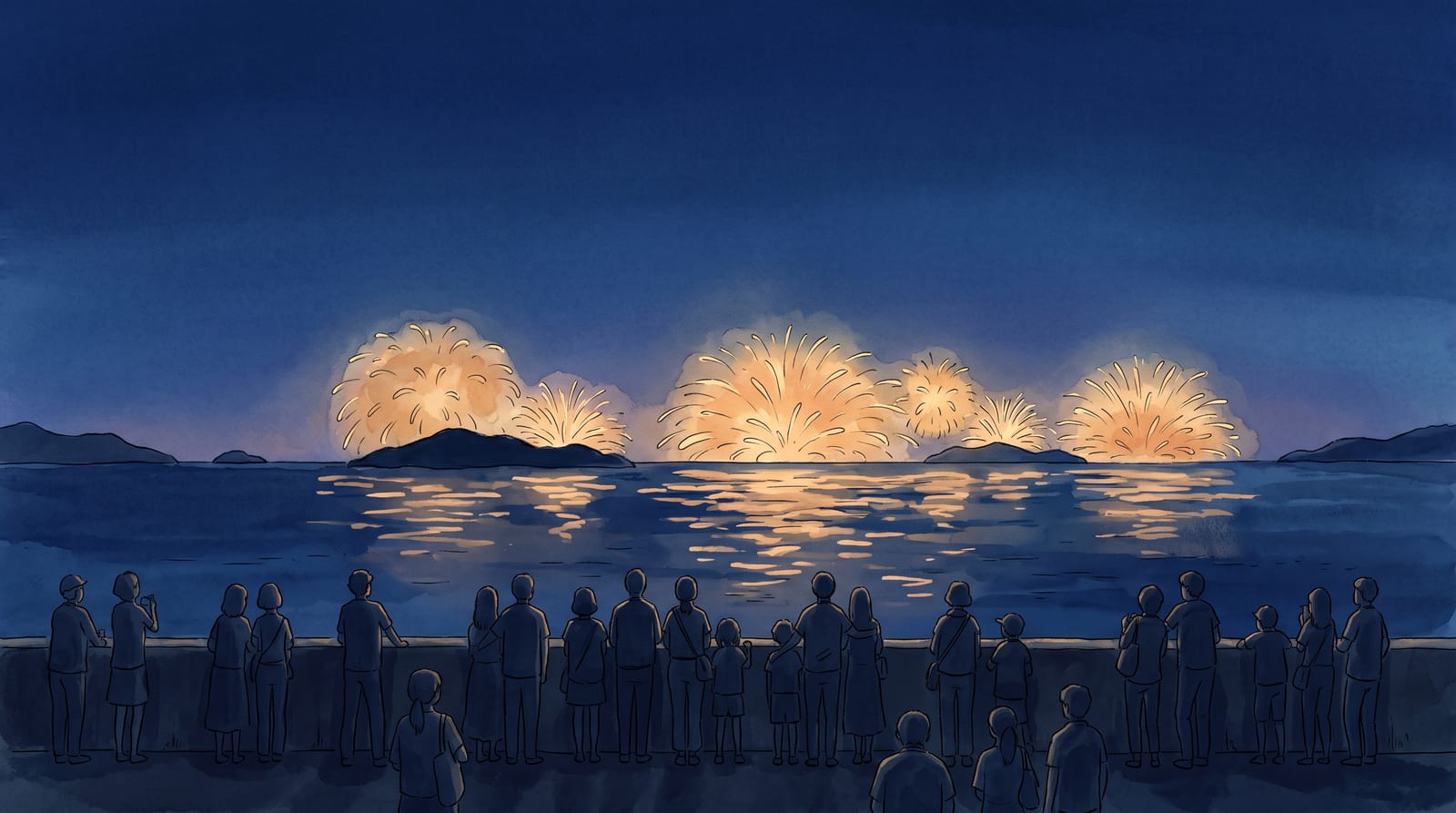
Fireworks fired from barges work the same way anywhere along the Seto Inland Sea: the shells launch from anchored platforms offshore, out of sight of the crowd on the embankment, so what reaches land is the flash first and the sound a beat later, arriving across the water. Takehara puts about 3,000 shells into the sky this way over half an hour, and — as of this month — it has an officially confirmed slot on the calendar: **19:45 to 20:15 on Saturday, August 29, 2026**.
That confirmation matters because a lot of people land on this page for a discouraging reason: the Kure Sea Fireworks Festival, once one of the largest in the region, ended after its 48th edition in 2025, and Kure City still has not confirmed a replacement for 2026. If that is how you got here, the practical question is simple — is there still a fireworks show worth planning a summer evening around, somewhere near Kure? About 40 minutes further down the same JR Kure Line, in Takehara, the answer is yes. What follows is what we verified and what we couldn't, plus the actual route to Onori Station.
Is Takehara having fireworks in 2026?
Yes, and it is now officially confirmed rather than merely well corroborated. That distinction is worth spelling out, because it was not the case just a day earlier — this event has been moving fast.
The Takehara Summer Festival Fireworks Display (たけはら夏まつり花火大会) is an annual event run by the Takehara City Tourism Association. Its Japanese-language official page now lists the 2026 edition directly: Saturday, August 29, 2026, 19:45–20:15, at the J-POWER Takehara Thermal Power Station grounds, with access and parking details included.
The English version of the same official site (takeharakankou.jp/en/event/10764/) has not caught up — as of this writing it still displays the 2025 listing, with last year's date and the old 20:00–20:30 time. If you land on the English page directly, you are looking at last year's information; the Japanese page (or a machine translation of it) is the one that has actually been updated.
This lines up with what several Japanese festival-calendar aggregators — WalkerPlus, Jorudan, ekitan, Sorahanabi — had already been reporting for weeks: the same August 29 date and a similar scale of event, with one of them (iwafu.com) already showing the correct 19:45–20:15 window that the official page has now confirmed. No edition number appears on the official listing, so we're not printing one here — treat any "Nth edition" figure you see elsewhere as unconfirmed.
No outdoor event is ever fully locked in months ahead of an August date — weather, logistics, and even venue details can still shift between now and the show — so check the official Takehara event page yourself before you book anything non-refundable. But the underlying situation has changed: this is now a confirmed date on the organizer's own site, not a well-corroborated guess.
What is the Takehara Summer Festival Fireworks Display?
The fireworks launch from barges anchored offshore at the J-POWER Takehara Thermal Power Station grounds, with a second, smaller venue at Bamboo General Park (バンブー総合公園) hosting food stalls and a hand-held "Buchiage" fireworks event for visitors. About 3,000 shells go up over roughly 30 minutes, reflected on the Seto Inland Sea — a smaller show than Kure's final edition, which launched around 2,000 fireworks for closer to 100,000 spectators at a much larger naval-backdrop event.
| Kure Sea Fireworks Festival | Takehara Summer Festival Fireworks | |
|---|---|---|
| 2026 status | Cancelled, no replacement confirmed | Officially confirmed on Takehara's Japanese page (EN page still shows 2025) |
| Fireworks count | ~2,000 (final 2025 edition) | ~3,000 |
| Setting | Kure Bay, JMSDF warships visible | Seto Inland Sea off Takehara, no naval backdrop |
| Nearest station | JR Kure Station | JR Onori Station, ~10 min walk |
| Scale | ~100,000 spectators (final edition) | Regional-sized, smaller crowds expected |
If what drew you to the Kure event was the naval backdrop specifically, nothing near Kure replaces the warships-and-fireworks pairing this year — that part of the experience isn't available anywhere on this coast right now. But if a decent-sized show within reach of Hiroshima was really the goal, Takehara covers that.
How do I get to the fireworks from Hiroshima and from Kure?
Both routes use the same line — the JR Kure Line — just from different starting points, and both typically involve one change of train.
From Kure
Take the JR Kure Line toward Mihara/Takehara to Onori Station (大乗駅, sometimes also written Ōnori). Based on standard timetabled routing, the journey is about 80 minutes with a transfer, commonly at Hiro Station, for a fare of roughly ¥860. That is a longer ride than it looks on a map — the JR Kure Line hugs the coast and stops often past Kure, and not every train runs the full distance to Takehara without a change.
From Hiroshima
From Hiroshima Station, the same line reaches Onori Station in roughly 1 hour 50 minutes to 2 hours, with one transfer (commonly at Hiro or Mihara), for a fare of about ¥1,340 with an IC card (around ¥1,690 for a paper ticket via the Mihara routing). That is close to a two-hour one-way trip for a 30-minute show, which is worth being honest about before you commit an entire evening to it.
Extra trains, and the last-train problem
The official event page confirms that extra JR Kure Line trains are planned for the night of the fireworks. That is a good sign, since the regular JR Kure Line service thins out considerably in the evening and Onori is a small station. What we could not verify is an exact last-train time back toward Kure or Hiroshima after the 20:15 finish. Do not assume the daytime timetable applies — check the current JR West timetable or a transit app (Yahoo Norikae Annai, Jorudan, or Google Maps transit) once you are on-site, and have a backup plan if you are relying on the very last train.
Should I combine this with Okunoshima (Rabbit Island)?
It lines up better than it might look at first. Okunoshima belongs to Takehara City, not Kure, and is reached by ferry from Tadanoumi Port — also in Takehara. Tadanoumi Station and Onori Station are both on the JR Kure Line, about 4.7 km apart with one station (Aki-Nagahama) between them. In practice that means a day on the rabbit island and an evening at the fireworks are a realistic single-day plan, not two separate trips.
A workable version of that day: take the ferry to Okunoshima in the morning, spend several hours with the rabbits, and catch the last ferry back to Tadanoumi around 16:25 on the Daisan Omishima service. From Tadanoumi Station, ride the JR Kure Line the short distance to Onori, get dinner near the venue, and be in place for the 19:45 start. For the details of getting to Okunoshima itself — ferries, fares, and the rabbit-food rules — see our guide to reaching Rabbit Island and the full Okunoshima visitor guide.
The gap between 16:25 (last ferry) and 19:45 (fireworks) is comfortably wide, so the tight part of this plan is not the connection itself — it is confirming both timetables close to your travel date, since ferry and festival schedules both shift seasonally.
What to know before you go
Fireworks festivals in small Japanese coastal towns get crowded fast, and Takehara's is no exception in scale terms: the official event page lists parking at two separate venues — about 700 spaces (paid) at the main J-POWER site and about 355 spaces (paid) at the Bamboo General Park sub-venue, roughly 1,055 combined — which gives a sense of how many cars converge on a town this size for one evening. Aggregator reports describe road traffic around the venue building from about 17:00 and staying heavy for an hour or so after the show ends. If you are driving, budget extra time on both ends; if you are on the train, the crush at Onori Station immediately after 20:15 will not be pleasant, and the extra trains mentioned above are the reason it stays manageable rather than a reason to relax.
August in the Seto Inland Sea is humid, and a 30-minute show is not long enough to justify skipping shade and water while you wait — most visitors arrive well before 19:45 to claim a viewing spot, so the actual waiting time in the heat is closer to an hour or two.
Rain is the honest risk to plan around. The official 2026 page states the event proceeds in light rain but is cancelled outright — not postponed — in severe weather, with updates posted to the Takehara tourism site and the city's official Facebook and X accounts. There is no rain date. If a typhoon or a heavy front is forecast for August 29, do not build your whole evening around the fireworks specifically.
A Japan eSIM is worth having for a day like this, since you will likely be checking live train departures and the festival's cancellation announcements from a station platform with no other way to get online. Klook Japan eSIM
FAQ
Is the Kure fireworks festival happening in 2026?
No. The Kure Sea Fireworks Festival was permanently discontinued after its 48th and final edition in 2025, and as of this writing no replacement event has been confirmed for 2026. See our full explainer, Is the Kure Fireworks Festival Happening in 2026?, for the full story and what to do in Kure this summer instead.
When are the Takehara fireworks in 2026?
The official Takehara tourism site (Japanese version) confirms Saturday, August 29, 2026, 19:45–20:15, with about 3,000 fireworks. The English version of the same official page still shows the 2025 listing, so rely on the Japanese page for current details, and check again close to your travel date since specifics can still change.
How do I get to the Takehara fireworks from Kure?
Take the JR Kure Line toward Mihara/Takehara to Onori Station (大乗駅). The trip is roughly 80 minutes with one transfer, commonly at Hiro, and costs about ¥860. From Onori Station it is about a 10-minute walk to the venue. Extra trains are typically added for the event, but confirm the last return service before the show starts.
How do I get to the Takehara fireworks from Hiroshima?
Take the JR Kure Line to Onori Station, a trip of roughly 1 hour 50 minutes to 2 hours with one transfer, for about ¥1,340 (IC card) to ¥1,690 (ticket) depending on the routing. It is a long one-way trip for a 30-minute show, so most Hiroshima-based visitors treat this as an evening built around Takehara itself, or pair it with a day on Okunoshima, rather than a quick side trip.
Can I combine the Takehara fireworks with Okunoshima (Rabbit Island)?
Yes. Okunoshima's ferry port at Tadanoumi and the fireworks venue near Onori Station are both in Takehara City, about 4.7 km apart on the same JR Kure Line, with the last Okunoshima ferry back to Tadanoumi at around 16:25 — comfortably before the 19:45 fireworks. See our guide to getting to Okunoshima for the ferry details.
What happens if it rains?
Per the official 2026 event page, the fireworks go ahead in light rain but are cancelled outright — not rescheduled — in severe weather. Cancellation updates are typically posted to the Takehara tourism site and the city's official social media on the day itself.
Related guides
More in our Kure and Hiroshima series:
- Is the Kure Fireworks Festival Happening in 2026? — why Kure's own festival ended, and what to do in Kure this summer instead
- Hiroshima to Kure day trip guide — train, bus, ferry, and car options with times and fares
- Okunoshima Rabbit Island complete guide — what to actually do once you land, feeding rules, and the island's wartime history
- How to get to Okunoshima (Rabbit Island) — every route from Hiroshima, Osaka, and Tokyo, ending at the Tadanoumi ferry
- One day in Kure: the 2026 itinerary — how to spend a full day at the museums, naval curry, and waterfront if fireworks aren't the priority
Author: Masayuki Ogasahara | Illustrations generated with AI (Gemini). This article contains an affiliate link to Klook. We may earn a small commission at no extra cost to you. We have not personally visited the Takehara Summer Festival Fireworks Display; all event, transport, and pricing details were verified against the official Takehara tourism site (Japanese-language version) on 2026-07-13 and cross-checked against multiple independent Japanese festival-calendar sources (WalkerPlus, Jorudan, ekitan, Sorahanabi, iwafu.com). The Japanese-language official page confirms the 2026 listing; the English version of the same site had not yet updated to match as of this writing — please check the official page yourself before finalizing travel plans, since event details can still shift.