
This post contains affiliate links. We may earn a small commission at no extra cost to you.
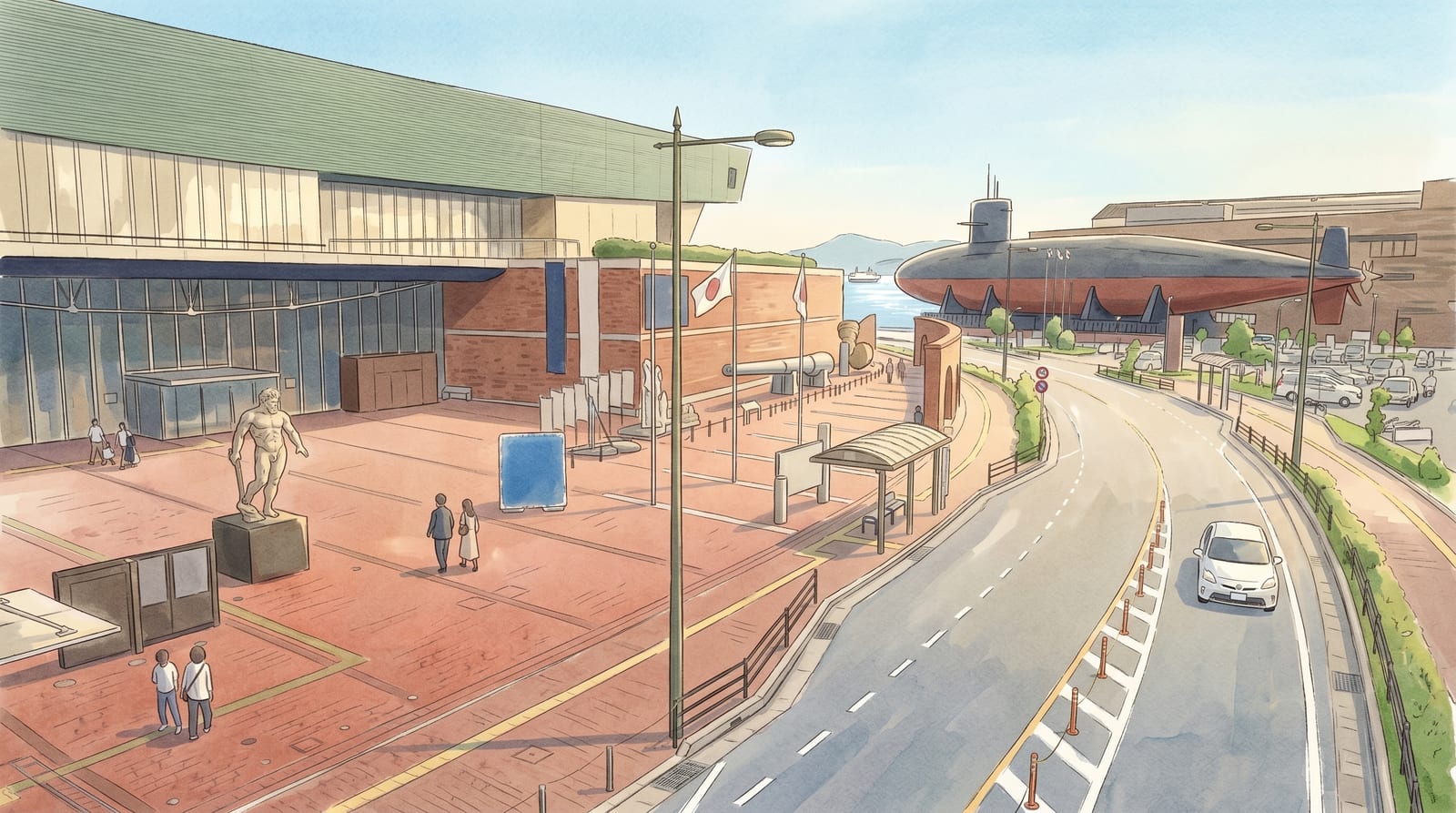
The itinerary writes itself almost the moment you arrive. You step off the train, walk five minutes toward the water, and two buildings you could spend the next three hours inside are facing each other across a brick plaza. The battleship Mutsu's main gun barrel — not a replica, the actual gun, raised from the Seto Inland Sea — lies along the museum side of the plaza, and past the far edge a chain-link fence opens onto the harbour, where active JMSDF vessels sit at their moorings close enough to read the hull numbers. The question on a first visit to Kure is not "what is there to do" but "which direction to point the afternoon."
We spent a day in Kure in June 2026, shortly after the Yamato Museum reopened from its 14-month renovation. The museums were quieter than we expected on a weekday morning, the curry lunch took about forty minutes, and we were back on the ferry terminal by 13:00 with half a day of options still open. Here is the structure that works, and the four ways the afternoon can branch.
For the train times and transport route comparison from Hiroshima, see our full Hiroshima-to-Kure transport guide — this article picks up from the moment you arrive.
Is one day in Kure enough?
For most first-time visitors, yes. The core of the city is compact: both museums, the nearest naval curry restaurants, and the cruise terminal are all within a five-minute walk of each other and a five-minute walk from the station.
What one day cannot do is cover everything equally. The Yamato Museum alone runs 90 minutes to two hours if you read the exhibit text carefully. The submarine museum takes another 60 to 90 minutes. Factor in lunch and the afternoon option of your choice, and a tight day already pushes into the early evening. Etajima requires crossing to another island. The night view at Mt. Haigamine is a separate charter taxi excursion that fits best as a post-dinner extension.
Two days opens the city up: a second morning for the parts you rushed through, a slow lunch somewhere new, and the night view without the time pressure. But we know most people are working with one day, so the itinerary below is built around that.
The fixed core: a Kure morning
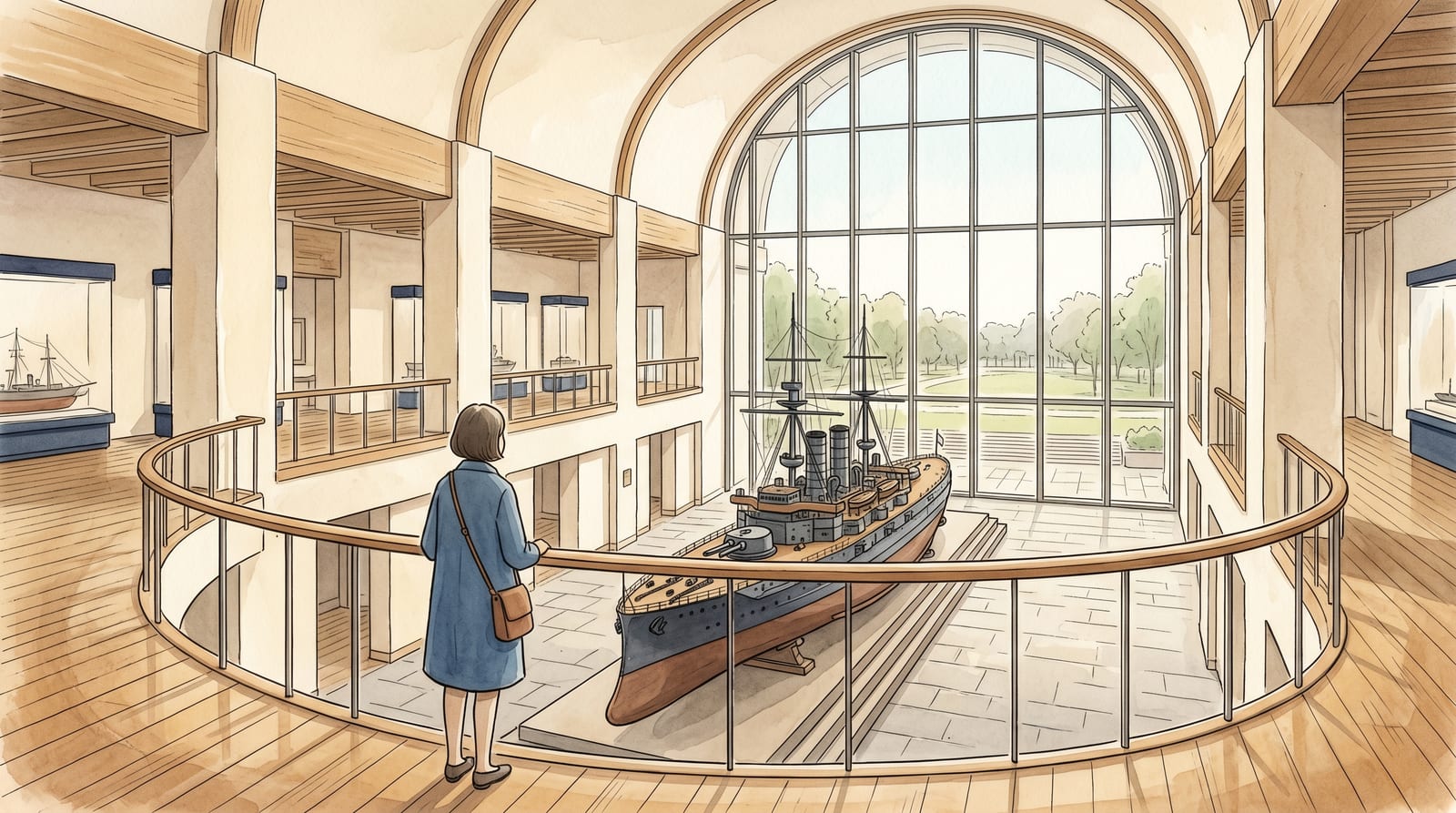
Start at the Yamato Museum when it opens at 09:00. General adult admission is ¥1,000. The museum reopened on April 23, 2026 after a 14-month renovation — the largest since the building opened in 2005 — and the exhibit layout has been refreshed.
The centrepiece is the 1:10 scale model of battleship Yamato: 26.3 metres long, built from original construction drawings. Beneath it, a circuit of exhibits covers the naval arsenal that built the ship, the human cost of the war at sea, and the engineering of the Yamato herself — nine 46-centimetre main guns, a fully loaded displacement of 72,800 tons, launched here in 1940. Of her crew of roughly 3,332, about 3,055 did not come home from the April 1945 mission that sank her. The museum does not let you forget that.
Allow 90 minutes to 2 hours here. Bring headphones: the audio guide is free via the Yamato Museum Navi smartphone app, available in English, Traditional Chinese, and Korean. If you do not have a smartphone with data, tablet rentals are at the ticket counter. A free English-guided tour of the museum runs on Sunday mornings between 09:00 and 12:00 — ask at the main entrance for the departure time.
If your phone plan does not include Japanese data, pick up a Klook Japan eSIM eSIM before leaving Hiroshima so the audio guide and maps work from the moment you arrive.
Cross the plaza and walk 1–2 minutes to the JMSDF Kure Museum — nicknamed the "Iron Whale" — directly opposite. Admission is free. The museum opens at 10:00, so if you arrived at the Yamato Museum right at 09:00 and spent 90 minutes there, the timing works almost exactly.
The draw here is JS Akishio (SS-579), a 76.2-metre retired Yushio-class submarine beached beside the building. Visitors walk a one-way route through the interior, from the bow torpedo room through the command centre, where two working periscopes look out over the harbour toward the active JMSDF base across the water. Allow 60 to 90 minutes.
A note on closed days: both museums and the closest certified curry restaurant all close on Tuesdays. This matters enough to repeat: do not plan this morning for a Tuesday.
The full Yamato Museum guide and the JMSDF Kure Museum guide each go into considerably more depth on individual exhibits if you want to prepare before you go.
Naval curry lunch
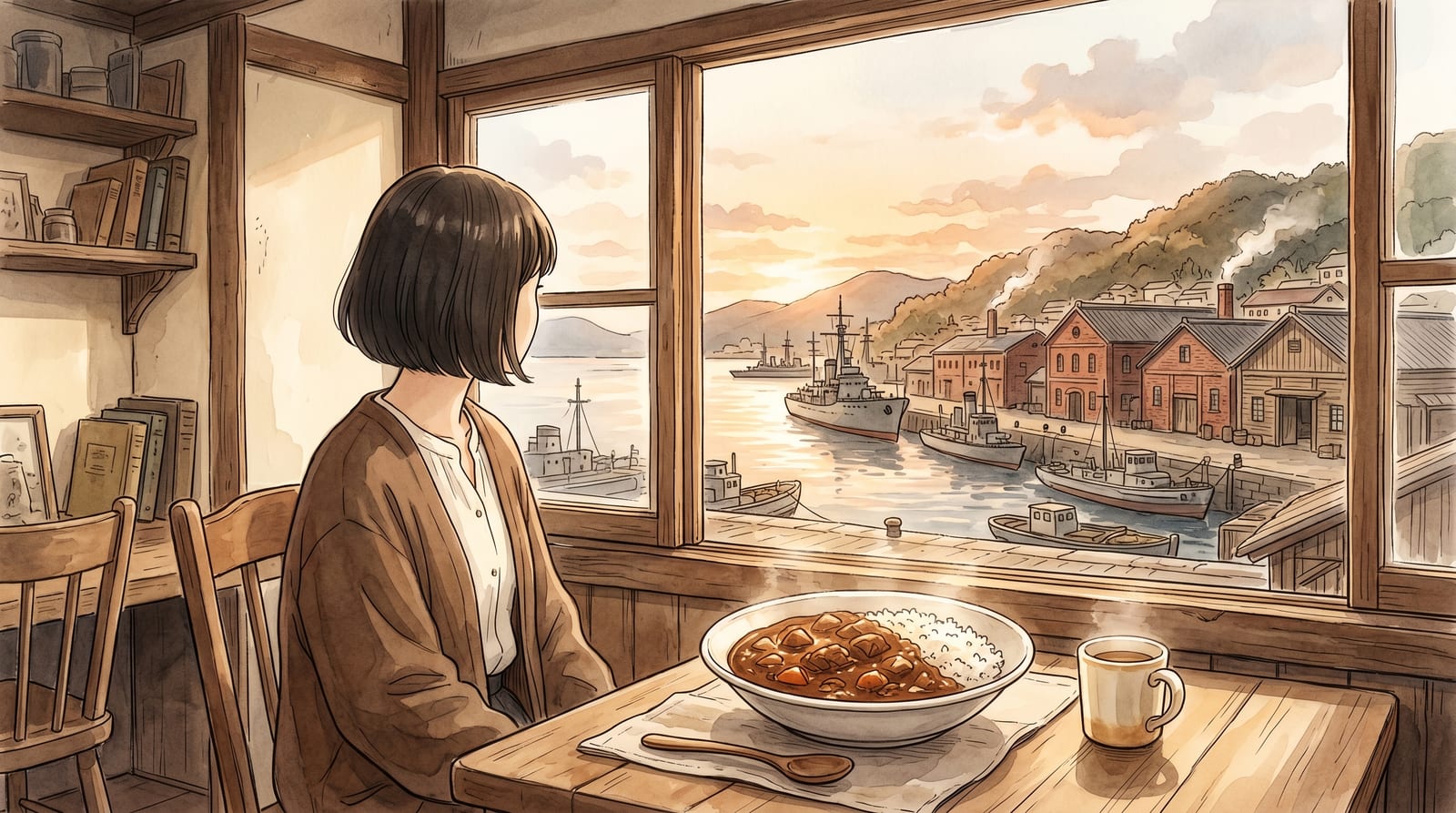
Kure's naval curry programme works like this: each participating restaurant serves a recipe passed directly from the crew of a specific JMSDF ship. The ship's captain signs off on the result. About 22 restaurants are certified in the 2025–26 season, each tied to a different vessel.
The closest certified restaurant to the museums is Kure Haikara Shokudou (呉ハイカラ食堂), a 1–2 minute walk from the Yamato Museum at 4-21 Takaramachi. It serves the JS Sōryū submarine recipe: the iron-plate Sōryū Teppan Curry (¥1,650) or an entry-level Submarine Curry (¥980). Hours are 11:00 to 15:30, last order at 15:00, and it is closed on Tuesdays. Cash is the safe assumption.
If you prefer a different venue or want to plan further ahead, pick up the free JMSDF Kure Curry Guidebook at the Kure Tourist Information Plaza, a one-minute walk from Kure Station. It lists all certified shops with a map and includes a sticker sheet for the seal rally.
Choose your afternoon
This is where the day diverges. Four options, each about 2–3 hours. They are not interchangeable — read through and pick the one that fits your interests and the day of the week.
Option A: Kure harbour warship cruise
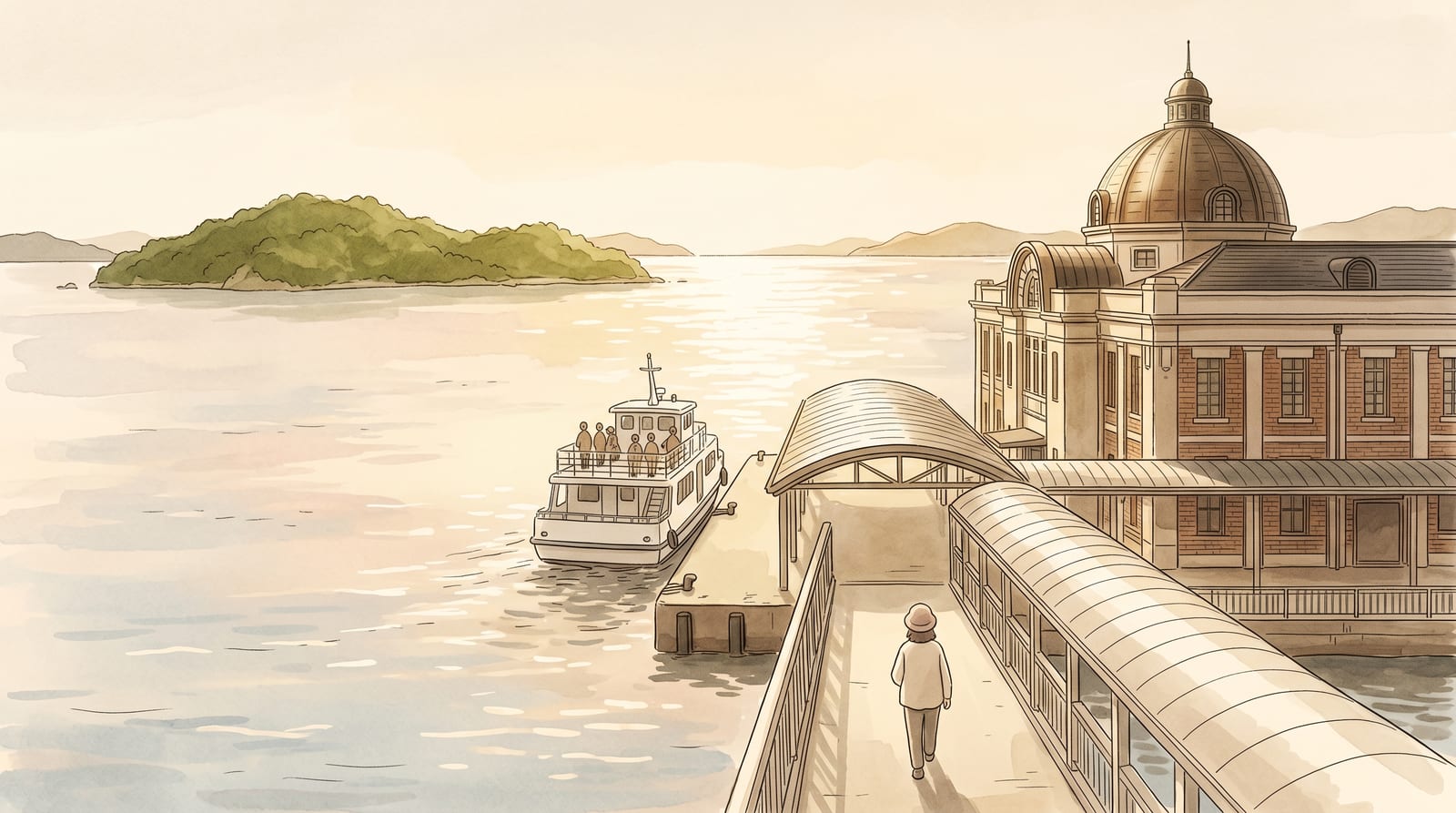
The harbour warship cruise departs from the Kure Chuo Sanbashi Terminal, a 1-minute walk from the Yamato Museum entrance. Tickets are ¥2,200 for adults, ¥800 for children, for a trip of about 40 minutes past the JMSDF Kure base — close enough to see hull numbers and crew on deck.
On weekdays (Monday, Wednesday, Thursday, Friday) the cruise runs at 10:00, 11:00, 13:00, and 14:00. On weekends and public holidays it adds a 12:00 and 15:00 sailing. No Tuesday sailings.
Important: the cruise must be booked online at bunker-supply.com at least two days before your sailing. The form is in Japanese; same-day and next-day phone reservations are not accepted. If you would rather book in English, a Kure Bay warship cruise is also listed on Klook Kure Bay cruise. Either way, book before you leave home.
This option suits anyone whose main interest is seeing current JMSDF vessels at close range rather than just in photographs. It is the most time-efficient afternoon add-on: 40 minutes on the water, then you are back at the pier near the museums.
Option B: Etajima and the former naval academy
The Etajima guide covers this in full, but here is the structure from a Kure morning: the Kure Chuo Sanbashi Terminal (1 minute from the Yamato Museum) runs a ferry to Koyō Port on Etajima in about 20 minutes for ¥450, or a high-speed boat in 10 minutes for ¥650. From Koyō Port it is about 10 minutes by local bus or 7 minutes by taxi to the JMSDF First Service School.
The academy tour is free and guided (in Japanese only, about 90 minutes). Weekday tours start at 11:15, 13:30, and 15:15; Saturday, Sunday, and public holidays add a 09:30 tour. No advance booking is needed for groups under 50 — registration is at the main gate from 30 minutes before each session.
The red-brick Midshipmen's Hall, completed in 1893 to a British architect's design and still in daily use, is one of the most architecturally unusual buildings you will see on a Japan trip. The Educational Reference Hall on site does not allow photography inside.
Allow half a day for Etajima including ferry time and the tour. From a Kure-museum morning, take the 13:30 or 15:15 tour. Boats are timed to connect with the tour schedule.
This option works best for visitors with a particular interest in the Imperial Japanese Navy — the academy trained officers from 1888 to 1945, including Isoroku Yamamoto. Combined with the Yamato Museum morning, it is the deepest single-day immersion in Kure's naval history.
Option C: "In This Corner of the World" film locations
The 2016 animated film directed by Sunao Katabuchi follows Suzu, who marries a civilian naval clerk and moves to Kure in 1943. The 2019 version added about 33 minutes of footage — it is an extended cut, not a sequel.
The marked locations are spread across Kure and reached on foot or by bus. The recreated layout of the Hōjō family home where Suzu lives sits on the Uneharachō hillside, with a guide board designed by manga author Fumiyo Kōno. The neighbourhood is residential: do not enter private property or terraced fields. No parking is available at most spots.
Start at the Kure Tourist Information Plaza (one minute from Kure Station) and pick up the free illustrated film-location map. It lists specific spots including the Aoyama Club, the Mitsukura storehouses, the steps near the former naval hospital, and Koharu Bridge. The full film locations guide has detailed walking directions.
This option takes a half afternoon at minimum and rewards visitors who have seen the film. Without that context, the locations are primarily residential streets and historic fragments.
Option D: JMSDF open-ship day (advance planning required)
The JMSDF holds public warship viewings on the 1st, 3rd, and 5th Sundays and the 2nd and 4th Saturdays of each month. Admission is free.
This option requires significant advance planning and is not interchangeable with the others. Boarding requires winning a free advance lottery by email — applications close about 10 days before the date, results come by email the Monday before. Walk-up entry is not possible.
The check-in desk opens at 13:00 and closes at 13:20. Late arrivals after 13:20 cannot board even with a winning confirmation. The venue is at Showa-cho, about 2 km from the waterfront museums — take the Kure Kurahashijima Line bus from Kure Station, about 15 minutes to Showa Futo-mae, then a 2-minute walk. Allow 20 minutes total from the station.
Foreign visitors can apply, but the application form, lottery notification, and all on-site guidance are in Japanese only. The form requires a Japanese postal code; using your hotel's address works.
The open-ship guide has full application instructions.
| Warship Cruise | Etajima | Film Locations | Open-Ship Day | |
|---|---|---|---|---|
| Cost | ¥2,200 adult | ¥450–¥650 (ferry) + free tour | Free | Free |
| Advance booking | Required (online, 2 days ahead) | Not required (under 50 people) | Not required | Required (lottery, ~10 days ahead) |
| Time needed | ~40 min on water | ~3 hours (ferry + tour) | 2–4 hours | ~3 hours inc. transport |
| Available days | Mon/Wed/Thu/Fri/Sat/Sun (not Tue) | Daily (check monthly tour calendar) | Any day | 1st/3rd/5th Sun + 2nd/4th Sat |
| Language support | Japanese commentary | Japanese guided tour only | Map available in English | Japanese only |
| Best for | Active fleet photography | Deep naval history; architecture | Film fans; slow walkers | Boarding an actual warship |
Evening extension: Mt. Haigamine night view
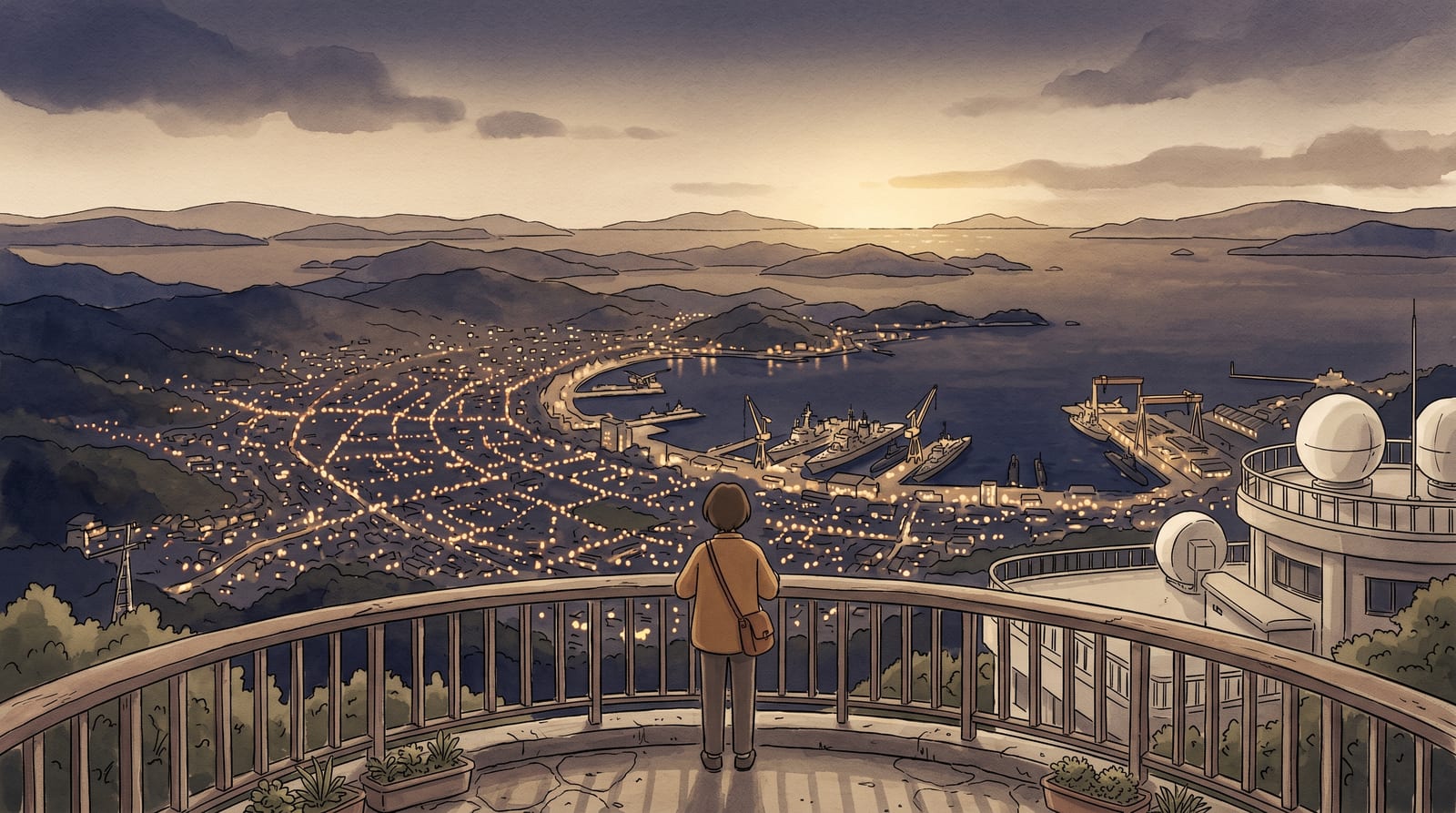
Mt. Haigamine stands at 737 metres above the city and is listed among the Three Great Night Views of Chugoku and Shikoku, Japan's Top 100 Night Views, and as a Japan Night View Heritage Site. The observatory is free.
Public transport will not get you there and back for an evening night view. The nearest bus stop is Kamiyama-toge, after which it is roughly 90 minutes uphill on foot — realistic for a morning hike, not for arriving at dark. By car, it is about 30 minutes from the Kure IC, but the summit parking is only about 6 spaces.
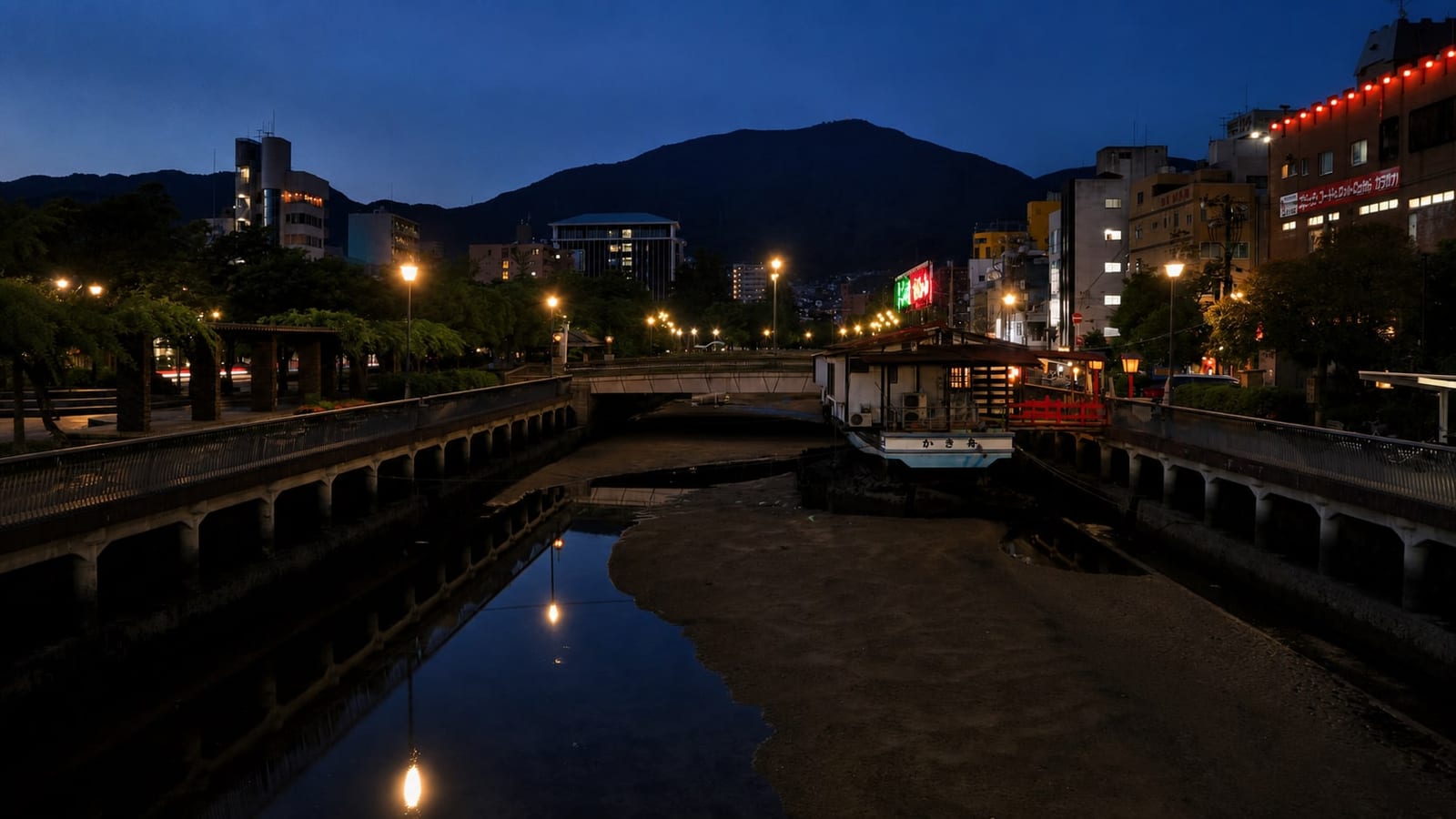
If the logistics below rule the summit out, dusk in the city centre is a consolation with its own character — the photo above is the Sakaigawa river at blue hour, with a kakibune (floating oyster restaurant) under the same mountain you would otherwise be standing on.
The two practical options for visitors without a car:
| Viewport Kure Hotel Night Tour | Kure Tabi Taxi Night Course | |
|---|---|---|
| Fare | ¥1,900 per person (round trip) | ¥12,700 chartered (4–5 pax) / ¥17,100 (up to 9 pax) |
| Group size | Minimum 4, maximum 9 | No minimum; up to car capacity |
| Route | Hotel → Haigamine → Hotel | Tourist info center → Haigamine → yatai alley → Tourist info center |
| Duration | Confirm with Godo Taxi when booking | About 2 hours |
| Booking | Call Godo Taxi: 0823-21-8191 (Japanese only) | Call Kure Tourist Info: 0823-23-7845, 09:00–19:00, no closed days |
| Meeting point | Viewport Kure Hotel entrance, 5 min before departure | Kure Tourist Information Center |
| Payment | Cash to driver before boarding | Confirm payment method when booking |
If you are travelling in a group of four or more, the Viewport Kure tour at ¥1,900 per person is the most cost-effective. For two people, the Tabi Taxi at ¥12,700 total (about ¥6,350 per person for two) is the realistic option. Both require Japanese-language phone calls to book — if that is a barrier, ask your hotel's front desk to call on your behalf.
Sample itineraries
Half-Day
Museums + curry, back by mid-afternoon
- Train from Hiroshima Station (~35–50 min)
- Arrive Kure, walk to Yamato Museum
- Yamato Museum (allow 90 min)
- Cross plaza to JMSDF Kure Museum (allow 60 min)
- Naval curry lunch at Haikara Shokudou (closes 15:30)
- Train back to Hiroshima
Full Day — Best Balance
Museums + curry + afternoon option
Recommended- Train from Hiroshima Station
- Arrive Kure, begin Yamato Museum
- JMSDF Kure Museum
- Naval curry lunch
- Harbour cruise (book online ahead) or ferry to Etajima or film-location walk
- Train back to Hiroshima
Deep Kure
Adds Etajima, Mt. Haigamine, and a slower second morning
- Day 1: Both museums + naval curry + harbour cruise + Mt. Haigamine night view (charter taxi, book ahead)
- Day 2: Ferry to Etajima and the former naval academy (free guided tour) + film-location walk on return
- Stay: Rakuten Travel Kure hotels — look for a hotel near Kure Station for the easiest logistics
Getting to Kure from Hiroshima
The JR Kure Line runs from Hiroshima Station to Kure Station in about 35 minutes on the Akiji Liner rapid, or about 50 minutes on a local train. The one-way IC-card fare is about ¥510. Trains run every 20–30 minutes through the day.
A JR Pass is not worth it for the Hiroshima–Kure ride alone — the single fare is only about ¥510 each way. But if Kure is one stop in a wider Japan itinerary that already includes Shinkansen travel, Japan Rail Pass the pass covers the Kure Line ride and can still be the most economical way to bundle the whole trip.
For the full breakdown of all four transport options (train, bus, ferry, car), see our Hiroshima-to-Kure transport guide.
If you would rather not manage timetables at all, GetYourGuide Kure day tour runs day tours from Hiroshima with round-trip transport and an English-speaking guide.
FAQ
How should I structure one day in Kure?
Keep the museums in the morning, lunch in between, and one afternoon option of your choice. The Yamato Museum opens at 09:00 (¥1,000 admission); the JMSDF submarine museum opens at 10:00 and is free. Both take 60–90 minutes. After a curry lunch near the station, the afternoon branches into a harbour cruise (¥2,200, pre-book online), Etajima by ferry (¥450–¥650), a film-location walk, or — if you planned ahead — an open-ship boarding.
Do the museums close on certain days?
Both the Yamato Museum and the JMSDF Kure Museum are closed on Tuesdays, and so is the nearest certified curry restaurant. If your travel dates are flexible, any other day of the week works.
Is the harbour warship cruise bookable on the day?
No. It must be booked online at bunker-supply.com at least two days before your sailing date. The booking form is in Japanese. Same-day and next-day phone reservations are not accepted. The 13:00 and 14:00 sailings on weekdays are the most useful after a morning at the museums.
How much does a full day in Kure cost per person?
Both museums come to ¥1,000 (Yamato Museum) plus free (submarine museum). A naval curry lunch runs roughly ¥980–¥1,650. The harbour cruise adds ¥2,200; the Etajima ferry is ¥450–¥650 each way (the academy tour itself is free). Round-trip train from Hiroshima adds about ¥1,020. A full day with the cruise works out to roughly ¥5,200–¥5,870 per person total.
Can I board a warship without entering the lottery?
No. The JMSDF open-ship boardings at Kure require winning a free advance lottery by email. Walk-up entry is not accepted. The harbour warship cruise is a separate commercial tour that lets you view JMSDF vessels from the water — it requires online pre-booking but no lottery.
Is the Mt. Haigamine night view accessible without a car?
Not practically for an evening visit. The nearest bus stop (Kamiyama-toge) requires roughly a 90-minute uphill walk to the summit — not realistic after dark. The practical options are the Viewport Kure Hotel taxi tour (¥1,900 per person, minimum 4 passengers, contact Godo Taxi at 0823-21-8191) or Kure's Tabi Taxi night course (¥12,700 chartered for up to 5 people, contact Kure Tourist Information at 0823-23-7845). Both are booked by Japanese-language phone call only.
Related guides
More in our Kure series:
- Best day trips from Hiroshima — the full ranked list, with this Kure day as our top pick
- Yamato Museum complete guide — every floor, every major exhibit, what to skip if time is short
- JMSDF Kure Museum (Iron Whale) guide — inside JS Akishio and the three exhibit floors
- Kure naval curry guide — the certification programme, which ships each restaurant represents, and our picks
- Kure harbour warship cruise guide — booking, what you see, best seats
- JMSDF Kure open-ship days — board an active warship via the monthly lottery
- Etajima and the former naval academy — the ferry, the tour, and the red-brick Midshipmen's Hall
- In This Corner of the World film locations — walking guide with the official location map
Last visited: 2026-06 | Author: Masayuki Ogasahara | Illustrations generated with AI (Gemini) using real reference photographs where a specific place is shown. The hero illustration of the museum plaza is derived from Yamato Museum and JMSDF Kure Museum by Yousuke, CC BY-SA 2.0. Other photographs are original or used with permission; some include light AI-assisted post-processing for cleanup or exposure, with the scene itself unchanged. This article contains affiliate links to GetYourGuide, JRPass.com, Klook, and Rakuten Travel. We may earn a small commission at no extra cost to you. All admission, pricing, and operational information was verified against official sources in June 2026; please confirm with the venue before your visit as details can change.
