
This post contains affiliate links. We may earn a small commission at no extra cost to you.
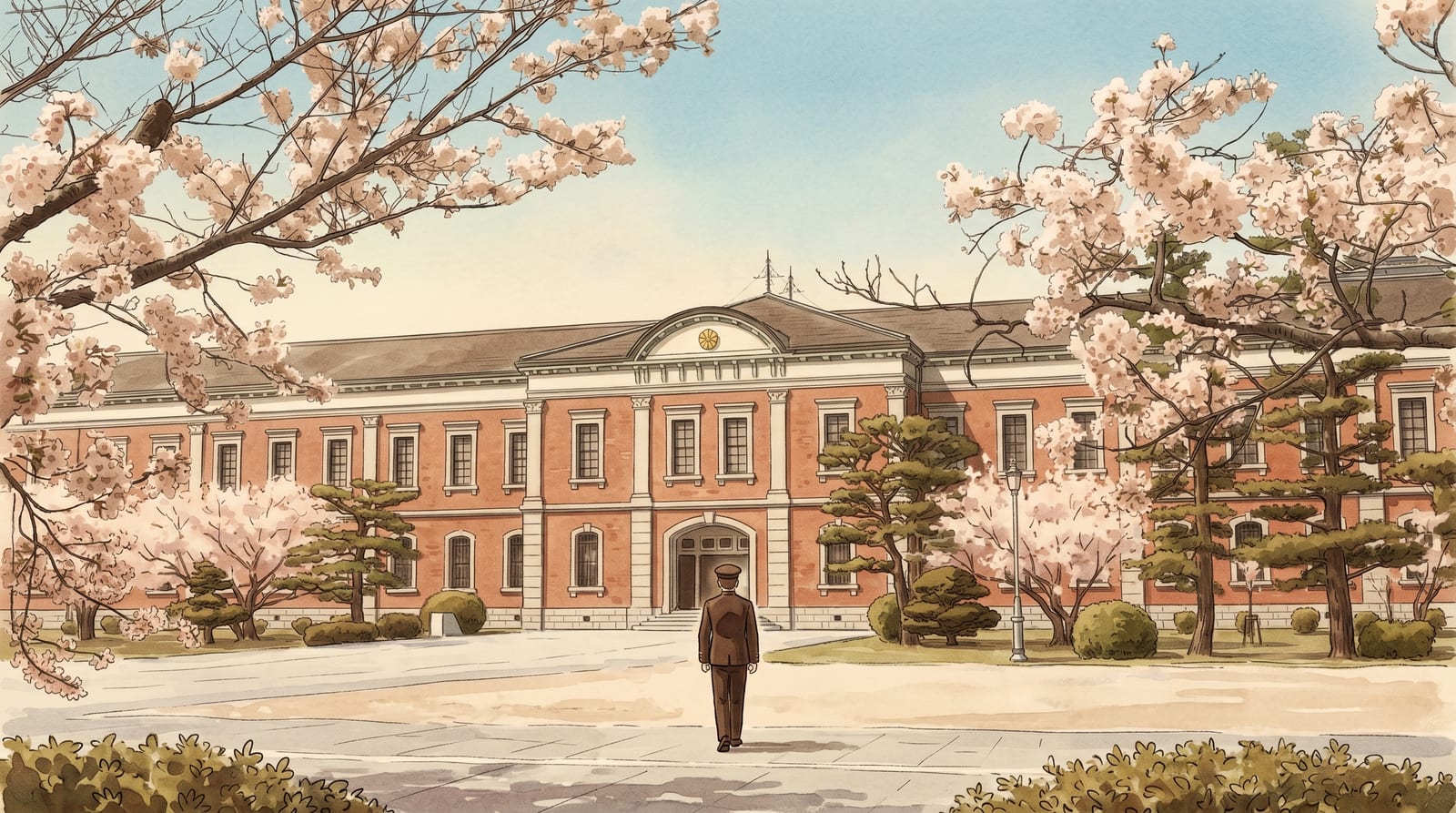
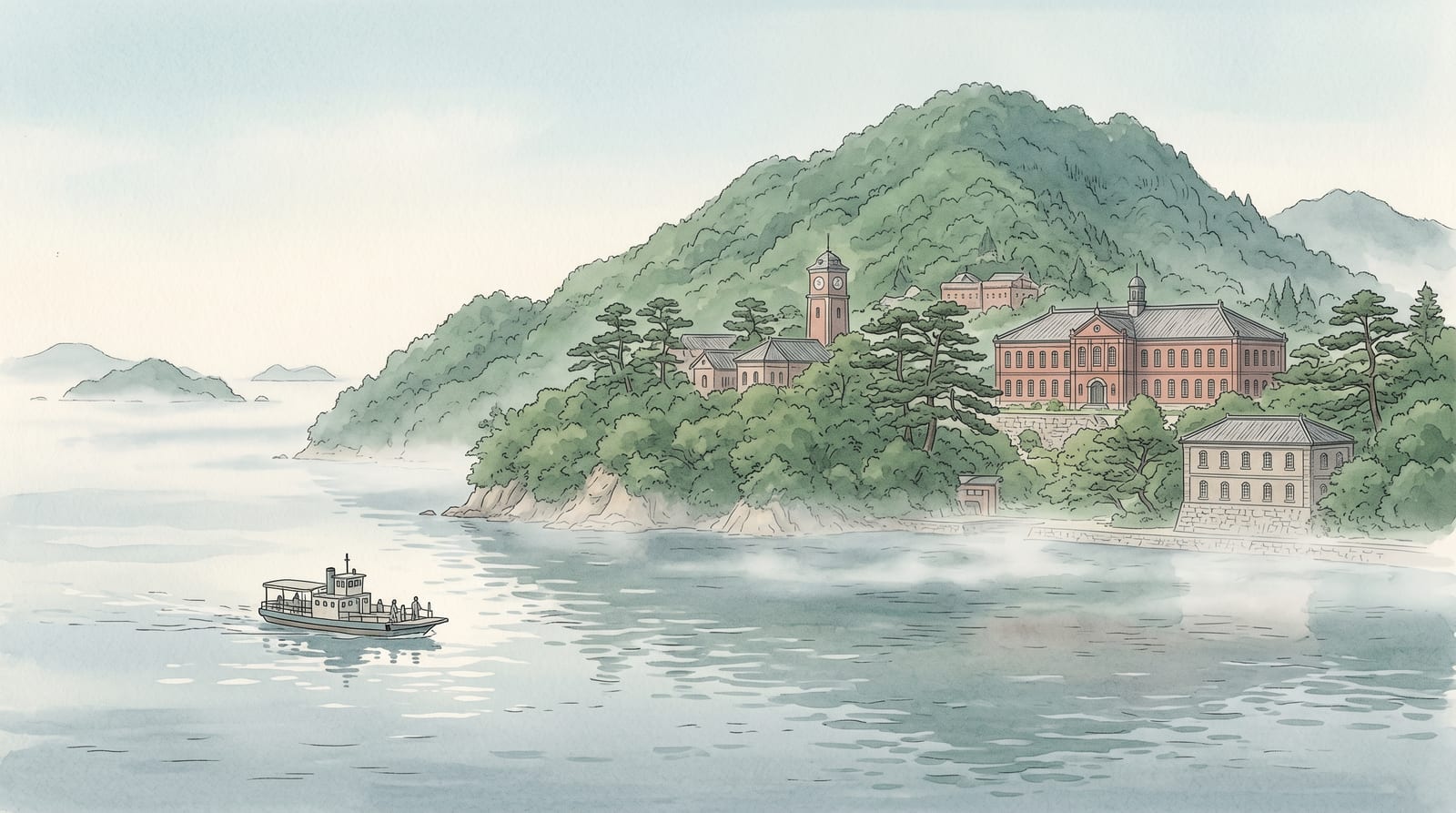
In 1888, the year American settlers were racing to stake land in the Oklahoma Territory, Japan was constructing something quieter on a small island in the Seto Inland Sea: an officer school for a navy that did not yet exist at scale. The red-brick Midshipmen's Hall that went up on Etajima five years later still stands, still used, and the cadets who walk its corridors today train in the same building that shaped the officers of the Imperial Navy — a continuity of place that almost no military institution in the world can match.
Most people travelling from Hiroshima to Kure come for the Yamato Museum and leave by early afternoon. The ferry across to Etajima takes twenty minutes from the same waterfront terminal, but the island stays off most itineraries. Part of the reason is practical: the campus is an active JMSDF base and tours are guided-only. Part is simply distance — an island feels further than it is. We went to see whether the crossing was worth it, and it was, with conditions.
What is the Etajima Naval Academy, and why does it matter?
The site now known as the JMSDF First Service School (海上自衛隊第1術科学校) was originally the Imperial Japanese Naval Academy (海軍兵学校).
The academy was established in 1888 on Etajima Island, Hiroshima Prefecture, having relocated from Tokyo to this remote island partly for discipline: isolation kept cadets focused. The location also had strategic logic — the Seto Inland Sea was where the Imperial Japanese Navy would grow, and Kure Naval Arsenal, directly across the water, would become its manufacturing heart. The school has opened its grounds to public tours since 1960, and now draws about 50,000 visitors a year — some 5.1 million cumulatively — making it one of Etajima's signature sites.
The Etajima academy is traditionally spoken of, alongside the United States Naval Academy at Annapolis and the Britannia Royal Naval College at Dartmouth, as one of the world's three great naval academies — a designation Japanese Wikipedia carefully frames as "an opinion" (意見) rather than an objective or credentialed ranking. How the institution came to stand in that company is itself part of the story.
In 1873, Commander Archibald Lucius Douglas of the Royal Navy arrived at the Naval Training School (海軍兵学寮) leading a 34-member British advisory team, charged with building Japan's officer corps from the ground up on the Royal Navy model. The Douglas mission, as it is remembered, served through approximately 1875 and imported not just seamanship curriculum but a specific idea of what a naval officer should be: the phrase "a gentleman before an officer" (士官である前に、紳士であれ) traces directly to this period. English was a required subject from the outset. That British foundation is why Dartmouth appears in the academy's lineage — the school was consciously modelled on it, not merely compared to it after the fact.
One thing that surprises visitors familiar with Annapolis or Dartmouth: those institutions restrict casual access to most of their operational campus. At Etajima, the guided tour is free, open to any individual who registers at the gate, and walks you through the building where the academy's history has been accumulating since 1893. The officers working inside today are not re-enactors.
The red-brick Midshipmen's Hall (生徒館) was completed in 1893, most often attributed to the British engineer John Diack, though at least one architecture-documentation source leaves that attribution uncertain. The building remains in daily use today — the history here is not behind glass.
The academy trained generations of Japanese naval officers until Japan's defeat in 1945, after which the facilities passed through postwar occupation and reorganisation before being taken over by the JMSDF. The First Service School today trains officers in the same buildings, with the added dimension of an on-site museum — the Educational Reference Hall — that houses materials from the imperial-era academy.
For visitors, the significance is direct: this is not a reconstruction or a memorial. You are walking through a building that has been continuously occupied since 1893.
How do I get to Etajima from Hiroshima or Kure?
Etajima is an island — there is no bridge or train. All access is by ferry or high-speed boat. The most practical departure point if you are combining this with Kure is the Kure Chuo Sanbashi Terminal (呉中央桟橋ターミナル, 4-44 Takaramachi, Kure).
The terminal is 1 minute from the Yamato Museum entrance and about 5–7 minutes from JR Kure Station. If you combine Etajima with a morning at the Yamato Museum cluster, you walk out of one attraction and straight to the ferry dock.
Ferry or high-speed boat from Kure (recommended)
Setonaikaikisen (瀬戸内海汽船) operates two services from Kure to Koyō Port (小用港) on Etajima:
- Ferry: approximately 20 minutes, fare ¥450 per adult
- High-speed boat: approximately 10 minutes, fare ¥650 per adult
The crossing is on the Seto Inland Sea, which is calm in most weather. The ferry is the obvious choice unless you are running tight against a tour start time. Check exact departure times on the Setonaikaikisen website before planning your day — the schedule is not reproduced here because it changes seasonally and buses on the Etajima side need to connect.
Critical planning note: the academy runs four tours a day (09:30, 11:15, 13:30, 15:15), and the official timetable pairs each one with a specific ferry and bus. Board the boat that connects to the tour you want — arriving at Koyō Port after the last tour of the day starts means turning around.
From Koyō Port to the academy
From the ferry terminal at Koyō Port, a local route bus runs to the 第1術科学校前 (JMSDF First Service School) stop in about 10 minutes — or roughly 7 minutes by taxi, which the school recommends as a backup, since buses depend on the timetable and road conditions. The official connection timetable pairs a bus with each tour session, so a connecting service meets the boat you arrived on. Confirm the current fare locally.
Because the buses run only on these tour connections, do not expect a frequent service — align your ferry with the tour you want, and keep a taxi in mind if you miss the connection.
Direct ferry from Hiroshima Port (alternative)
You can also reach Etajima by high-speed boat from Hiroshima Port (Ujina), without going through Kure first. The crossing to Koyō Port takes about 22 minutes and costs about ¥1,080 one way, and the official connection timetable times these boats to meet the academy tours (for example, the 08:05 boat from Ujina arrives Koyō at 08:27 for the weekend 09:30 tour). This route makes sense if you are based in Hiroshima and going straight to Etajima without the Kure museum cluster.
JR Pass note
A JR Pass does not cover the Setonaikaikisen ferry. If Etajima is part of a wider Japan itinerary involving Shinkansen travel, Japan Rail Pass can still make the Hiroshima–Kure JR train leg economical — but the ¥450 ferry is out-of-pocket regardless. At ¥450 each way, the ferry cost is not the planning consideration; the ferry schedule is.
What will I see on the guided tour?
The campus tour is approximately 90 minutes. Visitors join a group tour led by a JMSDF guide; self-guided walking is not permitted. The tour covers the main campus buildings, with the three highlights below.
1. The Midshipmen's Hall (生徒館)
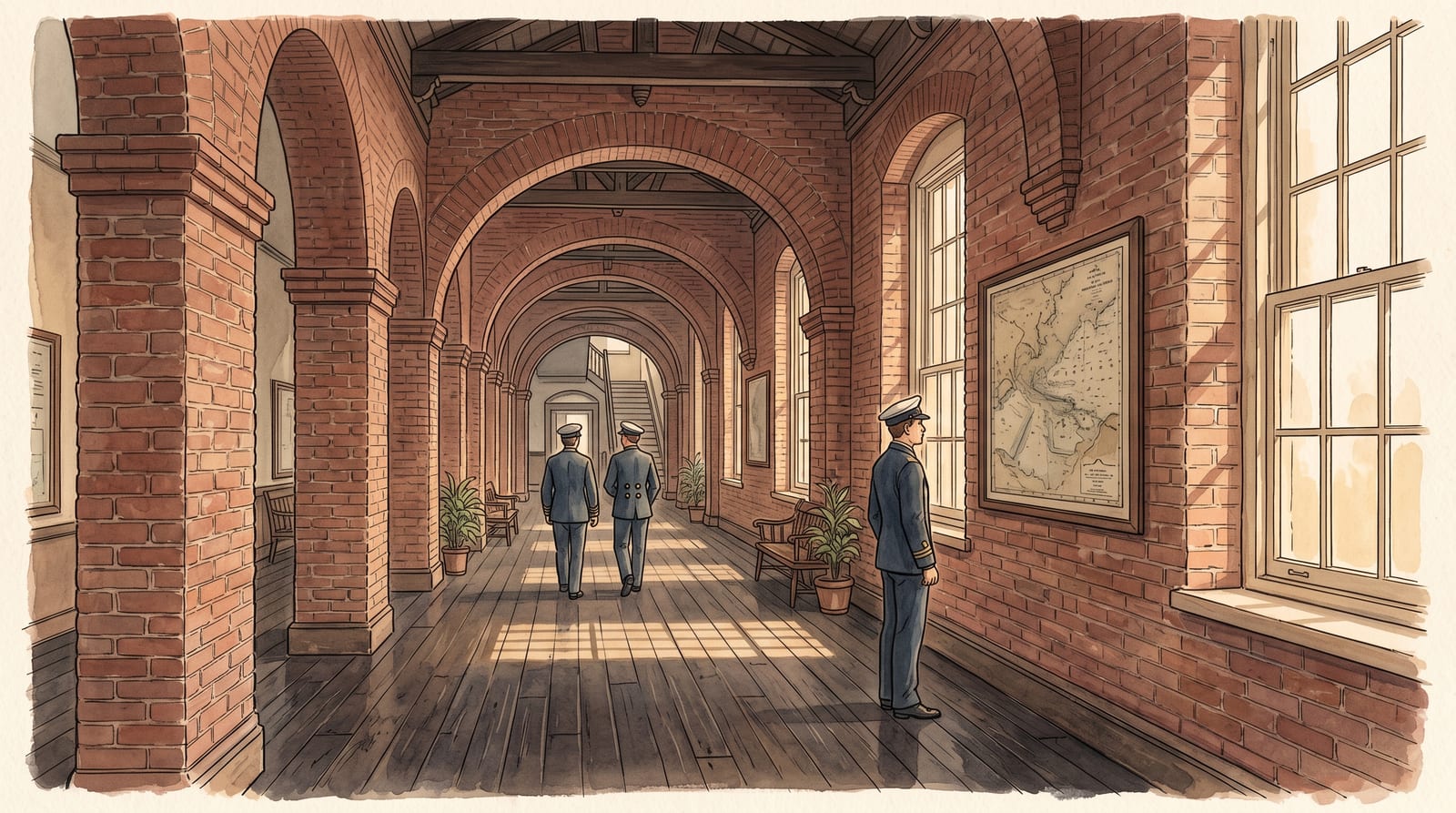
The red-brick Midshipmen's Hall (生徒館) was completed in 1893 and remains in active use as a facility building for JMSDF officer candidates. The facade stretches about 144 meters — visitors are told the length runs roughly that of a period destroyer, a Meiji-era statement of scale said to have required over a million bricks.
A cherished story holds that those bricks were imported from England, each wrapped individually in paper and carried by warship from Britain. The story is part of the building's identity, and worth knowing — it captures the ambition of the Meiji project. But its accuracy is disputed. The most rigorous Japanese architecture documentation describes the bricks as domestic (国産) and explicitly calls the England-by-warship account a 伝説 (legend). Other respected sources still assert English brick, pointing to the "English bond" (イギリス積み) laying pattern as evidence. No primary source confirms the paper-wrapping detail. What is settled: the building, in English-bond brickwork, ranks among the finest Meiji-era brick construction in Hiroshima Prefecture.
This building is the reason most people make the ferry crossing. Unlike the Yamato Museum, where history is curated into exhibits, here it is structural — in the wall thickness, the arched corridors, the worn wooden floors that every cohort since 1893 has walked. The building is not a monument to itself. It is simply still in use.
The tour passes through or adjacent to the building. What you see depends on the current training cycle, since cadets are in residence.
2. The Grand Auditorium (大講堂)
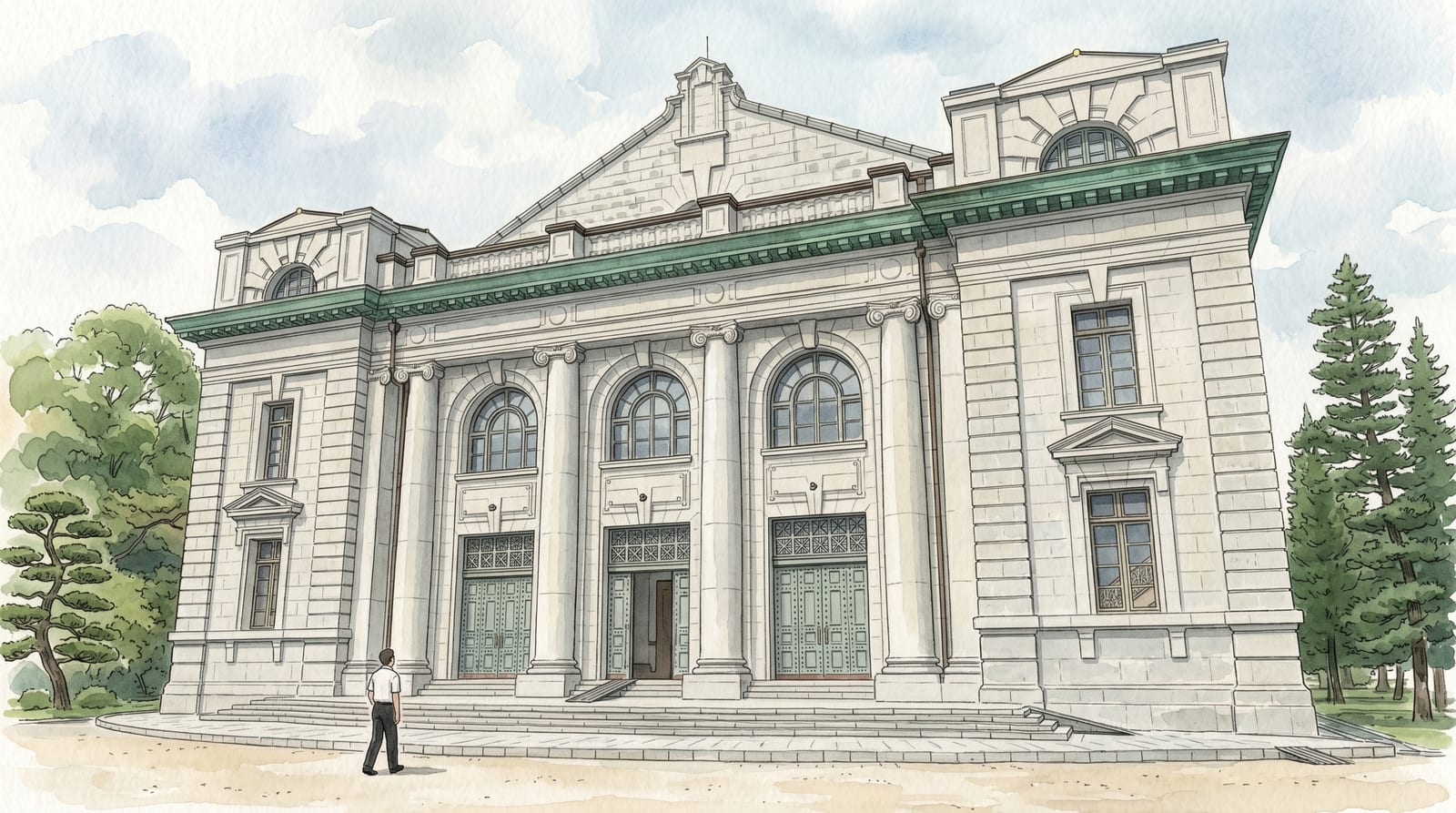
The Grand Auditorium (大講堂), completed in 1917, is faced in Seto Inland Sea granite and seats roughly two thousand people for entrance and graduation ceremonies. Visitor accounts often describe a chandelier shaped like a ship's wheel (舵輪) — a detail that circulates widely but has not been confirmed against the school's own documentation; treat it as reported rather than certified.
The scale of the building relative to the rest of the campus makes a point about what the academy considered important. This is a hall built for ceremony — for the formal transfer of authority from institution to officer — and it still functions in that role today.
3. The Educational Reference Hall (教育参考館)
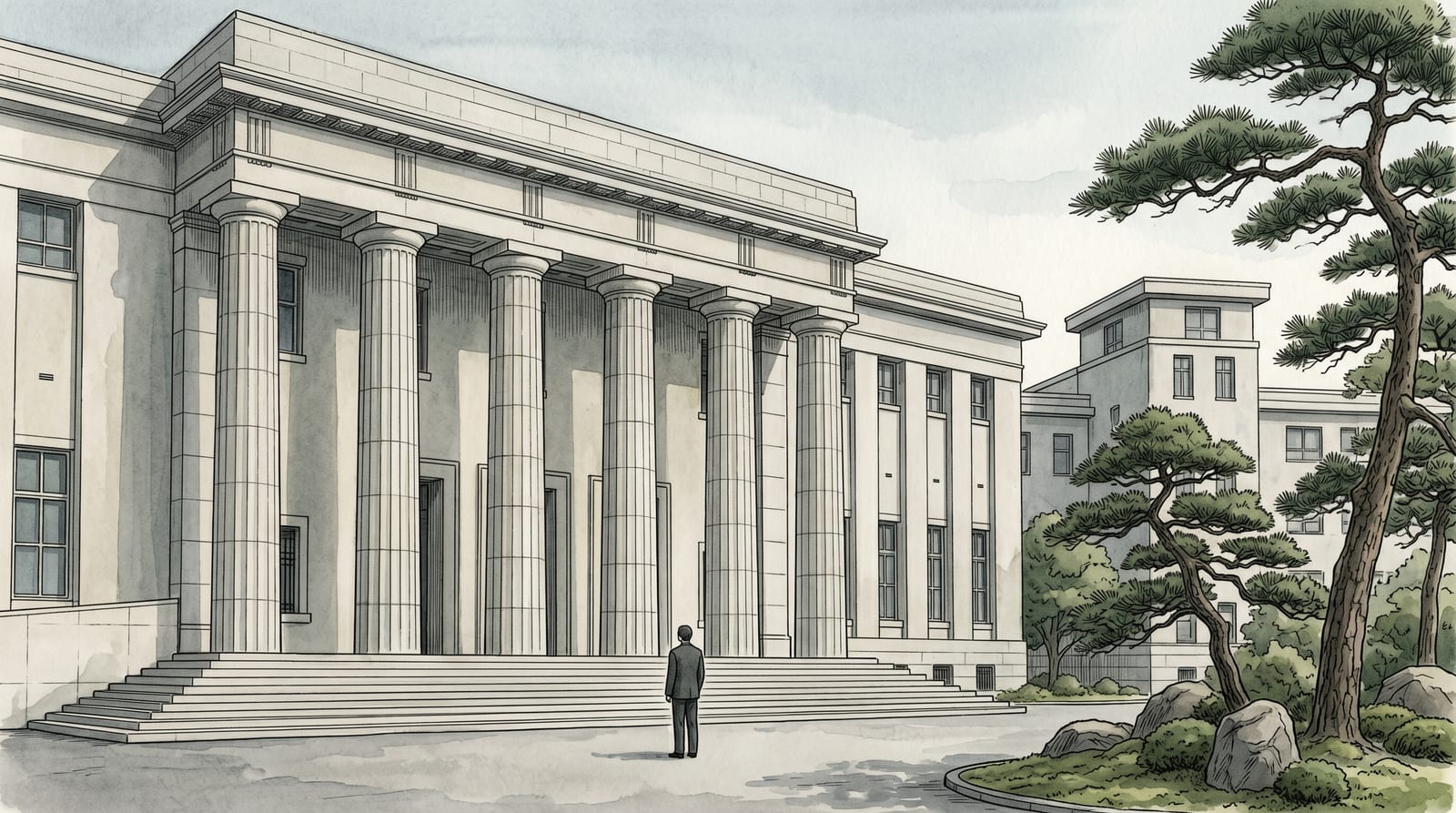
The Educational Reference Hall (教育参考館), completed in 1936, is a Greek-temple-style reinforced-concrete building funded partly by graduates' donations. The collection runs to roughly 16,000 items, with about 1,000 on display at any time, covering Meiji through WWII naval history.
At the top of the marble staircase, behind a copper door, a small reliquary chamber (遺髪室) holds an unexpected collection: a lock of hair attributed to Admiral Tōgō Heihachirō, a lock attributed to Admiral Yamamoto Isoroku — and a lock said to be from Horatio Nelson. The Nelson lock's provenance is more layered than the standard account. Most versions of the story say Admiral Tōgō attended the coronation of George V in 1911, brought back a framed lock of Nelson's hair, and donated it to the academy. According to Japanese sources, that original was lost in the postwar period; the lock displayed today was reportedly re-gifted to the JMSDF by the Royal Navy in 1981. In other words: yes, a lock of Nelson's hair genuinely sits in Japan — but not the one Tōgō carried home.
Photography is strictly prohibited inside the hall. Visitors remove hats on entry — a mark of respect that the school enforces consistently.
The holdings center on special-attack (kamikaze and kaiten human-torpedo) crew members' final letters and personal effects. These are handwritten pages from young men, some in their late teens, addressed to parents, siblings, or commanding officers — displayed with a memorial rather than triumphal intent. The hall does not offer a triumphalist reading of the wartime period; it records what happened to the people trained here. This is not sightseeing. It rewards some preparation, since both the labeling and the guide's commentary are in Japanese.
What are the tour times and how do I join?
This is the most important logistical section of this guide — read it before planning your ferry.
Tour schedule
Tour times differ between weekdays and weekends.
- Weekdays — 3 tours: 11:15–12:45, 13:30–15:00, 15:15–16:45
- Weekends and public holidays — 4 tours: 09:30–11:00, 11:15–12:45, 13:30–15:00, 15:15–16:45
There is no 09:30 tour on weekdays — the earliest weekday tour starts at 11:15. Each session runs about 90 minutes, and the official connection timetable pairs each one with a specific ferry from Kure (and Hiroshima) and the Koyō Port bus. For example, the 12:20 ferry from Kure (arriving Koyō 12:40) connects to the 13:30 tour; on weekends, the 08:46 high-speed boat connects to the 09:30 tour. Plan the boat around the tour you want — if you reach Koyō Port after the last tour of the day starts, there is nothing to join.
Tours run on designated viewing days published in a monthly calendar (見学日) on the official site, and may be cancelled for ceremonies, training, or weather. Confirm both your date and the current connection times before you travel:
Viewing days + tour times: mod.go.jp/msdf/onemss/kengaku/ Ferry/bus connections: mod.go.jp/msdf/onemss/about/facility/rensetujikoku
Operating days
Tours do not run every day — they operate on designated viewing days published in a monthly calendar (見学日) on the official site, and can be cancelled for ceremonies, training, or weather. There is no fixed weekly closed day; the monthly calendar is the source of truth. Check your date against it before you travel.
How to join as an individual visitor
Individual visitors and small groups do not need advance booking. Registration is at the main gate, from 30 minutes before the tour until the start time — you fill in a short form and are directed to the assembly point. Arrive before the start time, or you cannot enter.
You cannot enter the campus independently. Tours are guided only, and visitors cannot separate from the group or leave early.
For foreign visitors, the most important thing to know up front: the tour is conducted in Japanese only — the school does not offer foreign-language guidance. A real-time translation app helps with signage, and because there is no printed pamphlet on site, the academy suggests printing its leaflet in advance.
Group bookings
Organized tour groups are required to book in advance through the official JMSDF channel. Details are on the official JMSDF access page.
Practical tips for foreign visitors
Registration and entry
The Etajima academy is an active JMSDF training base, not a civilian attraction — you can only enter on the guided tour, and you cannot walk the campus freely or leave the group early.
Individual visitors (49 or fewer) need no advance booking — registration is at the main gate from 30 minutes before the tour (see What are the tour times and how do I join? above). The official guidance does not state a passport or photo-ID requirement for individuals, though carrying your passport at an active base is sensible. Groups of 50 or more must contact the school at least two weeks ahead (Tel 0823-42-1211).
Photography rules
Photography is permitted on the campus grounds and of the exterior buildings during the guided tour. The Educational Reference Hall is strictly no photography inside. Follow your guide's instructions on what may and may not be photographed — this is a working base, not a tourist attraction with a clear published photo policy for every corner.
Do not photograph anything you have not been explicitly told you can photograph.
Language
The tour is in Japanese only — the academy does not offer English or other foreign-language guidance. A real-time translation app (camera mode for signage and displays) is useful, and since there is no printed pamphlet on site, print the leaflet from the academy's website before you go. Download Japanese translation data offline in case island coverage is patchy.
The Educational Reference Hall's exhibits are also in Japanese. The solemn atmosphere carries even without the language; the factual context requires the app.
Walking, footwear, and dress
The tour is on foot and covers roughly 1.2–1.5 km of the campus, so wear comfortable walking shoes — the academy specifically asks visitors to avoid high heels and metal-studded shoes, and to bring rain gear in wet weather. Because this is a military education facility, the school also asks visitors not to wear tank tops, short shorts, or sandals. The route is outdoor walking and is not described as wheelchair-accessible; visitors with limited mobility should contact the school in advance.
Stay connected
Data coverage on Etajima island should be confirmed with your carrier before you go — it is a relatively rural island. If your phone plan does not include Japan data, pick up a Klook Japan eSIM eSIM before your trip.
Food, lockers, and cash
Admission is free. There is an on-site eatery, Restaurant Etajima, but it can sell out and its weekend/holiday hours are irregular — reserve ahead if you plan to eat there (operated by Ikkō, Tel 0823-42-2211). Free small coin lockers are available at the academy (no large-luggage storage). ATM access on the island is limited, so carry enough cash for the ferry and any meal before you leave Kure.
Should I combine Etajima with the Kure waterfront museums?
Yes — but only if you have a full day. The Kure waterfront cluster (Yamato Museum, Tetsu no Kujira, harbour warship cruise) and Etajima form a natural naval-history arc. The Yamato Museum tells the story of the ship, and Tetsu no Kujira puts you inside a submarine. Etajima is where the people who commanded both were trained.
The logistical connection is convenient. The Kure Chuo Sanbashi Terminal, where you board the ferry to Etajima, is 1 minute from the Yamato Museum entrance and about 5–7 minutes from JR Kure Station. You can spend the morning at the museum cluster and cross to Etajima in the early afternoon — provided the Etajima tour schedule supports it.
The constraint is time. The Yamato Museum alone merits 2–3 hours; the Tetsu no Kujira runs 60–90 minutes; the Etajima tour is 90 minutes plus travel. That is a full seven or eight hours minimum, and it does not include lunch.
| Yamato Museum | Etajima Naval Academy | |
|---|---|---|
| Focus | Naval shipbuilding history, WWII, Battleship Yamato | Naval officer training institution, 1888–present |
| Admission | ¥1,000 | Free |
| Time needed | 2–3 hours | ~90 minutes + travel |
| Highlight | 26.3m, 1:10 scale model of Yamato; Zero fighter; Kaiten torpedo | 1893 red-brick Midshipmen's Hall; Educational Reference Hall |
| Atmosphere | Quiet, curated museum; open to all without booking | Active military campus; guided-only; predominantly Japanese language |
| Best for | Anyone interested in naval or WWII history, families, first-time Kure visitors | Naval history enthusiasts with a full day, those drawn to the human stories of officer training |
Note also: the Yamato Museum and Tetsu no Kujira are closed on Tuesdays — as is Kure Haikara Shokudou. Any day-plan that combines both the Kure cluster and Etajima should not be scheduled on a Tuesday.
Half-day vs full-day: Sample itineraries from Hiroshima
These plans assume the official tour times have been confirmed from mod.go.jp/msdf/onemss/about/facility/rensetujikoku before your departure. Do not finalize ferry bookings without first confirming the Etajima tour schedule.
Quick Visit
Etajima only, from Hiroshima via Kure — weekend/holiday 09:30 tour (weekday earliest is 11:15)
- Depart Hiroshima Station, JR Kure Line rapid (~35 min)
- Arrive Kure; walk ~5 min to Kure Chuo Sanbashi Terminal
- High-speed boat to Koyō Port (arrives 08:56)
- Connecting bus or taxi to 第1術科学校前 (~10 min)
- Guided tour (register from 30 min before)
- Return bus to Koyō; 11:55 ferry back to Kure
- Back in Kure for lunch or onward to Hiroshima
Best Balance Recommended
Yamato Museum morning + Etajima afternoon
- Depart Hiroshima Station, JR Kure Line rapid
- Arrive Kure; walk 5 min to Yamato Museum (open 09:00)
- Yamato Museum: scale model, Zero fighter, history exhibition (~2.5 hours; admission ¥1,000)
- Quick lunch near Yamato Museum (Kure Haikara Shokudou, 1–2 min walk, open from 11:00, closed Tuesdays )
- Walk 1 min to Kure Chuo Sanbashi Terminal ; 12:20 ferry to Koyō Port (~20 min, ¥450)
- Connecting bus or taxi to 第1術科学校前 (~10 min)
- Guided tour
- Return bus to Koyō; 15:35 ferry back to Kure (arrives ~15:55)
- Optional: Tetsu no Kujira (free, last entry 17:30, closed Tuesdays )
- Train back to Hiroshima
Full Naval History Arc
Kure cluster + Etajima + warship cruise
- Day 1: Yamato Museum (morning) + kaigun curry lunch + Tetsu no Kujira (afternoon) + optional Kure harbor warship cruise (¥2,200 per adult, no lottery)
- Day 2: Catch the 08:46 boat from Kure for the 09:30 Etajima tour; back in Kure by about 12:15; if you won the JMSDF open-ship lottery, the afternoon viewing is 13:30–15:00
- Stay: One night in Kure — Rakuten Travel Kure hotels for current availability near the waterfront
Historical context: The officers of Etajima
The academy was designed to be isolating. Cadets arriving at Etajima were separated from civilian life by the water around them, placed in a highly structured environment, and trained in a culture that foregrounded duty and self-discipline. The curriculum covered navigation, gunnery, engineering, and English — a legacy of the Douglas mission's insistence that language competency was part of the gentleman-officer ideal.
One of the institution's most enduring discipline rituals was codified in 1932, when Commandant Matsushita Hajime wrote the 五省 (Five Reflections): five questions recited by cadets each evening after a bugle call, in the five minutes before the end of evening study — Have I been sincere? Have I been worthy in my words and actions? Have I acted with courage? Have I worked with full effort? Have I been diligent? The JMSDF still observes this ritual today. It is reportedly also adopted at the United States Naval Academy at Annapolis, where an English rendering is said to be recited — though that claim, widely repeated in Japanese accounts, has not been confirmed by a U.S. Naval Academy primary source.
Some of the most significant figures in Japanese naval history trained at Etajima: Isoroku Yamamoto, who planned the attack on Pearl Harbor and later commanded the Combined Fleet, graduated from the academy in 1904.
The institution was not primarily a place of ideology; it was a professional school that happened to exist within a period when Japan's military strategy would lead to catastrophic consequences.
The Educational Reference Hall holds materials that engage with the end of the academy's imperial era honestly, including records of graduates who died in special attack missions. The language of the exhibits does not celebrate these deaths; it records them. For visitors who come to the Pacific War from outside Japan, understanding the institutional context — that these were trained professionals, not anonymous combatants — adds a different dimension to what the museums in Kure document in hardware terms.
The JMSDF's First Service School continues in the same buildings with a different mandate: training officers for a self-defense force operating within Japan's postwar constitutional framework, with an institutional culture that has had to consciously navigate its own historical inheritance. The academy's own materials describe this history with the phrase "importance of peace" — a framing that is visible in how the Educational Reference Hall presents its exhibits, and in the measured tone of tour guides.
FAQ
Is the Etajima Naval Academy tour free?
Yes — admission is free. The tour is guided-only and runs approximately 90 minutes. Individual visitors do not need to book in advance; registration is at the main gate from 30 minutes before the tour. Only groups of 50 or more are required to book ahead.
Can I visit without a booking?
Yes, as an individual or small group. Walk up to the gate before a scheduled tour, register, and join. You cannot walk the campus independently and you cannot leave the tour early.
What are the tour times?
Tour times differ by day: weekdays have three tours (11:15–12:45, 13:30–15:00, 15:15–16:45); weekends and public holidays have four, adding a 09:30–11:00 tour. There is no 09:30 tour on weekdays. Each runs about 90 minutes, in Japanese only, and connects with a specific ferry from Kure. Tours run on designated viewing days — check the monthly 見学日 calendar at mod.go.jp/msdf/onemss/kengaku/ and the connection timetable before you travel.
Do I need a passport to enter?
The official tour guidance does not list a passport or photo-ID requirement for individual visitors. You fill in a reception form at the main gate (available from 30 minutes before the tour). Carrying your passport is still sensible at an active base, but it is not stated as required. Groups of 50 or more must arrange the visit in advance.
Can I take photos?
Photography is generally permitted on the campus grounds and of exterior buildings during the guided tour. The Educational Reference Hall is strictly no photography inside. Follow your guide's instructions — this is an active military base.
Is the tour in English?
No. The official guidance states tours are conducted in Japanese only — no foreign-language guidance is offered. A real-time translation app (camera mode for signage) is useful, and the academy suggests printing the leaflet from its website in advance, since there is no pamphlet on site. The Educational Reference Hall's exhibits are also Japanese-only.
How long should I allow for the whole day from Hiroshima?
A round-trip from Hiroshima covering Etajima alone takes about 5–6 hours. If you combine it with a morning at the Yamato Museum cluster in Kure, allow 8–9 hours minimum. A two-day itinerary is the most relaxed option and gives time for the Kure harbor warship cruise as well.
What is the ferry fare and journey time from Kure?
The Setonaikaikisen ferry from Kure Chuo Sanbashi Terminal to Koyō Port takes approximately 20 minutes and costs ¥450 per adult. A high-speed boat is approximately 10 minutes and ¥650.
Is a JR Pass useful for this trip?
A JR Pass covers the Hiroshima–Kure train fare (about ¥510 each way) but not the ferry to Etajima. The pass is not cost-effective for the Hiroshima–Kure–Etajima route alone. If Etajima is part of a broader Japan trip involving Shinkansen travel, Japan Rail Pass may still make sense as part of bundling the wider itinerary — but it should not be purchased specifically for this day.
Related guides
More in our Kure naval-history series:
- Hiroshima day trips, compared — where the naval-history route fits among the alternatives
- Yamato Museum complete guide — the 1:10 scale model and the 2026 reopening
- JMSDF Kure Museum (Tetsu no Kujira) — walk through a real submarine
- Kure harbour warship cruise — see the active fleet without the lottery
- JMSDF Kure open-ship days — how to win the lottery and board an active warship
- Hiroshima to Kure day trip — full transport and itinerary guide
- Kure naval curry guide — every JMSDF-certified ship recipe in Kure
- In This Corner of the World locations — pilgrimage map for the 2016 film
Last visited: 2026-06 | Author: Masayuki Ogasahara | Illustrations generated with AI (Gemini) using real reference photographs. The Students' Hall, Grand Auditorium, and Educational Reference Hall illustrations are AI watercolor renderings derived (image-to-image) from Wikimedia Commons reference photos: Officer Candidate School, former Naval Academy by Japan Ministry of Defense, CC BY 4.0; Naval Academy Auditorium by HKT3012, CC BY-SA 4.0; and Naval History Museum, Etajima by Sanjo, CC BY-SA 3.0. This article contains affiliate links to GetYourGuide, JRPass.com, Klook, and Rakuten Travel. We may earn a small commission at no extra cost to you. Operational information — tour times, Japanese-only guidance, registration, walking distance, dress code, fares, and on-site facilities — was confirmed against the official JMSDF 見学案内/Q&A and Setonaikaikisen in June 2026. Tours run on designated monthly viewing days and can be cancelled, so verify your date and the current connection times on the official site before your visit.


