
This post contains affiliate links. We may earn a small commission at no extra cost to you.
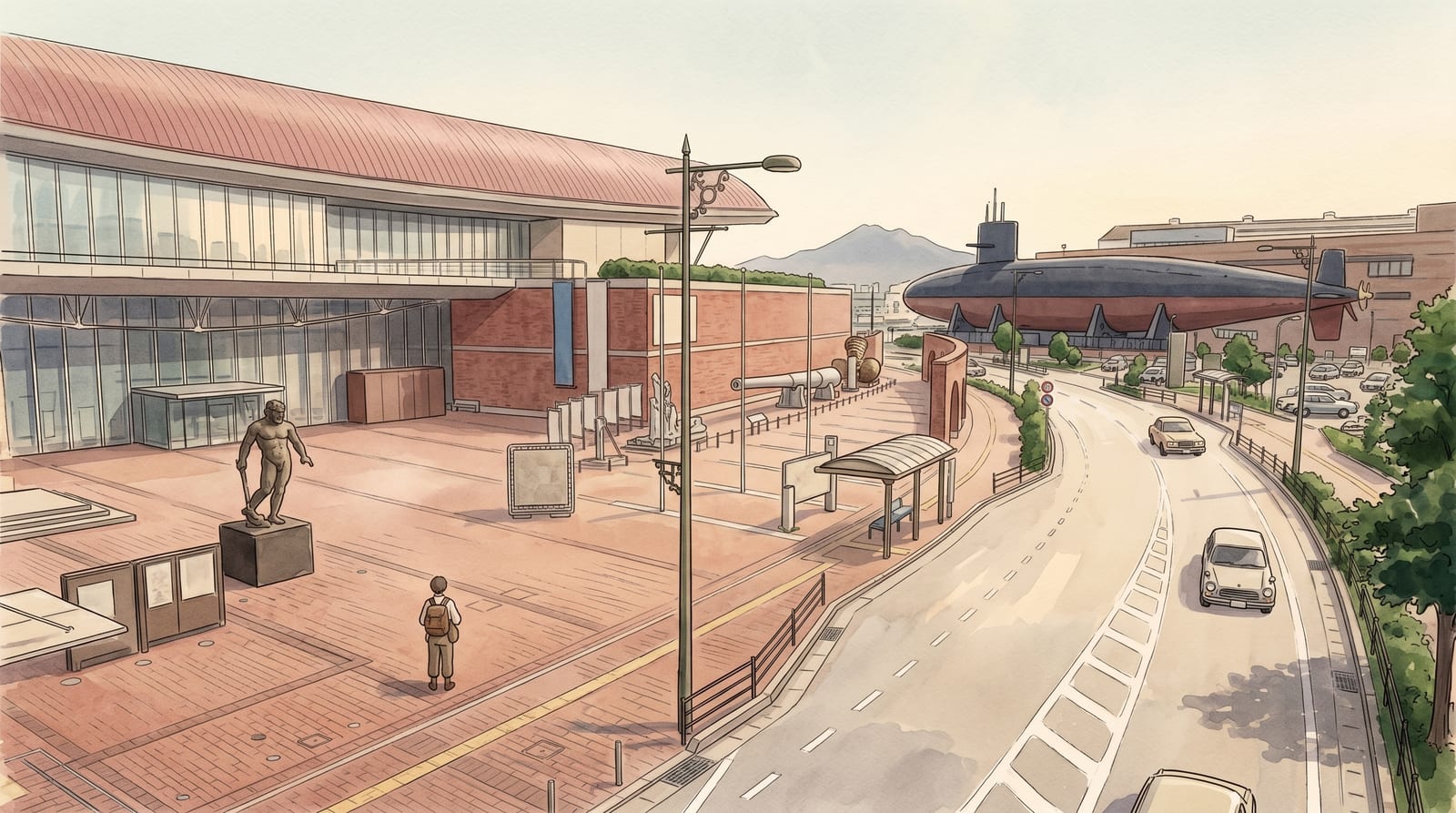
At some point during your walk through the JS Akishio's interior, you crouch through a hatch into the command center and realise you are standing at the helm of a real submarine — one that dove beneath the Pacific until 2004. The periscope is live: press your eye to the eyepiece and you can see Kure harbour framed in that narrow circle of glass, the same view a crew of 75 once had. It is the kind of moment a photograph cannot hold, which is probably why the JMSDF Kure Museum draws a consistent stream of visitors despite its almost total absence from the standard Hiroshima day-trip circuit.
If you are staying in Hiroshima and want a quieter, more local side trip than Miyajima, Kure is one of the easiest and most meaningful half-day trips you can take. The JMSDF Kure Museum adds a sharp counterpoint to the wartime lens of the nearby Yamato Museum: where that museum looks backward at what was lost, this one is about what was built in the decades after — a defence force, a minesweeping corps, and a submarine fleet that most foreign visitors know nothing about. We spent a morning here in May 2026. Here is what to spend time on, and what you can skim.
- Location
- 5-32 Takaramachi, Kure, Hiroshima 737-0029
- Admission
- Free (operated by the Japan Maritime Self-Defense Force)
- Opening hours
- 10:00 AM–6:00 PM (last entry 5:30 PM); closed Tuesdays and December 29–January 3
- From JR Kure Station
- 5-minute walk (about 400 m)
- From Hiroshima Station
- About 35 minutes by JR Kure Line rapid (IC fare ¥510)
- Centrepiece
- JS Akishio (SS-579), Yushio-class submarine, 76.2 m, commissioned 1986, decommissioned 2004
- Nearest museum
- Yamato Museum, 2-minute walk south (¥1,000)
What is the JMSDF Kure Museum and why does it matter?
The Japan Maritime Self-Defence Force Kure Museum (海上自衛隊呉史料館, Kaijō Jieitai Kure Shiryōkan), officially nicknamed Tetsu no Kujira (てつのくじら館, "Iron Whale Museum"), is a public education facility operated by the Japan Maritime Self-Defense Force.
It opened on April 5, 2007, on the Kure waterfront, directly across from the Yamato Museum. The name comes from its centrepiece: the JS Akishio (SS-579), a Yushio-class diesel-electric submarine permanently installed beside the museum building — making this the only place in Japan where you can walk the interior of a real submarine on dry land.
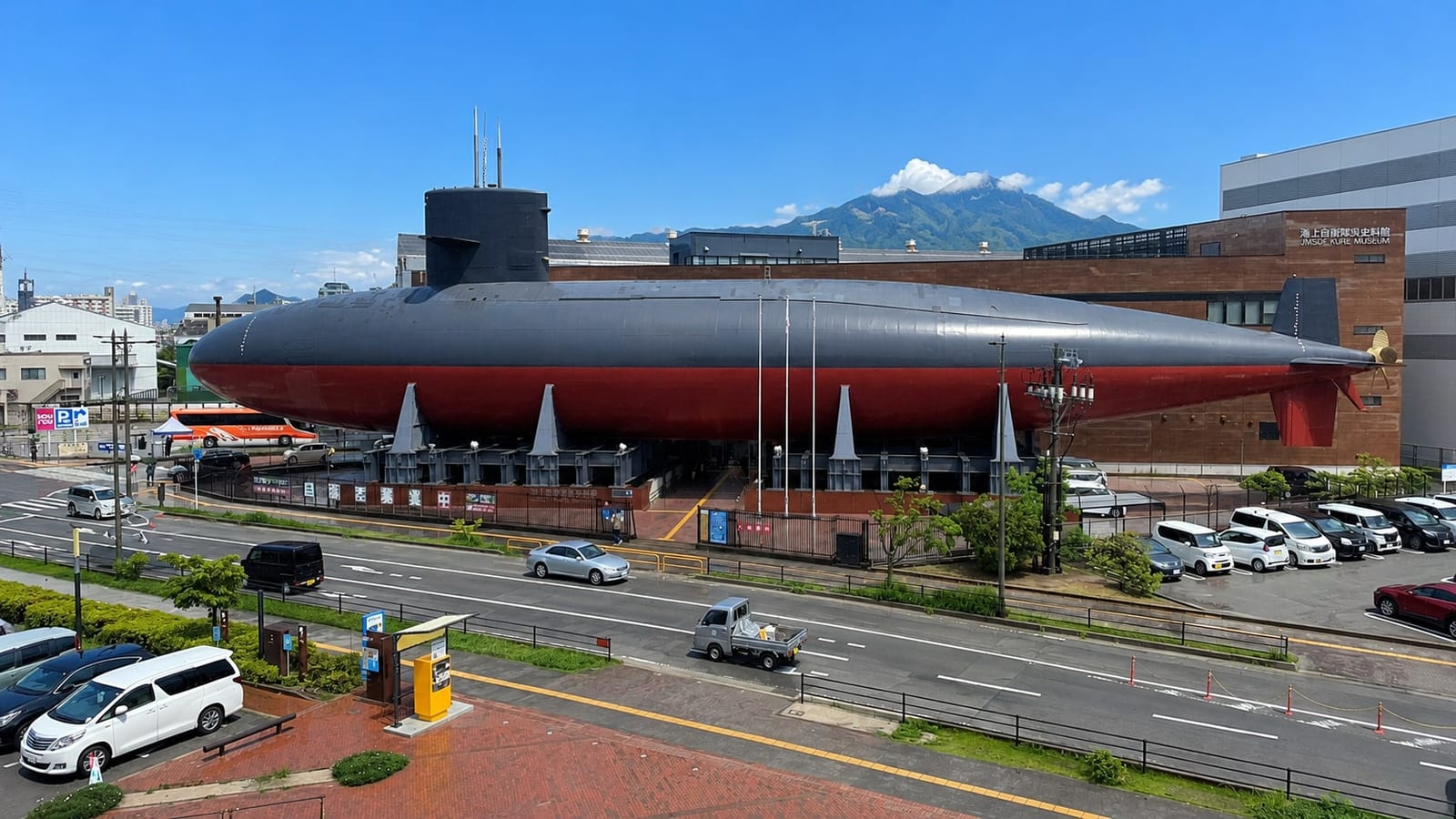
You cannot miss it from the station-side walkway: the whole 76-meter boat sits in the open, raised on cradles, and it reads more like a beached whale than a museum exhibit — which is exactly where the nickname comes from.
The museum has three floors. Floors 1 and 2 cover JMSDF history and, especially, the history of mine countermeasures — the often-overlooked story of how Japanese naval forces spent years after World War II clearing the mined waters around Japan's coast, a task that shaped what the JMSDF became. Floor 3 covers submarine operations and connects directly to the Akishio. Admission is entirely free.
The JMSDF also operates two sister museums: one in Kanoya, Kagoshima (aircraft focus) and one in Sasebo, Nagasaki (surface ships). The Kure museum is the submarine and minesweeping branch of that three-part national memory project.
How do I get to the JMSDF Kure Museum from Hiroshima?
The museum is at 5-32 Takaramachi, Kure, Hiroshima 737-0029, a 5-minute walk (roughly 400 meters) south of JR Kure Station along the waterfront pedestrian route.
By train (recommended)
The JR Kure Line runs from Hiroshima Station to Kure Station. Rapid trains take about 35 minutes; local trains take about 50 minutes. The IC card fare is ¥510 each way. Trains depart every 20–30 minutes during daytime.
A JR Pass is not worth it for the Hiroshima–Kure ride alone — the single IC fare is about ¥510 each way. But if Kure is part of a wider Japan itinerary that includes Shinkansen travel, Japan Rail Pass can still be the most economical way to bundle the entire trip.
By ferry (scenic alternative)
Setonaikaikisen operates a passenger ferry from Hiroshima Port to Kure Chuo Sanbashi (the central pier terminal). Journey time is approximately 45 minutes, fare approximately ¥1,100 for adults. The JMSDF Kure Museum is a 3-minute walk from the pier.
This is worth considering if you're starting from the Hiroshima Peace Park area (which is closer to Hiroshima Port than Hiroshima Station) or simply want to arrive by water.
By bus
Hiroshima Bus runs limited-express coaches from Hiroshima Bus Center to Kure Station Bus Terminal. Journey time is approximately 55 minutes. Less frequent than the train, but useful if you're starting from the Peace Park area or central Hiroshima.
By car
The Hiroshima-Kure Expressway connects the cities in about 40 minutes. The museum itself does not have a dedicated parking lot — the official site directs visitors to use the Kure Central Pier Terminal parking or other nearby paid lots. The adjacent paid lot shared with the Yamato Museum (67 spaces, ¥100 per hour) is within a few minutes' walk.
Guided alternative
If you'd rather skip the logistics — especially if your group doesn't speak Japanese — GetYourGuide Kure day tour runs private day tours from Hiroshima that include round-trip transport and an English-speaking guide covering both Kure museums.
What can I see inside the JMSDF Kure Museum?
The museum has three floors plus the Akishio submarine, accessible from Floor 3. Most visitors spend 60–90 minutes here, though submarine enthusiasts regularly spend longer. We'd suggest starting at Floor 1 and working up.
Floor 1: JMSDF history and the road from 1945
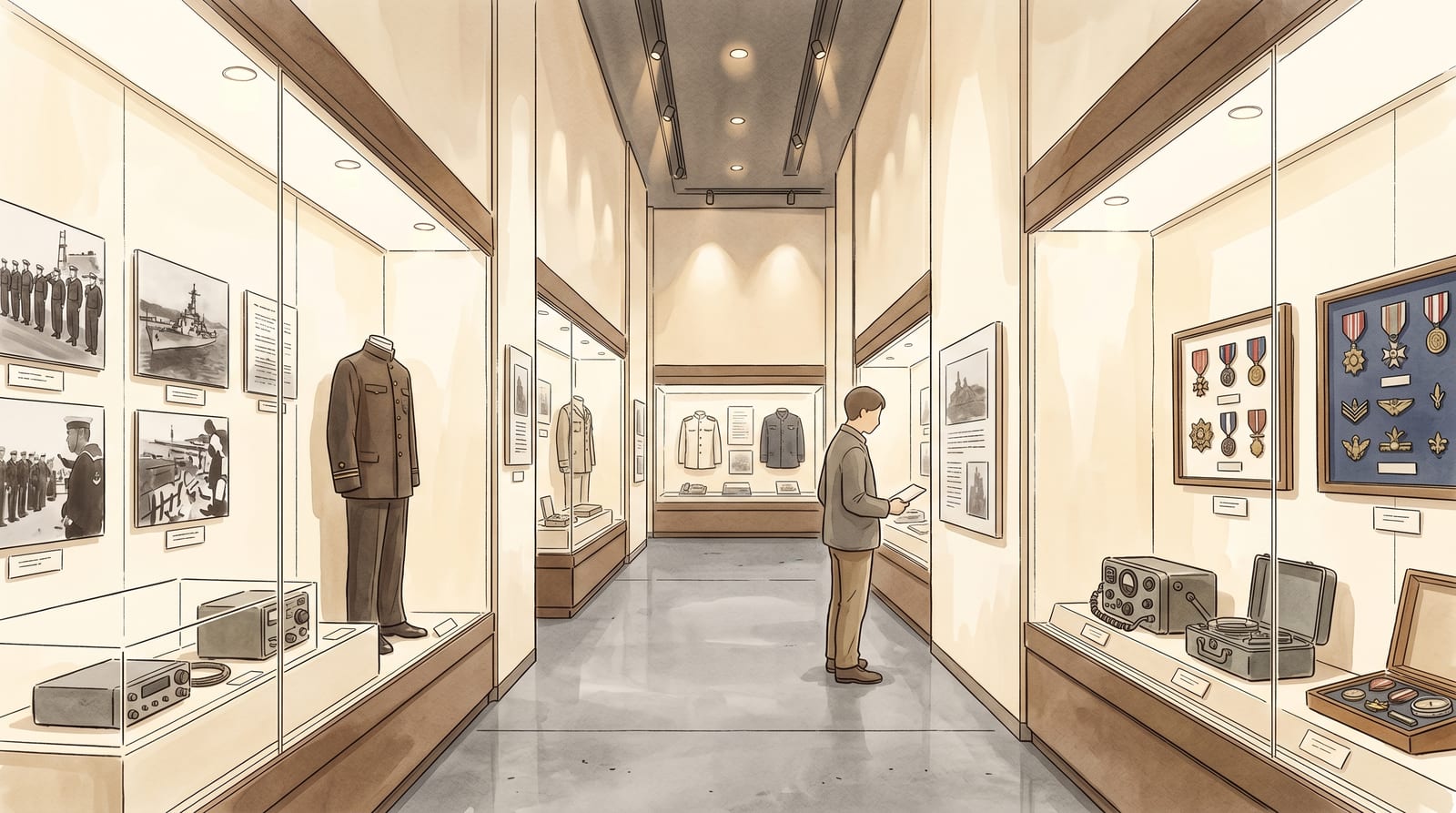
The ground floor tells the story of the Maritime Self-Defense Force from its founding through to the present day. The exhibits cover Japan's postwar security framework, the JMSDF's structure and fleet, and early equipment — much of it sourced from the United States under the Mutual Security Act.
The English QR code guides here are genuinely useful: scan the code beside each exhibit with your smartphone camera and you get a short English explanation. It's not as seamless as a dedicated audio guide, but it covers the key points.
For most international visitors, this floor functions as useful context rather than the main attraction. Spend 20–30 minutes here before heading up.
Floor 2: The minesweeping story
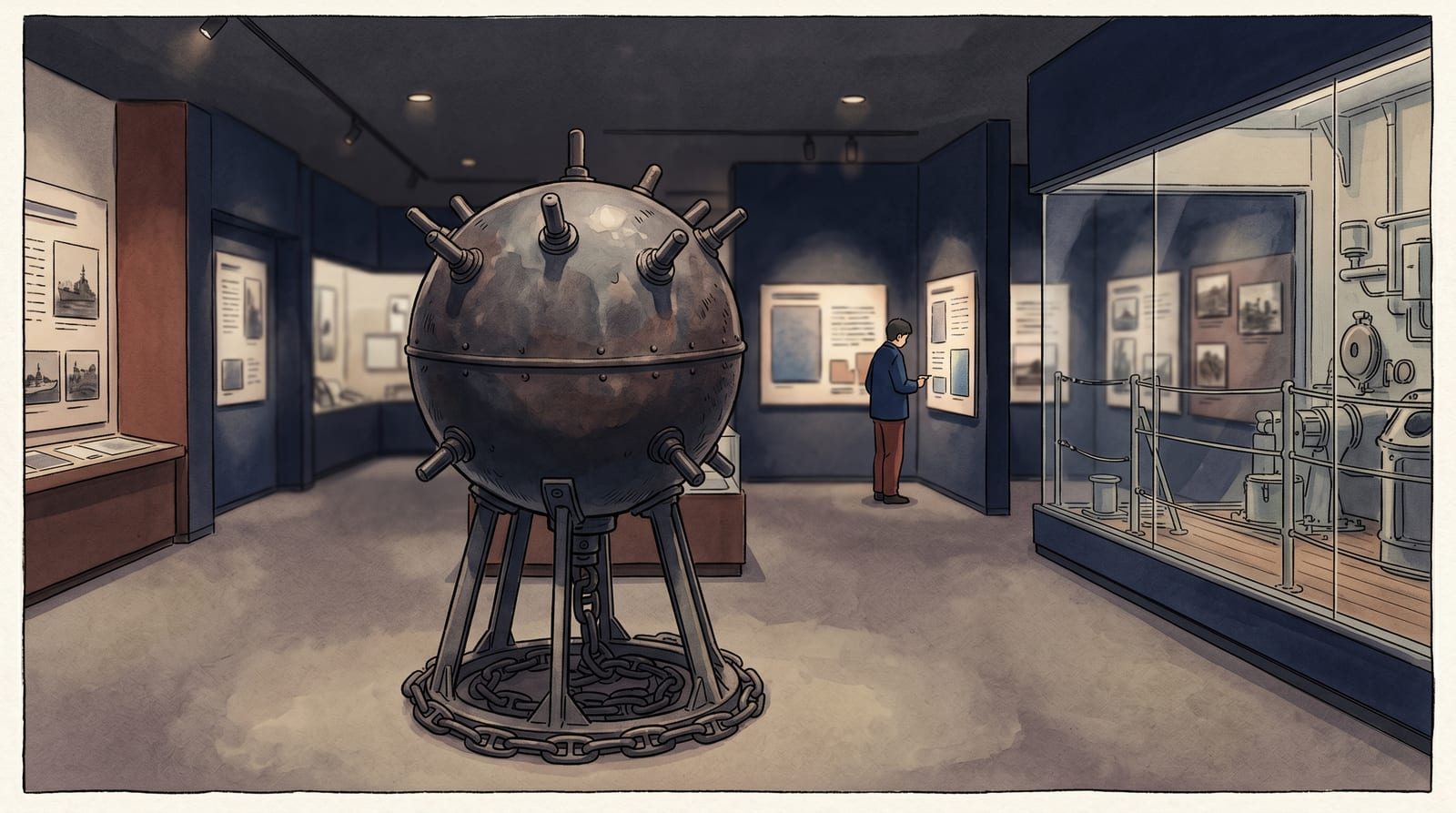
If you only have time to skim: the mine reproductions are on the right, the Korea 1950 story is on the left — the left side takes longer.
This floor is the museum's most distinctive exhibit and the one most foreign visitors skim past. That is a mistake — and not only because of the full-scale mine reproductions.
By August 1945, Allied forces had seeded Japan's coastal waters with an estimated tens of thousands of mines (commonly cited around 66,000 ) — an operation that effectively closed the country's ports and paralysed fishing and supply chains. When the war ended, Japan had to clear them using converted fishing boats and whatever ex-navy vessels were available. In some documented cases, crews triggered mines deliberately at close range — what the museum labels "sacrifice minesweeping." The effort ran from October 1945 until a nationwide safety declaration in 1952, at a cost of roughly 78–79 lives. Their names are inscribed on a monument at Kotohira-gū shrine in Kagawa — a roughly 6-metre memorial raised in June 1952, with the calligraphy of Prime Minister Yoshida Shigeru, where an annual service is still held on the last Saturday of May. (The memorial is not in Kure — it is an off-site counterpart to what the museum's floor exhibits.)
The floor's deeper story — almost entirely absent from English-language travel coverage — concerns what happened in autumn 1950, before the coastal clearance was even complete.
On October 2, 1950, U.S. Admiral Arleigh Burke requested Japan deploy minesweepers to the Korean War. A formal GHQ/SCAP order followed within days. The result was the 日本特別掃海隊 (Japan Special Minesweeping Unit): roughly 46 minesweepers, one large trial ship, and about 1,200 former Imperial Navy men — organised under the Japan Coast Guard, because the JMSDF would not be founded for another four years. The ships removed their Japan Coast Guard markings and flew SCAJAP flags rather than the national ensign, a deliberate arrangement that obscured Japan's participation and navigated the constitutional constraints of a nominally demilitarised country fighting in a shooting war. The Tokyo government classified the entire deployment. The public was told nothing.
From October to December 1950, the force swept approximately 327 kilometres of channels and 607 square kilometres of anchorages off Wonsan, Incheon, Chinnampo, and Kunsan, disposing of at least 27 mines.
On October 17, 1950, at around 15:21, the minesweeper MS14 (第14号掃海艇) — the vessel nearest the shore, passing off the Korean island of Yeido near Wonsan — struck a mine and sank. Galley chief Nakatani Sakatarō (中谷坂太郎), who had gone below to the after galley, was killed. Eighteen others were wounded; the surviving crew were rescued by a U.S. landing craft. His family received around ¥4 million in compensation from the U.S. side. One family account, published decades later, described the payment as accompanied by an expectation of silence — a characterisation the official record neither confirms nor refutes. The Kotohira-gū memorial received his name in 1952, with no public disclosure of how he died. A posthumous decoration was added in the 1979 war-dead honours. No public announcement accompanied it. Nakatani is today often described as the only Japanese person killed in a combat-zone military operation since 1945 — sources split between "only" and "first," so the superlative is worth holding lightly — but the underlying facts are not disputed.
The exhibits include full-scale reproductions of different mine types used in Pacific conflict, a section of actual minesweeper deck, and the history of Japan's minesweeping contribution to the First Gulf War in 1991 — the JMSDF's first operational deployment outside Japanese waters. Modern remotely-operated vehicles (ROVs) used for current mine disposal are also on display.
Plan 30–40 minutes here. The Gulf War section alone tends to surprise visitors who know little about Japan's post-1990 defence posture. The 1950 section, for those who slow down to read it, tends to follow them home.
Floor 3 and the Akishio submarine: The main event
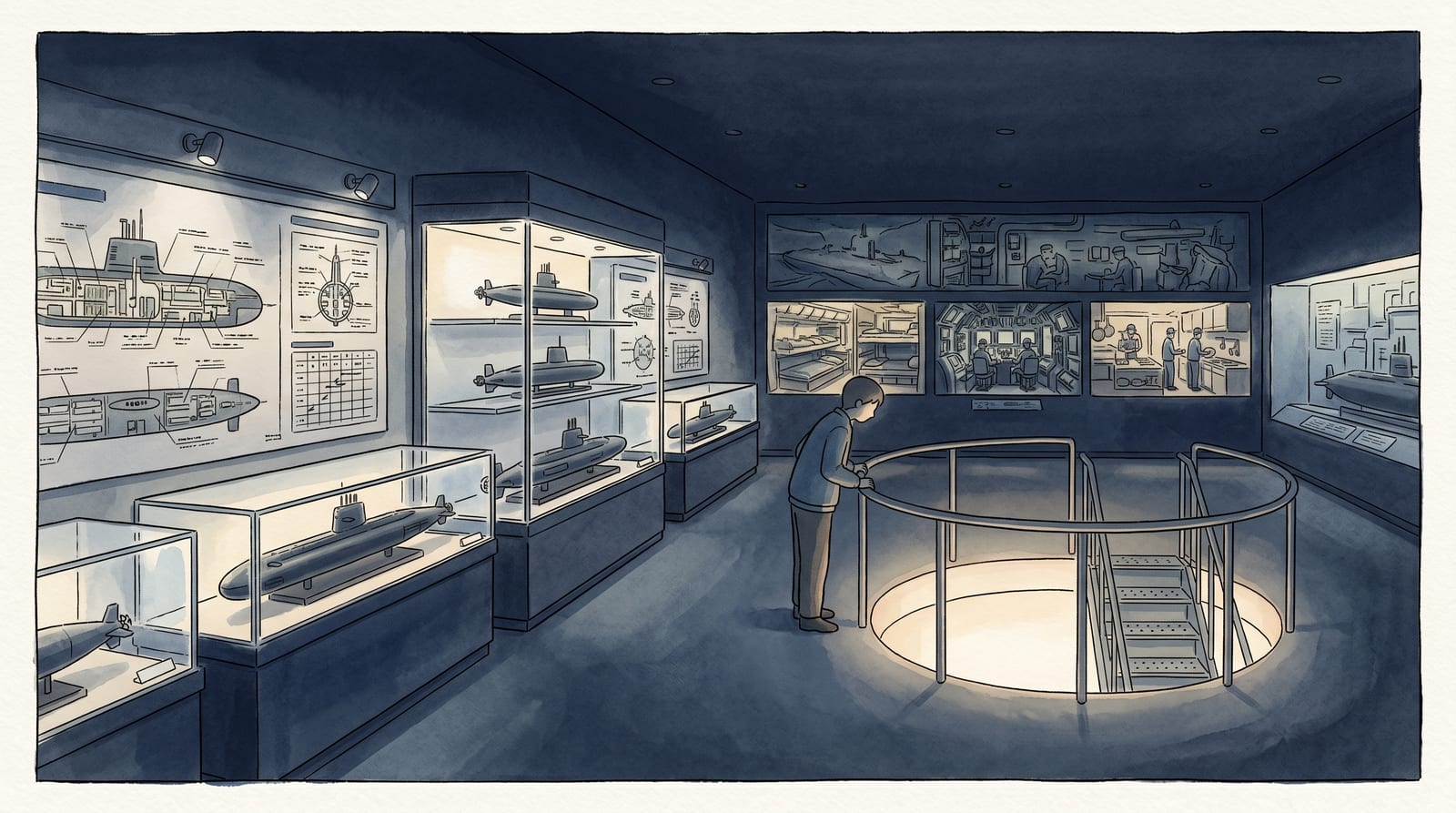
Floor 3 is mostly preamble — submarine history, crew-life dioramas, and displays on submarine rescue operations — but follow it to the end and you reach the connecting corridor into the JS Akishio herself. That corridor is the real draw.
The Akishio (SS-579) is a Yushio-class diesel-electric submarine — a second-generation design developed from the earlier Uzushio class, with a teardrop hull for improved underwater performance. She is 76.2 meters long, with a beam of 9.9 meters and a standard displacement of 2,250 tons surfaced.
Her service history: keel laid April 1983 at Mitsubishi Heavy Industries' Kobe shipyard, launched January 22, 1985, commissioned March 5, 1986. She was decommissioned on March 3, 2004. What followed is the museum's nickname for it: 空飛ぶ潜水艦 — "the flying submarine."
On September 24–25, 2006, the 76-metre hull was towed from the dockyard to the Kawarahishi West Pier, lifted clear of the water by one of Japan's largest floating cranes, set down on a special multi-axle trailer dolly, and driven through Kure's public roads in the small hours to its current position beside what would become the museum building. The museum opened on April 5, 2007 — the submarine already in place.
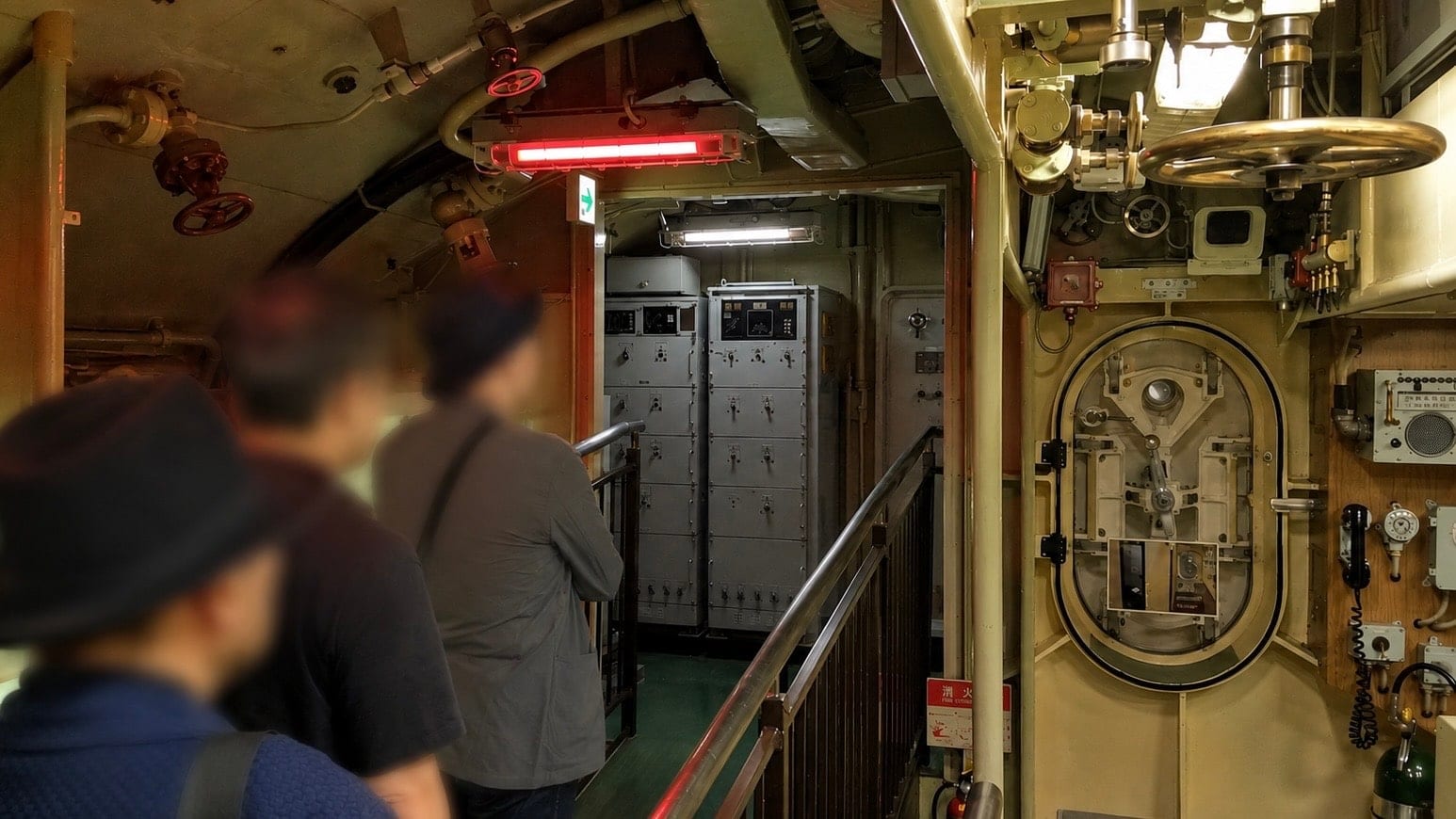
Visitors follow a one-way route through the interior. The spaces open to visitors include the captain's cabin, officers' quarters, the command center (cockpit), and two working periscopes. The periscopes offer a live view over Kure harbour. The helm seat in the cockpit is a popular photo spot.
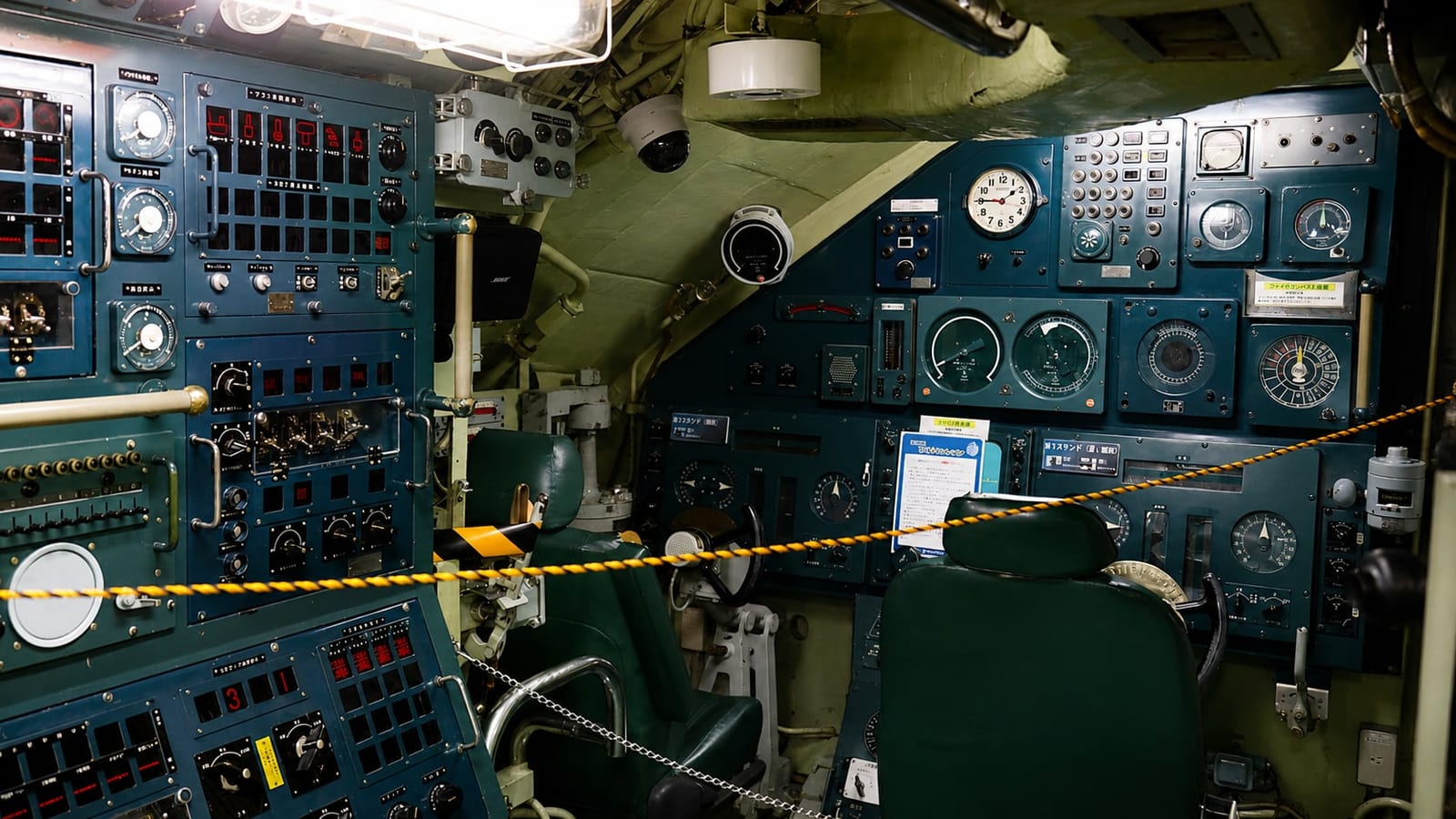
A practical note: the passages are narrow and low in places. Tall adults — roughly above 175cm — will need to duck at several points. This is not a limitation, just the physical reality of a 1980s military submarine designed for efficiency, not tourism.
Practical tips for foreign visitors
The museum is designed with international visitors in mind, but a few things help.
English support
No staff-led English tours operate here (unlike the Yamato Museum's Sunday morning English-volunteer tours). The English support is self-service: QR code guides at each exhibit link to English text on your smartphone, and free multilingual pamphlets (English, Traditional Chinese, Simplified Chinese, Korean, French, Spanish, Portuguese) are available at the entrance.
About half the exhibit panels have Japanese text only, so the QR system matters more here than at the recently renovated Yamato Museum. Bring a phone with a working camera and a data connection, or pick up a SIM beforehand.
Photography
The control room and periscope stations are frequently described as popular photography spots, and visitor accounts consistently report photography being permitted throughout the submarine. Flash and tripods are typically restricted in Japanese military museums, so check the posted notices on arrival for the current policy.
Accessibility
The Akishio submarine interior is entered through a narrow submarine hatch and follows a one-way route with steep internal steps, so it is not realistically wheelchair accessible. Visitors with limited mobility can still see the three museum-building floors. We recommend confirming current elevator and accessibility arrangements with the museum directly before your visit.
The café
The museum building has an on-site café (described as a "coffee lounge" on the official site). The signature item is the Akishio Curry — a submarine-shaped curry dish approved by the Akishio's tenth commanding officer. Café last orders are at 5:00 PM. This is a good option for a light lunch if you're visiting Tetsu no Kujira before the Yamato Museum and want to eat between stops rather than walking to Akarenga Doori.
Cash and the surrounding area
The museum itself is free, and the Akishio café is cash only — cards are not accepted. Restaurants in the immediate area — especially older curry shops near Akarenga Doori — are frequently cash-only. For foreign-card ATMs, the convenience stores around the museum plaza and Kure Station are the most reliable option — the same area that serves the Yamato Museum.
Stay connected
If your phone plan doesn't include data in Japan, pick up a Klook Japan eSIM eSIM before your trip. The QR code exhibits work best with a live data connection, and the museum does not provide public Wi-Fi for visitors.
Should I combine it with the Yamato Museum?
Almost certainly yes. The two museums are about a 2-minute walk apart across a shared plaza, facing each other across Takaramachi street.
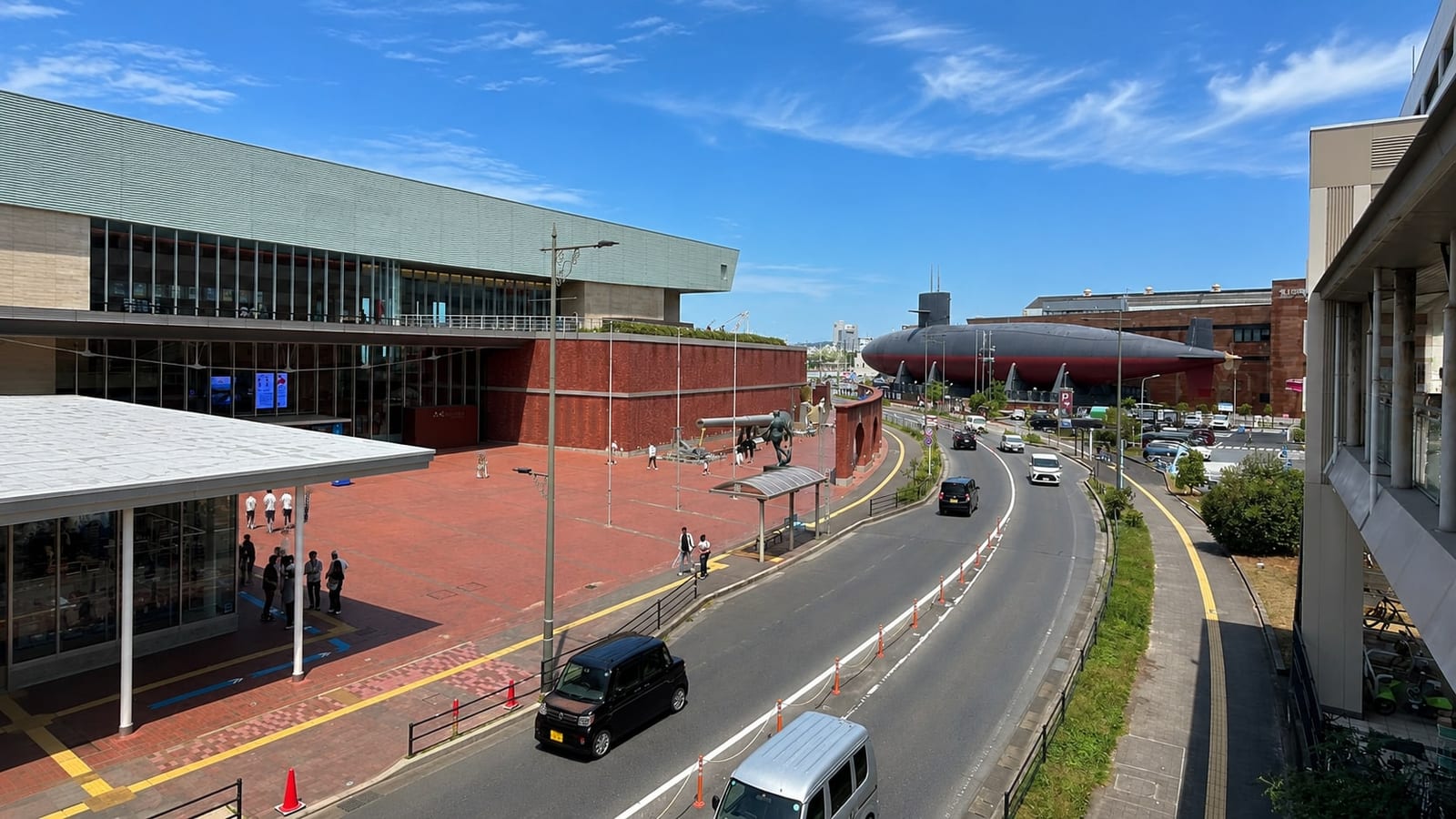
What makes the pairing particularly satisfying is the temporal contrast: the Yamato Museum centres on the loss of 1945 — the largest battleship ever built, sunk in an operation that cost roughly 3,055 lives. Tetsu no Kujira is about the recovery that followed — mine clearance, reconstruction, and a modern defence force built from the ground up. Together they give a more complete picture of Kure's naval identity than either can alone.
| Yamato Museum | JMSDF Kure Museum (Tetsu no Kujira) | |
|---|---|---|
| Focus | Historical naval shipbuilding centred on WWII battleship Yamato | Modern Japanese maritime defence: minesweeping and submarines |
| Admission | ¥1,000 (adults) | Free |
| Time needed | 2–3 hours | 60–90 minutes |
| Highlight | 26.3m, 1:10 scale model of Yamato; Zero fighter; Type 10 Kaiten | Walk through the 76.2m JS Akishio submarine; working periscopes |
| Atmosphere | Quiet, curated, contemplative — loss and memory | Visceral and hands-on — cramped corridors, real equipment |
| Best for | History fans, families, Space Battleship Yamato / Kantai Collection fans | Submarine enthusiasts, modern JMSDF interest, any visitor seeking free depth |
A typical combined itinerary:
- Morning (9:00–12:00): Yamato Museum (including English Sunday tour if applicable)
- Lunch (12:00–13:30): Kaigun curry at Akarenga Doori — Kure Haikara Shokudou or Minato Machi Coffee Ten
- Afternoon (13:30–15:30): JMSDF Kure Museum (Tetsu no Kujira)
If you genuinely have to choose only one, and cost is no object, the Yamato Museum offers the deeper, more curated experience. But the JMSDF Kure Museum is free and takes about 90 minutes. More importantly, it includes something the Yamato Museum cannot: the physical experience of standing inside a real submarine. Skipping one to see only the other, when they share the same plaza, is like leaving Kyoto having seen only one of the gold and silver pavilions — technically possible, hard to justify.
Our dedicated Yamato Museum guide covers that side of the plaza in full.
Where to eat near the JMSDF Kure Museum
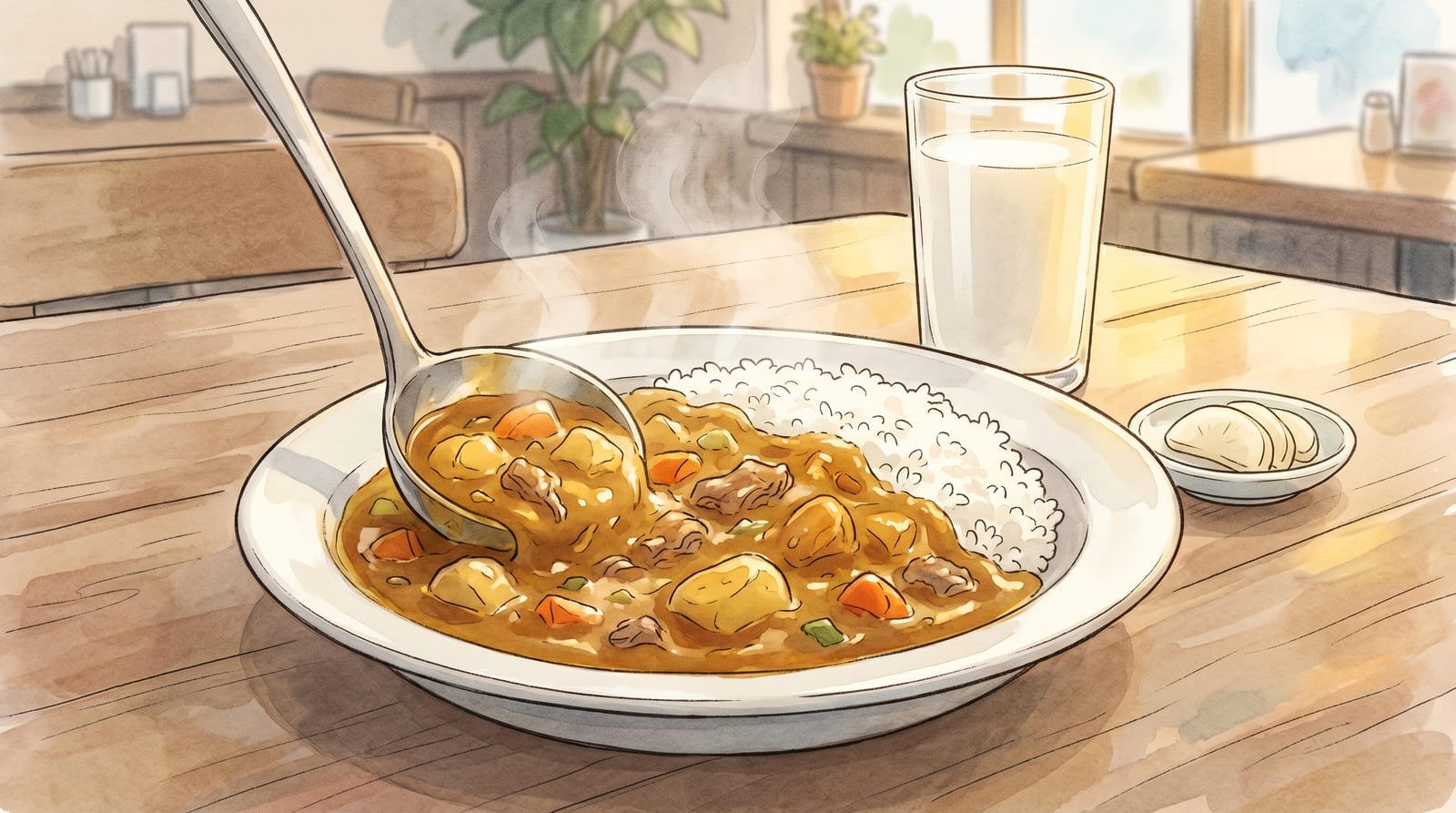
The streets between Kure Station and the waterfront museum plaza — particularly Akarenga Doori — are home to the highest concentration of certified Kure Kaiji Curry (呉海自カレー) restaurants. These are shops serving curry recipes verified and endorsed by specific Japan Maritime Self-Defense Force vessels.
On-site: Akishio Curry at the museum café
The easiest lunch option is the Akishio Curry inside the museum itself — a submarine-shaped rice mound in curry sauce approved by the Akishio's 10th commanding officer. It is an inexpensive light-lunch option and, like the café generally, cash only. Last orders are at 5:00 PM.
Kure Haikara Shokudou (呉ハイカラ食堂)
A short walk from the museum plaza on Akarenga Doori. Serves the recipe from JS Sōryū, a Sōryū-class submarine, as their signature "Teppan Curry."
Minato Machi Coffee Ten (港町珈琲店)
A registered Kure Kaiji Curry member with a harbour-view café atmosphere — JMSDF submarines are sometimes visible from the window seating.
For the full certified network and the 2026 stamp-rally map, see the official Kure Kaiji Curry site (kure-kaijicurry.com) and the Kure City tourism page. Most of these restaurants are cash-only. See our dedicated Kure naval curry guide for the full certified network.
Sample itineraries from Hiroshima
Most visitors pair this museum with the Yamato Museum and naval curry for a full day. But if you're pressed for time, the museum works as a standalone 90-minute stop.
Quick Visit
Tetsu no Kujira only, from Hiroshima Station
- Depart Hiroshima Station, JR Kure Line rapid
- Arrive Kure Station, walk to museum (5 min)
- JMSDF Kure Museum — all three floors + submarine
- Akishio Curry in the museum café or a quick lunch at Akarenga Doori
- Return train to Hiroshima
- Back in Hiroshima
Best Balance Recommended
Both museums + naval curry lunch
- Depart Hiroshima Station
- Arrive Kure — Yamato Museum opens 9:00 AM
- Yamato Museum (English Sunday tour at 9:00 if Sunday)
- Kaigun curry on Akarenga Doori
- JMSDF Kure Museum (Tetsu no Kujira)
- Museum gift shop / Akarenga Doori stroll
- Return train to Hiroshima
- Back in Hiroshima
Deep Kure
Adds Mt. Haigamine + Etajima island
- Day 1: Full day above, ending with sunset at Mt. Haigamine — one of the "Three Great Night Views of Chugoku and Shikoku."
- Day 2: Ferry to Etajima, site of the former Imperial Navy Academy (now JMSDF Officer Candidate School), or explore the Tobishima island chain by rental car.
- Stay: The Kure Hankyu Hotel, a short walk from the station and the museums, is a convenient mid-range base; compare other options via Rakuten Travel Kure hotels.
History context: From Imperial Arsenal to Iron Whale
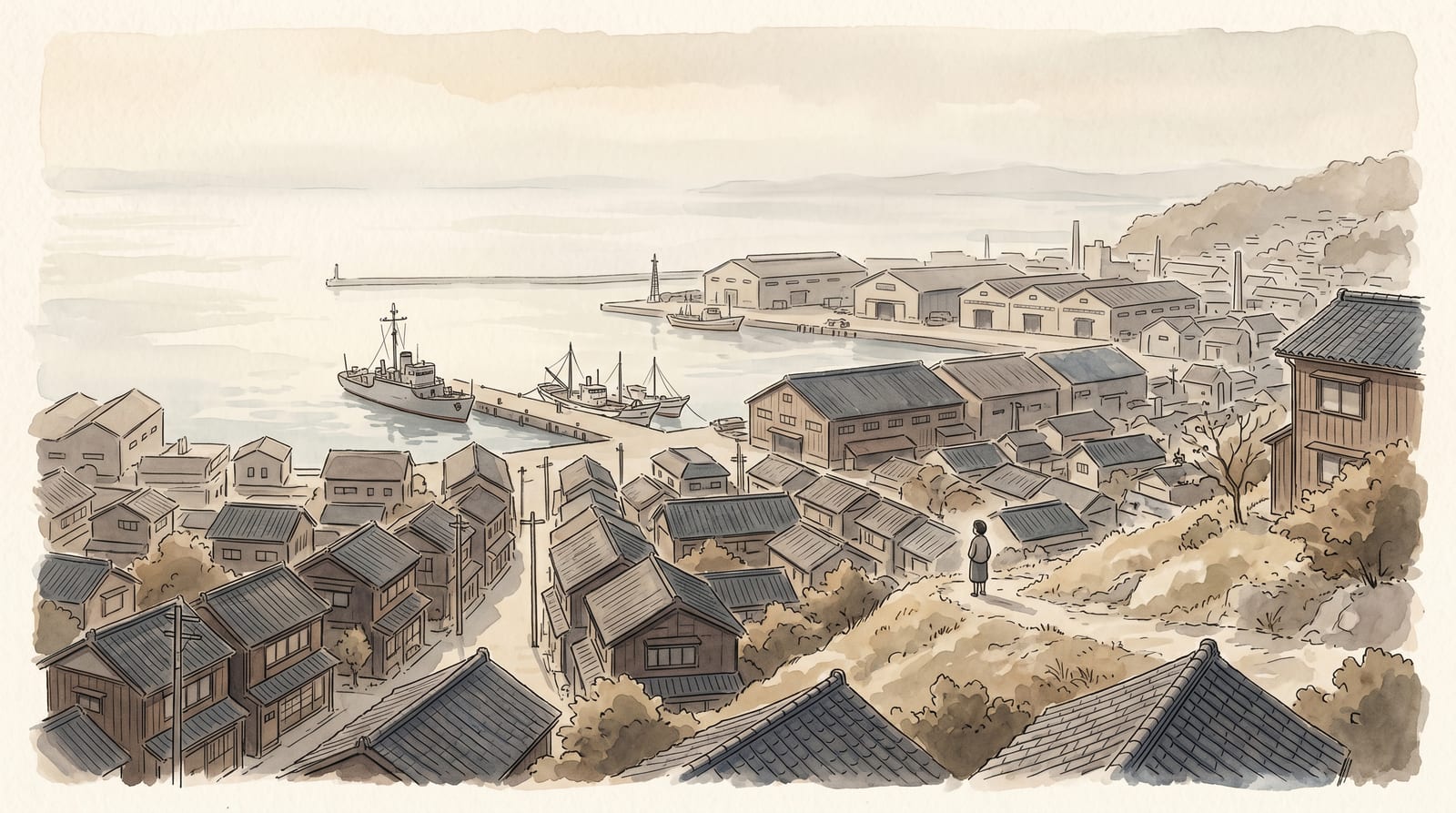
Kure was the Imperial Japanese Navy's largest arsenal — the facility that built the Yamato and the submarine fleet that became the JMSDF's founding inheritance. After 1945, the city's relationship with naval power didn't end; it transformed.
The immediate postwar years are the story the second floor tells: Japan's coastal waters were effectively closed by mines. The country's fishing industry, supply lines, and port trade were paralysed. What would become the JMSDF began its institutional life not with warships but with minesweepers, many of them converted fishing vessels. The corps cleared tens of thousands of mines from Japanese waters over the following decade — work that rarely appears in popular histories of the postwar period. The most dramatic early chapter was a secret: in autumn 1950, under U.S. orders, the minesweeping force was quietly deployed to the Korean War with national markings removed, nearly four years before the JMSDF itself existed. That story is on Floor 2.
The postwar submarine programme built on American technology and shipbuilding expertise inherited from the Imperial Navy's Kure yards. The Yushio class — of which the Akishio is a member — represented Japan's domestically designed submarine capability by the 1980s: a teardrop hull, diesel-electric propulsion, and a 75-person crew designed to operate silently in the contested waters of the Western Pacific.
The submarine is the experience most visitors come for. The minesweeping story on Floor 2 is what makes it mean something beyond a photo opportunity — the quiet record of how a post-war maritime force rebuilt itself from converted fishing boats.
FAQ
How long does it take to visit the JMSDF Kure Museum?
Plan 60–90 minutes for a complete visit covering all three floors and the Akishio submarine interior. If you linger at the periscopes or are particularly interested in the minesweeping history, 2 hours is not unusual.
Is it really free?
Yes, entirely. The museum is operated by the Japan Maritime Self-Defense Force as a public relations and education facility. No admission fee, no timed entry tickets, no booking required.
Can I go inside the Akishio submarine?
Yes. This is the only place in Japan where you can walk the interior of a real, decommissioned submarine on dry land — the "world's only" claim that sometimes circulates does not hold (real walk-through submarines exist overseas, including U-505 inside Chicago's Museum of Science and Industry and HMCS Onondaga in Canada ), but Japan's only is a well-supported distinction.
Visitors enter via a connecting corridor from the third floor of the museum building and follow a one-way walking route. Sections open to the public include the captain's cabin, officers' quarters, the command center, and working periscopes you can actively use.
The passages are narrow and low in places — tall visitors should expect to duck. There are no formal height or age restrictions.
Is there an English audio guide?
There's no dedicated audio device, but QR codes beside each exhibit link to English text guidance on your smartphone. Free printed pamphlets in English, Traditional and Simplified Chinese, Korean, French, Spanish, and Portuguese are available at the entrance. Bring a data connection or download what you need on the train.
When is it closed?
Tuesdays (or the following day if Tuesday is a public holiday), and December 29–January 3. Otherwise open daily 10:00 AM–6:00 PM, last entry at 5:30 PM.
What is the difference between this museum and the Yamato Museum?
The Yamato Museum covers World War II historical naval shipbuilding centred on battleship Yamato; admission is ¥1,000, and it reopened in April 2026 after renovation. The JMSDF Kure Museum covers modern Japanese maritime defence — minesweeping history and submarine operations — and is free. The two are approximately 2 minutes' walk apart and most visitors pair them in a single day. Our full guide to the Yamato Museum covers it in detail.
Is the JMSDF Kure Museum suitable for children?
Generally yes. Children with an interest in ships, submarines, or military equipment tend to find it engaging — the submarine interior is the most hands-on experience available at either Kure museum. The minesweeping content on Floor 2 is factual but not graphic. Note that passages inside the submarine are narrow; younger children will find it easier to move through than adults.
Related guides
More in our Kure series:
- Hiroshima day trips, ranked — how the submarine museum fits into a wider Kure day
- Yamato Museum complete guide — the 1:10 scale model and the 2026 reopening
- Hiroshima to Kure day trip — transport options, timing, and what to combine
- Where to eat kaigun curry in Kure — full guide to the certified Kure Kaiji Curry network
- In This Corner of the World locations — anime pilgrimage map across Kure
- Mt. Haigamine sunset — Kure's "Three Great Night Views of Chugoku and Shikoku" (coming soon)
Last visited: 2026-05 | Author: Masayuki Ogasahara | Illustrations generated with AI (Gemini) using real reference photographs. Hero illustration derived from Yamato Museum and JMSDF Kure Museum - Aug 21, 2017 by Yousuke, CC BY-SA 2.0. Photographs are original or used with permission; some include light AI-assisted post-processing for cleanup or exposure, with the scene itself unchanged. This article contains affiliate links to GetYourGuide, JRPass.com, Klook, and Rakuten Travel. We may earn a small commission at no extra cost to you. All operational information was verified against official and secondary sources in May 2026; please confirm with the museum before your visit as details can change.
