
- Location
- Mitarai, Osaki Shimojima, Kure City, Hiroshima Prefecture
- National designation
- Important Preservation District for Groups of Traditional Buildings, 1994
- Protected area
- 6.9 hectares
- Admission (outdoor)
- Free
- Admission (paid sites)
- ¥200 adult (Otome-za theater; Kaneko Residence)
- Bus from Hiro Station
- About 84 minutes (Setouchi Sanko Okitomo Line); around 12 buses a day
- Closed days
- Tuesday (both paid sites); outdoor streetscape open any time
- Ferry to Mitarai
- None as of 2026
This post contains affiliate links. We may earn a small commission at no extra cost to you.
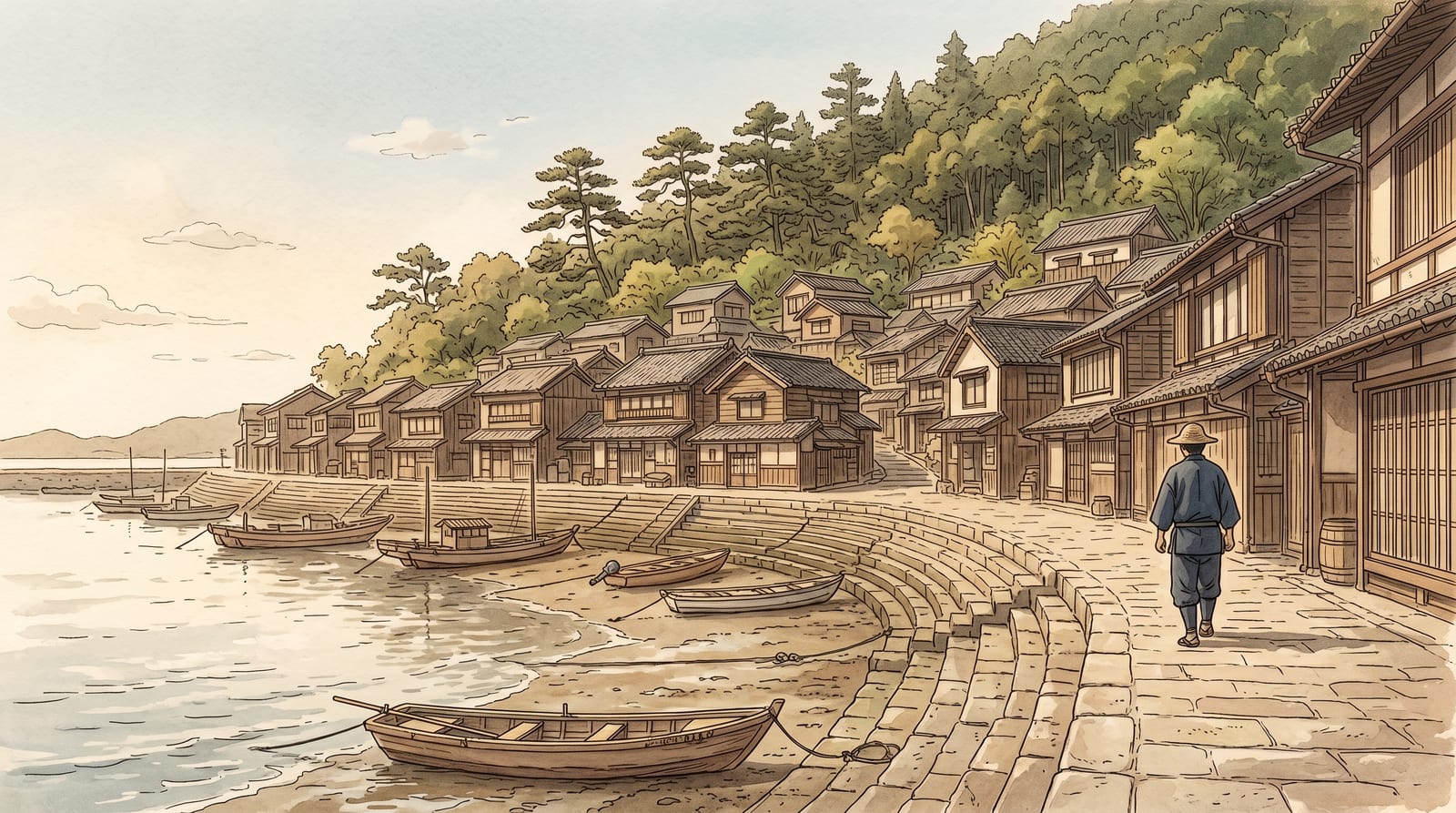
On the back quay at Mitarai, the gangi steps descend into the water like a paragraph that ends mid-sentence. You can stand there at low tide and count the stone layers worn smooth by two centuries of rope and hull, and the town behind you (the merchant house façades, the old clock shop, the shrine wall with its camphor tree) holds its shape the same way it did when a hundred vessels might have been anchored here waiting for the tide to turn. Most travel in Hiroshima Prefecture never gets past the island that everyone knows. Fewer than one in a hundred Hiroshima visitors ever finds Mitarai, and almost none of them arrive by sea anymore.
Hiroshima offers everything concentrated and obvious: the Peace Memorial Museum, Miyajima's floating torii at peak light, the pilgrimage logic of moving from tragedy to transcendence in one afternoon. Mitarai offers none of that. It is a two-hour bus ride past Kure into the outer Seto Inland Sea, on an island most English-language guides do not name. The argument for going is not efficiency. It is that the Edo-period port town here is the real thing: not rebuilt, not themed, preserved under a national law because the streetscape has not moved. For a particular kind of traveler, that is its own category of experience.
How Mitarai became Japan's most intact tide-waiting port
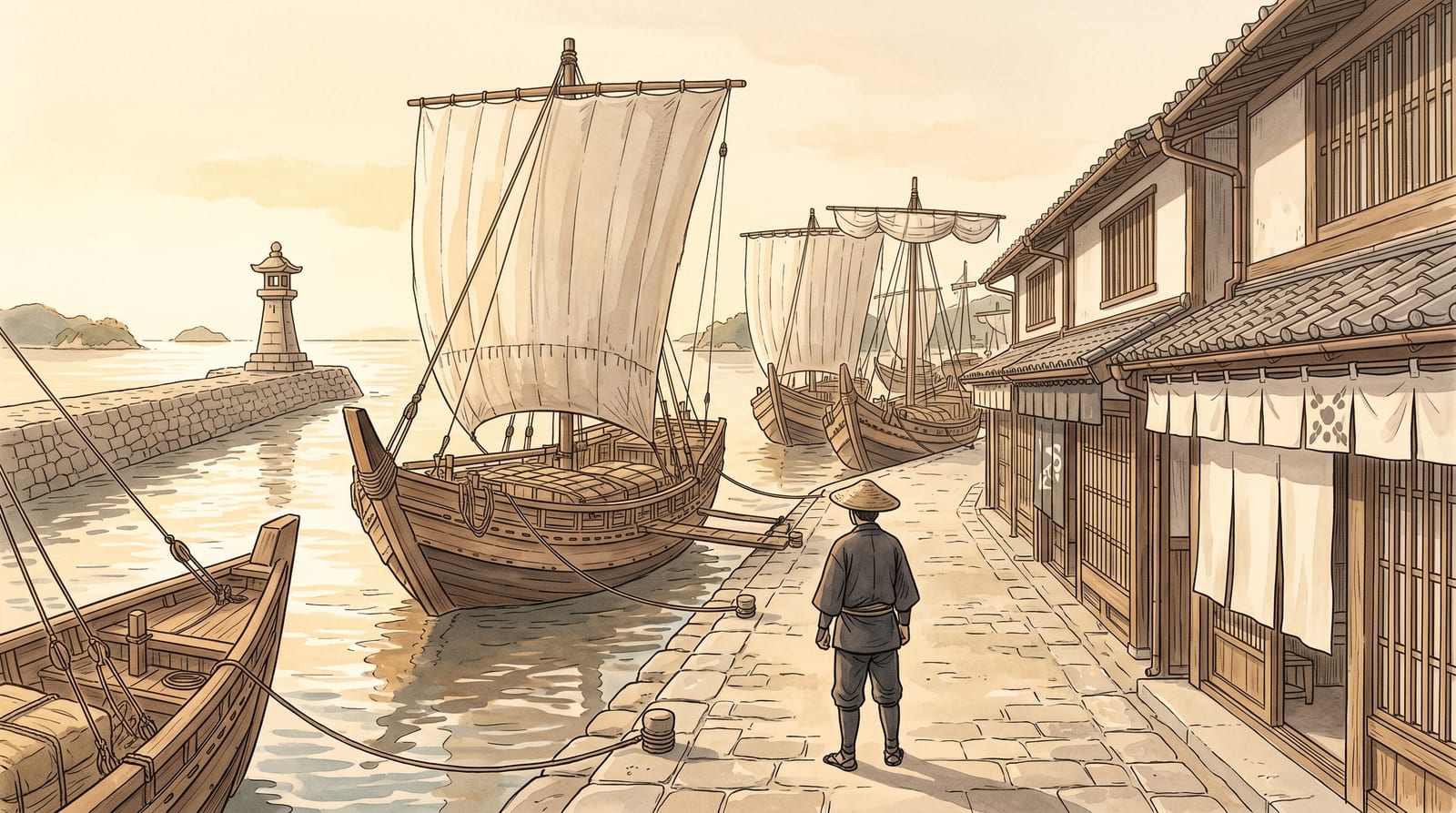
Before the age of steam, crossing the Seto Inland Sea depended entirely on reading the wind and the tide. The sea route between Osaka and western Japan ran through a narrow corridor, and ships had to anchor and wait — sometimes for days — when the current or wind turned against them. Mitarai, on the south coast of Osaki Shimojima, sat at exactly the right point on that corridor. In 1666 (Kanbun 6), the Hiroshima domain approved the first town layout on what had been farmland and fishing shore. Six years later, in 1672, the western sea route (西廻海運) was formally opened, connecting the Japan Sea ports and Hokkaido with Osaka by an outer course through the Seto Inland Sea, and Mitarai was directly on the line. The waiting function became the whole economy.
The Kitamaebune — the cargo ships carrying rice, herring oil, and fabric — stopped here for days at a stretch. So did the rice-tax vessels, official couriers, and private traders who needed provisions. Chandlers supplied them. Moneylenders handled cargo papers. Innkeepers filled their rooms. Merchants built the two-storey latticed houses that still line the main lane today. The port licensed four teahouses — 若胡子屋 (Wakaebisuya), 藤屋 (Fujiya), 堺屋 (Sakaya), 扇屋 (Ōgiya) — that ran as the town's nighttime economy. Wakaebisuya, which received domain approval in 1724 (Kyōhō 9), held roughly 100 courtesans at its peak.
The trade that moved between ship and shore had its own mechanics. Some women rowed small boats — おちょろ舟 (ochoro-bune) — out to the trading vessels anchored in the roadstead: close enough to see the port lights, too far for lower-ranking crews to afford a night ashore. They provided meals, sewing, laundry, and company as well as sex. The arrangement was documented, taxed, and a recognised part of how a tide-waiting port functioned. It continued in some form until the 1958 Prostitution Prevention Law (売春防止法) closed it.
Mitarai's Bakumatsu record is disproportionate to its size. Four notable figures passed through within documented history: the surveyor Inō Tadataka in 1806, during his nationwide coastal mapping; Philipp Franz von Siebold in 1826 on his return from Edo, reportedly examining patients in the port; Yoshida Shōin in 1853, passing through en route to Nagasaki; and five of the exiled court nobles (五卿) in 1864 in the course of their exile from Kyoto. In 1863, the Hiroshima domain designated Mitarai a base for secret Satsuma–Hiroshima trade operations (芸薩交易). By 1867, an anti-shogunate pact — later recorded as the "Mitarai Agreement" (御手洗条約) — was being coordinated through the port; the former Kaneko Family Residence is identified locally as the meeting site.
For roughly two centuries the waiting function held everything together. It ended precisely when the reason to wait disappeared. Steamships made ships independent of tide and wind. The San'yō Main Line (山陽本線) rerouted freight overland. Through the Meiji era, the anchored ships stopped coming, the merchant houses closed their shutters, and the teahouses ran quieter seasons until they stopped. Almost nothing was demolished or rebuilt over the following century, because there was no economic reason to rebuild it. When the Agency for Cultural Affairs surveyed the streetscape in the early 1990s, the Edo-period urban pattern was still largely intact: the gangi stone quays, the lanes, the merchant houses with their latticed fronts, the fire watch tower, the shrines at the approach. On 4 July 1994, Mitarai was designated a national Important Preservation District for Groups of Traditional Buildings — a "port town" classification, one of a small number in Japan. The reason it survives is the same reason it declined: the waiting stopped, and the town went still before anyone had time to change it.
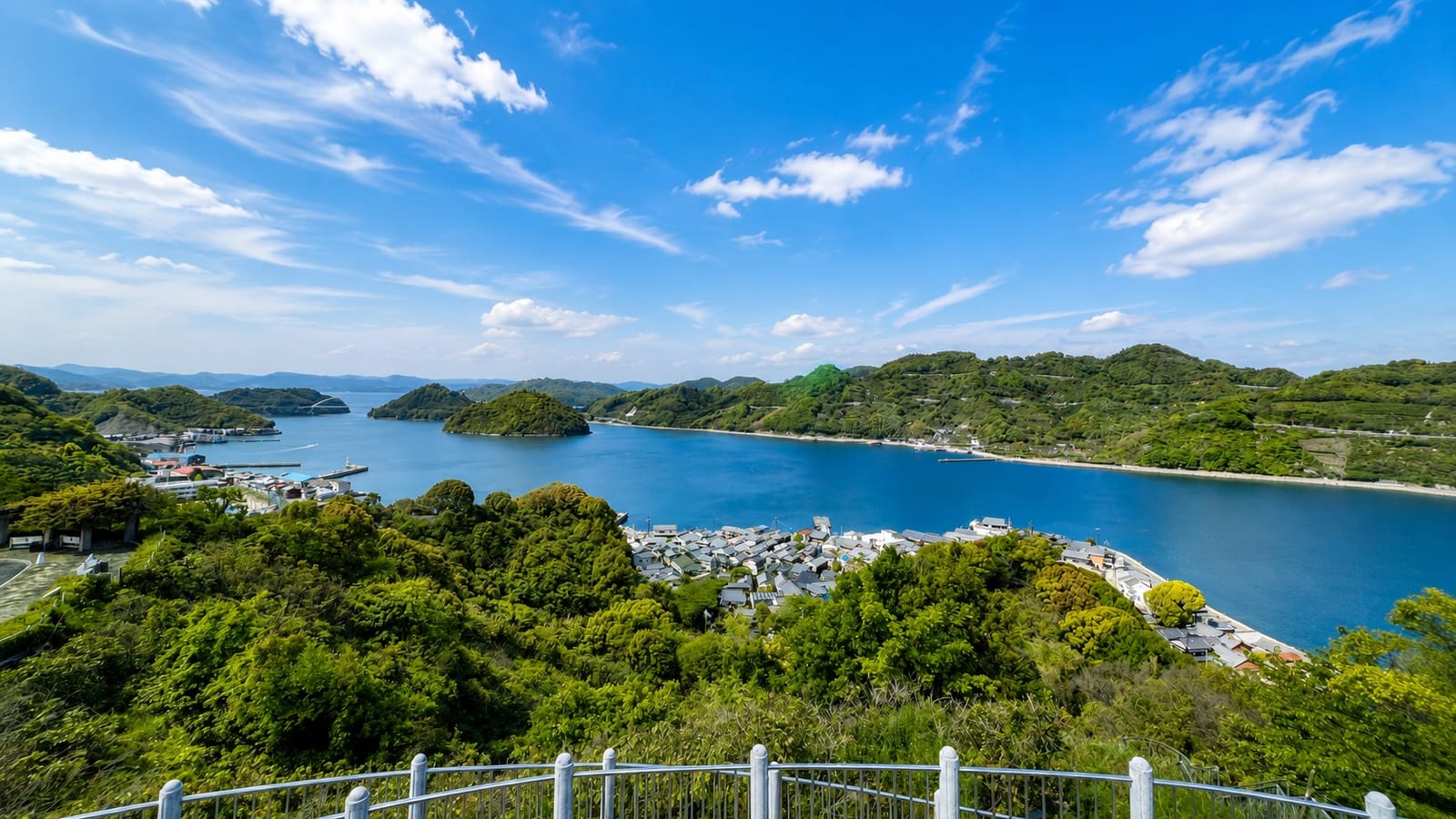
The protected area covers about 6.9 hectares. That is not large. You can walk the core in under an hour. But the density of intact Edo commercial architecture within it is unusual, and because the town is genuinely out of the way, you are unlikely to be doing it alongside tour buses.
Getting to Mitarai: the honest transport picture
Mitarai is not easy to reach. Understanding the access options clearly before you plan will save a wasted day.
By bus from Hiro Station (the standard public-transport route)
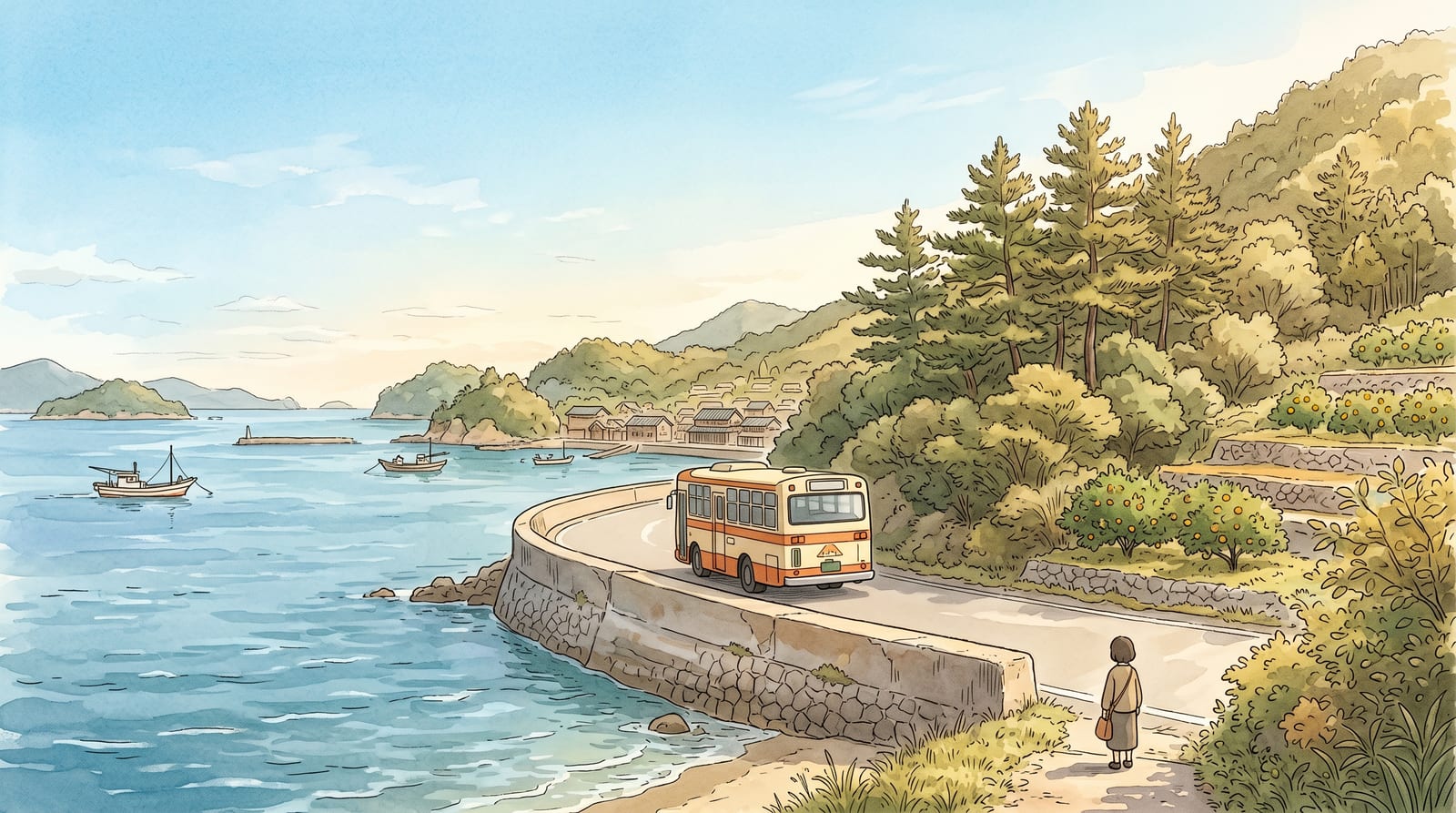
Mitarai sits at the far end of a Setouchi Sanko (瀬戸内産交) bus line called the Okitomo Line. The key detail: this bus starts at Hiro Station (広駅前) on the JR Kure Line, not at Kure Station.
From Hiroshima Station, take the JR Kure Line toward Kure or Aki-Kawajiri and continue past Kure Station to Hiro. At Hiro Station, board the Setouchi Sanko Okitomo Line bus. The ride to the Mitarai-ko (御手洗港) stop takes about 84 minutes. Service runs about a dozen buses a day (around 12).
The one-way bus fare is not published on any public website. Setouchi Sanko does not list fares online; call them on 0823-70-7051 to confirm before your trip.
A JR Pass covers your Hiroshima–Hiro leg on the JR Kure Line. The bus from Hiro to Mitarai is a private bus and is not covered by the pass. A JR Pass is not worth buying for this trip alone: the JR portion is one segment among many buses. But if Mitarai is part of a wider Japan itinerary involving Shinkansen travel, Japan Rail Pass can still make the whole trip cheaper than buying individual tickets.
No ferry to Mitarai
This bears stating plainly: there is no ferry or boat service to Mitarai as of 2026.
The Tobishima Liner express bus (Hiroshima Bus Center direct to Mitarai, operated by Sanyo Bus) was suspended in April 2023 and formally discontinued in March 2024. The Takehara-to-Osaki-Shimojima high-speed ferry run by Shimanami Kaiun was discontinued on 1 April 2025. The Imabari-Okamura Sekizen ferry (used by Tobishima Kaido cyclists) does not call at Mitarai.
If you read a travel article mentioning a ferry to Mitarai, check its date.
By car
By car via the Akinada Tobishima Kaido bridge chain, the Kure City official figure is about 1 hour 30 minutes from the Kure IC of the Hiroshima–Kure expressway. The Akinada Ohashi bridge (first bridge on the island chain) is a toll road for cars; the subsequent bridges on the islands are free.
Parking inside the Mitarai district is very limited. A small free car park near the northern edge of the preservation area reportedly holds only a handful of cars, though the exact capacity is not confirmed on official sources. On busy weekends and holiday periods, plan to park at the edge and walk in.
By bicycle along the Tobishima Kaido
Mitarai is on the fourth island of the Tobishima Kaido cycling route, Osaki Shimojima. Cyclists following the blue-painted road line pass through or near the preservation district. Adding a 1–2 hour stop in Mitarai turns the cycling day into a ride with a meaningful destination rather than a pure endurance question. See our Tobishima Kaido cycling guide for the full access, rental, and route details.
Guided option
If you would rather not manage the bus logistics, GetYourGuide Kure day tour offers day tours from Hiroshima that can include the Seto Inland Sea islands. Confirm with the tour operator that Mitarai is on the itinerary before booking.
What to see in Mitarai
Most of the best things in Mitarai cost nothing and close for nothing. The outdoor streetscape (the gangi quays, the main lanes, the shrines, the seawall) is free and open at all times. The two paid sites add depth but are not the main event.
Allow 1.5 to 2 hours for the outdoor circuit; 3 hours if you go inside both buildings.
The gangi and Chisago-hato lighthouse
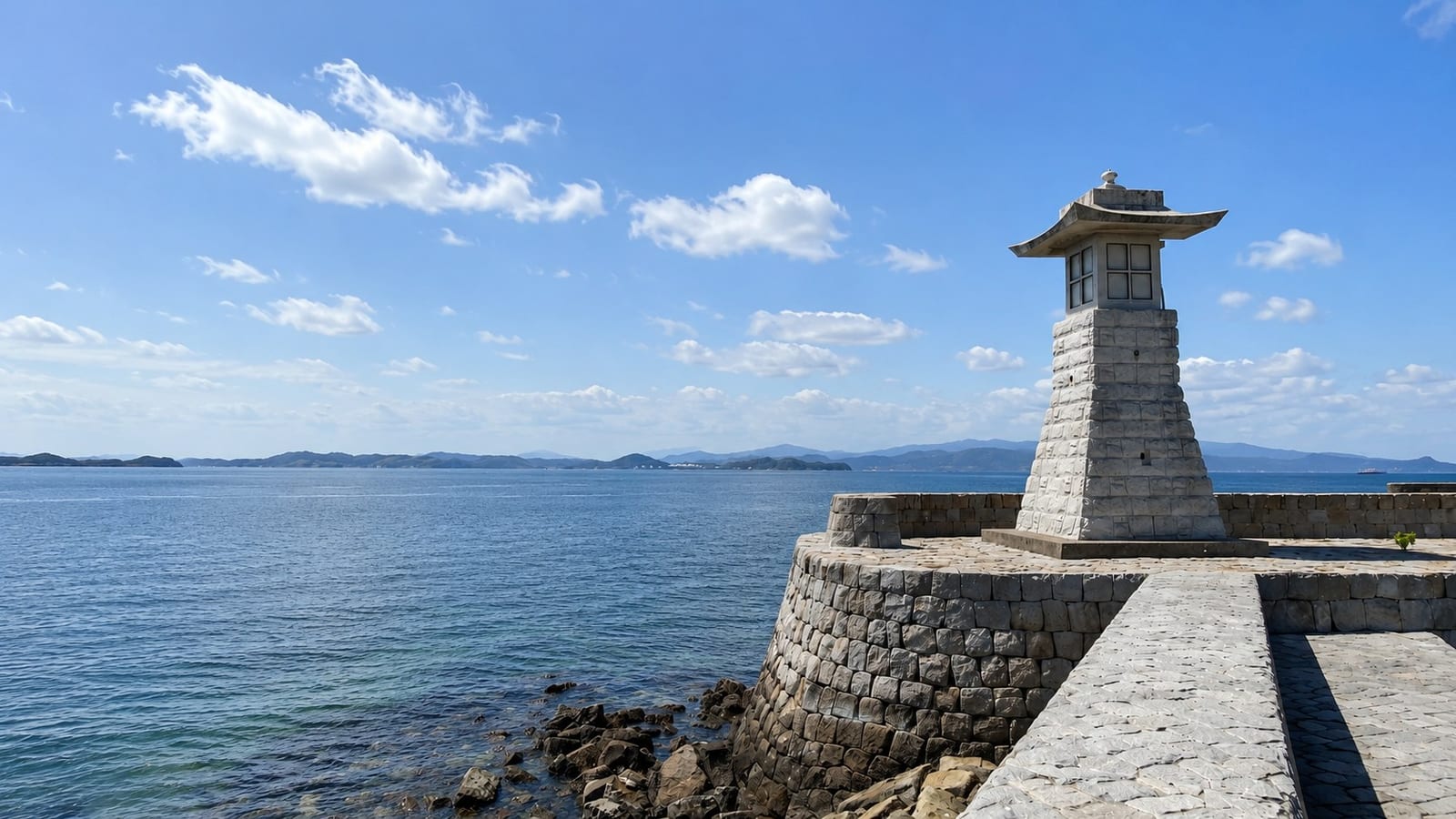
The gangi (雁木) are stone staircases built directly into the harbor wall, each one a landing stage for a single vessel: the architecture of a port where you go to the cargo, not the other way around. Mitarai's gangi stretch along the waterfront in a gently curved line, some worn to a deep gloss. At the end of the harbor stretches the Chisago-hato breakwater (千砂子波止), a roughly 120-metre stone mole completed in 1829 (Bunsei 12) and built by the Hiroshima domain, with Sumiyoshi Shrine raised at its shoreward end in 1828. At the breakwater's seaward tip stands the Chisago-hato lighthouse (千砂子波止高燈籠), a stone lantern completed in 1832. It is small but photographically striking. One important note: the lantern at the breakwater tip today is a modern concrete replica; the original 1832 stone lighthouse was relocated to the Sumiyoshi Shrine approach path in 1879 and stands there still.
Ebisu Shrine and the 1666 founding date
Walking along the quay, you reach the Ebisu Shrine (恵美須神社) at the eastern end of the preservation district. This is the oldest surviving religious site in Mitarai, laid out with the town in 1666 (Kanbun 6) — the same year the domain approved the first town plan. The main sanctuary (本殿, 1723) and worship hall (拝殿, 1746) are both designated Important Cultural Properties of Hiroshima Prefecture (1996). The small wooden structure — unrestored in the theme-park sense, simply old — sits right at the harbor edge, facing the direction ships would have come from.
Mitarai Tenmangu shrine
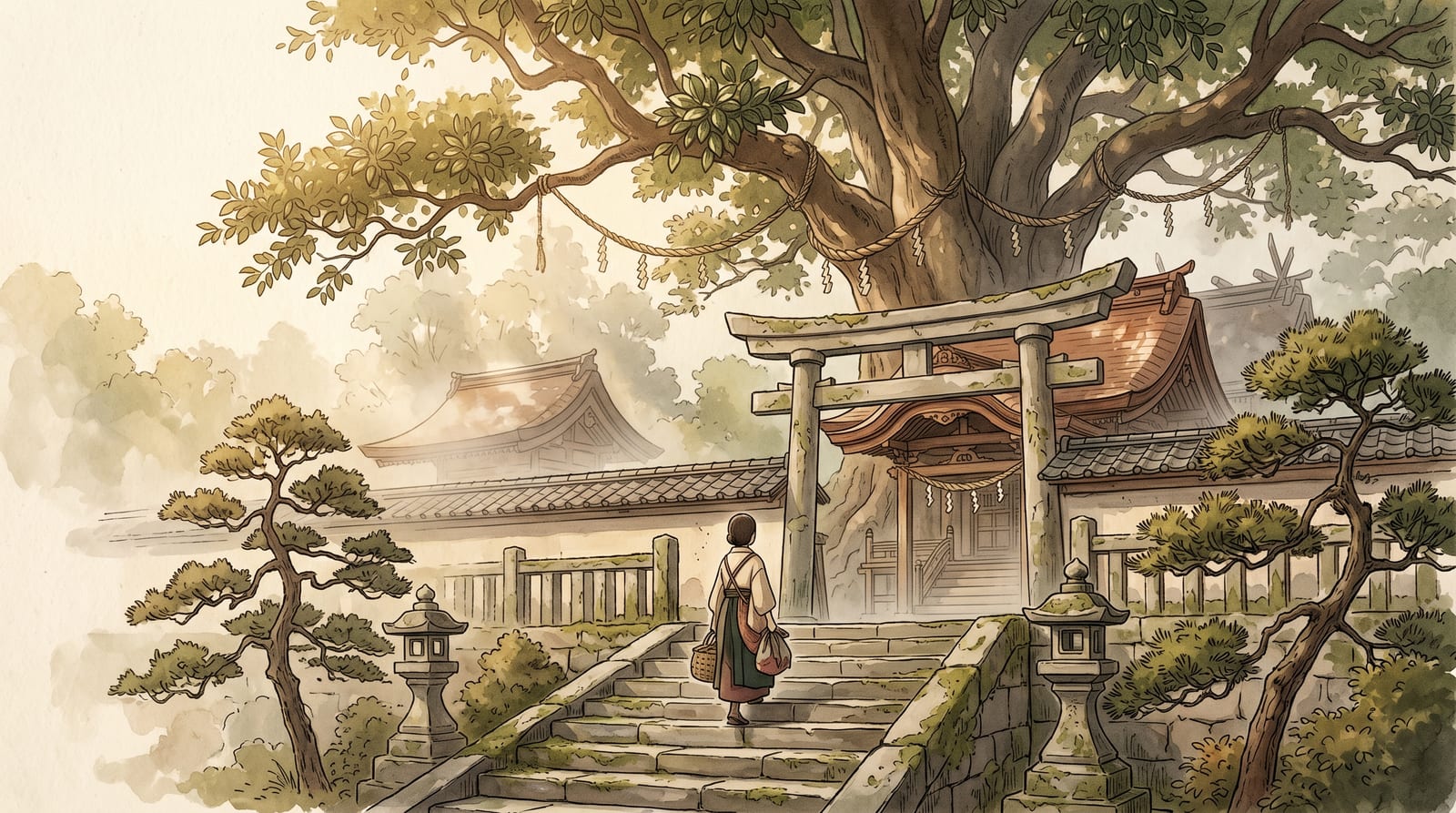
The Mitarai Tenmangu (御手洗天満宮) is dedicated to Sugawara no Michizane, the Heian-period scholar who became Japan's patron deity of learning after his exile and death in 903 CE. The place name "Mitarai" (literally "honorable hand-washing") comes from a local legend that Michizane washed his hands at a well here while passing through on his way to exile in Kyushu in 901.
This is a legend, not a documented historical event. The shrine's current hall dates to 1917; a shrine hall beside the well is recorded from 1871; and a Tenjin worship site in the area is mentioned from 1755. These are three different historical moments, not one continuous founding story.
The shrine grounds are free and open. The tree is large, old, and worth noticing.
Manjuji temple
Manjuji (満舟寺) is a Buddhist temple set against the hillside above the town, reached by a short stone-paved path. Its hillside position and stone walls make it one of the more atmospheric spots in the district, especially in morning light.
One popular story attributes the stone walls to Kato Kiyomasa, who supposedly built them in 1585 during Toyotomi Hideyoshi's Shikoku campaign. The local Yutaka-cho town history disputes this attribution and suggests a later date. We mention the story only to note that it is a popular tradition that local historians dispute. Not a settled fact. The walls themselves are worth seeing regardless.
Shinkō Tokeiten (新光時計店)
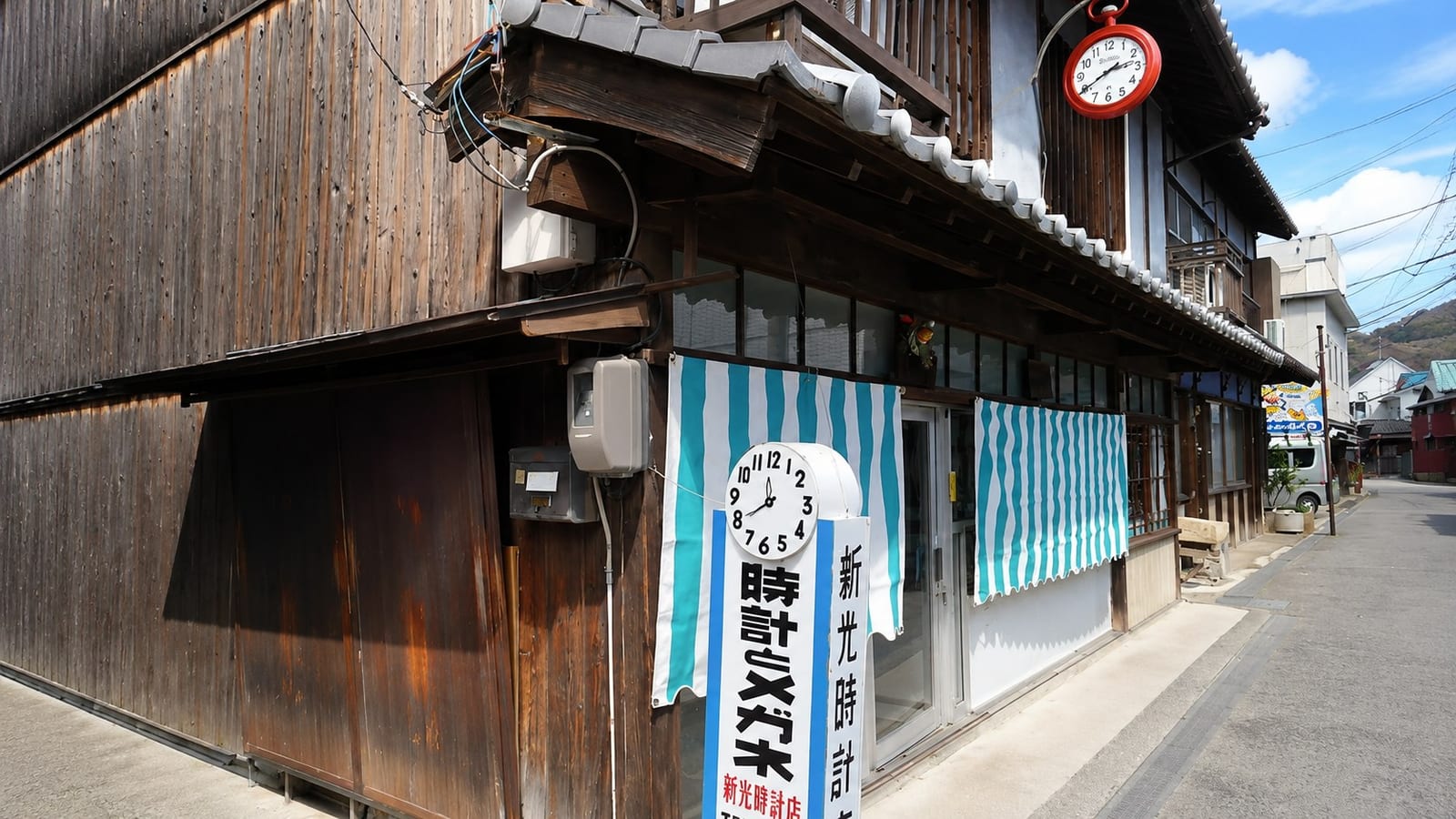
The current building dates to around 1919 (Taishō 8), when the port had already been quiet for a generation. Shinkō Tokeiten is a watch and clock repair business that has passed through five generations of the Matsuura family. The current owner, Matsuura Kōji, took over from his father Keiichi and carries on the same work: repairs of all kinds, from high-end domestic pieces to foreign-made watches of uncertain provenance, many sent to this island address from other parts of Japan and from abroad.
It is not a museum. There is no entry fee. The front display holds clocks; the back holds more. If the door is open, someone is working. That a repair business still operates in a town this size, in a building from 1919, taking commissions from senders who have nowhere closer to go, is the kind of detail the Chūgoku Shimbun covered without irony.
One note: some media coverage has called Shinkō Tokeiten "the oldest watch shop in Japan." That phrase appears in YouTube titles and travel features, not in the Chūgoku Shimbun profile or the specialist press. We cannot confirm it. The shop's own five-generation run is remarkable enough without the superlative.
Otome-za theater (paid, ¥200)
Address: 5915-4 Ocho (大長), Yutaka-machi, Kure
A small note on geography: Otome-za's address is in the Ocho (大長) district, adjacent to but not technically inside the Mitarai core preservation area. If you are combining both sites on a tight schedule, check the walking route at the Mitarai rest house before you set off.
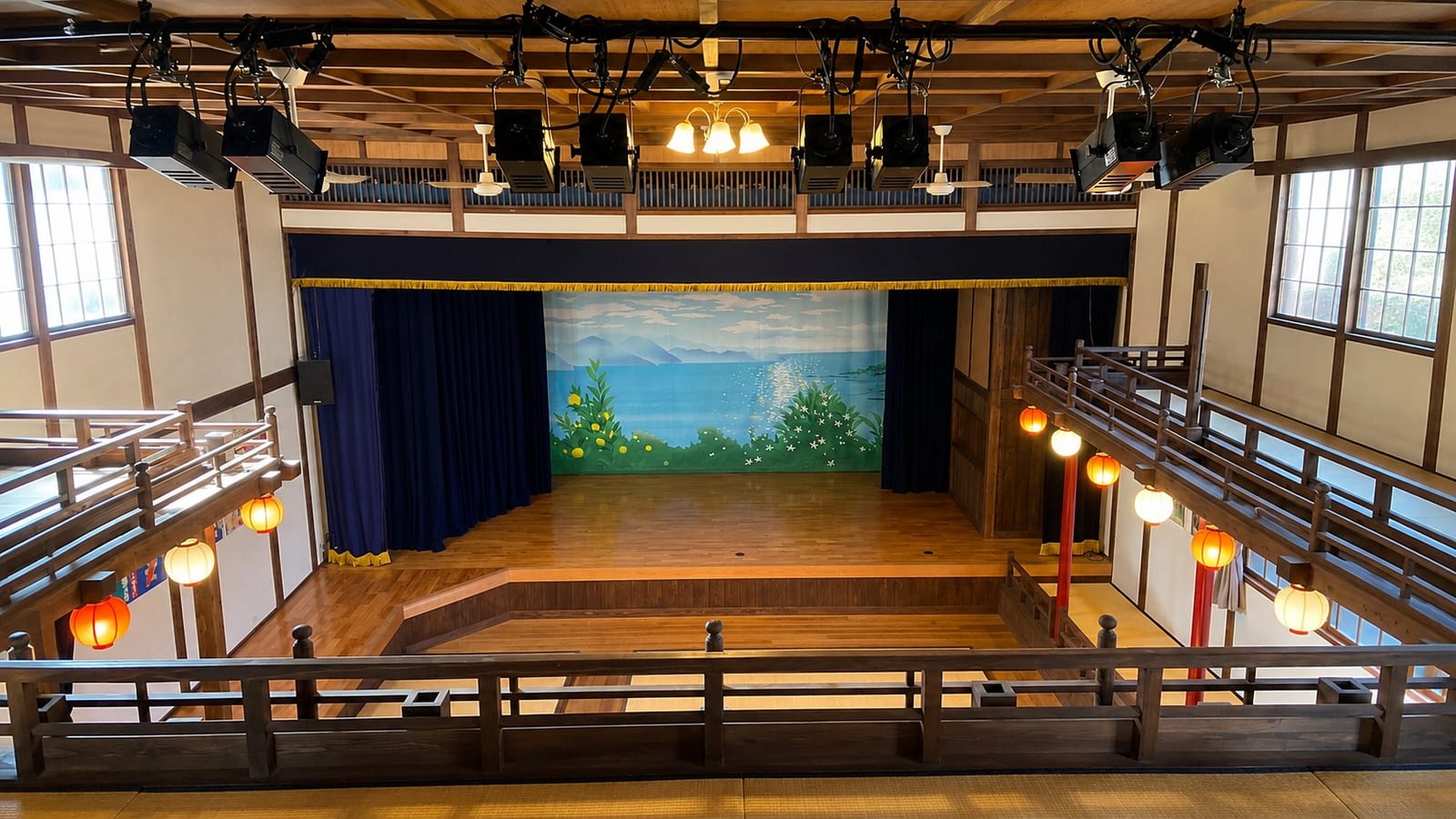
Otome-za was built in 1937 as a small local theater for kabuki and other performances. It later served as a cinema, fell into disuse, and was restored and reopened in 2002. The restored space has the original raked tatami audience floor, and a hanamichi runway (the elevated walkway through the audience that is the signature staging device of kabuki) survives intact. For a building of this type and vintage outside a major city, that is unusual.
Hours: 09:00–17:00, closed Tuesdays (next day if Tuesday falls on a public holiday) and year-end
Admission: ¥200 adults / ¥120 high school / ¥80 elementary and junior high. Kure City residents below high school age: free. Groups of 20+: group rate applies.
Former Kaneko Family Residence (paid, ¥200)
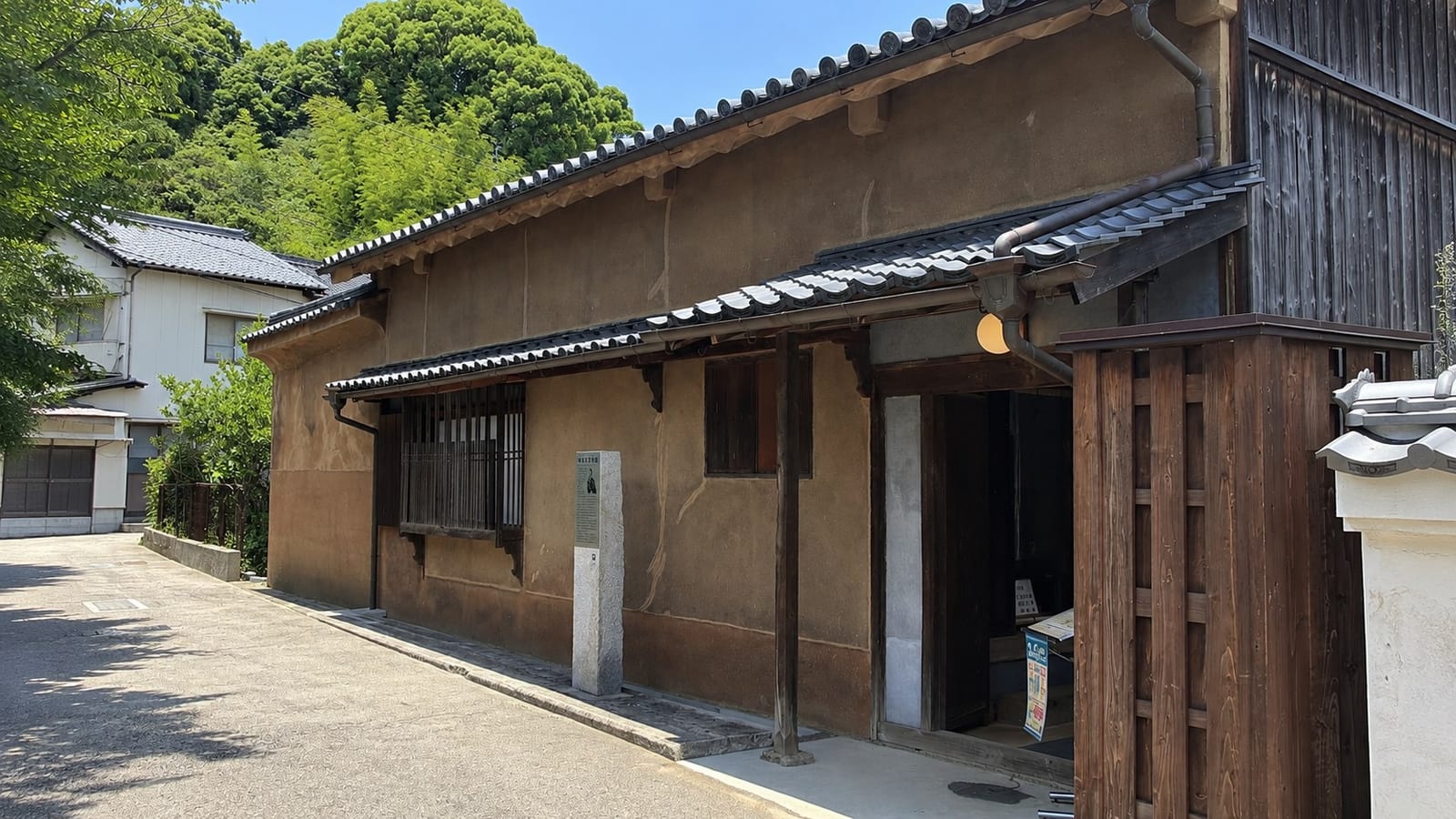
The former Kaneko Family Residence (旧金子家住宅) is a Kure City Cultural Property: a merchant villa with a tea room and nagaya-mon (combined gate and servants' quarters) that has been preserved as a site open to the public.
It carries one specific historical claim that historians treat as significant: this is recorded as the place where representatives of the Choshu domain and the Hiroshima domain concluded a secret anti-shogunate pact (sometimes called the "Mitarai agreement") in 1867 (Keio 3), a year before the Meiji Restoration.
Hours: 09:00–17:00 (last entry 16:30), closed Tuesdays (next day if Tuesday is a public holiday) and 29 December–3 January
Admission: ¥200 adults (group ¥160 for 20+) / ¥120 high school / ¥80 elementary and junior high
Note on weekday opening: some secondary sources have suggested the Kaneko Residence only opens on weekends or requires advance booking on weekdays. The official Kure City page does not state this restriction, but opening patterns for small cultural properties in Japan can vary from what is published. If you are planning a weekday visit specifically for this site, weekday visits may require advance reservation; confirm the current opening days and the booking number with Kure City before relying on a weekday visit.
Mitarai Showa-kan and the rest house
The Mitarai Showa-kan (御手洗昭和館) is a small private museum of retro toys and candy-store nostalgia: Showa-era (1926–1989) children's items, tin toys, dagashi snacks. It is reportedly ¥300 and runs on irregular hours. Check at the Mitarai rest house (御手洗休憩所) when you arrive.
The rest house itself is the practical first stop: free maps of the preservation district are distributed there, and the staff can orient you to what is currently open.
Food in Mitarai: what to expect honestly
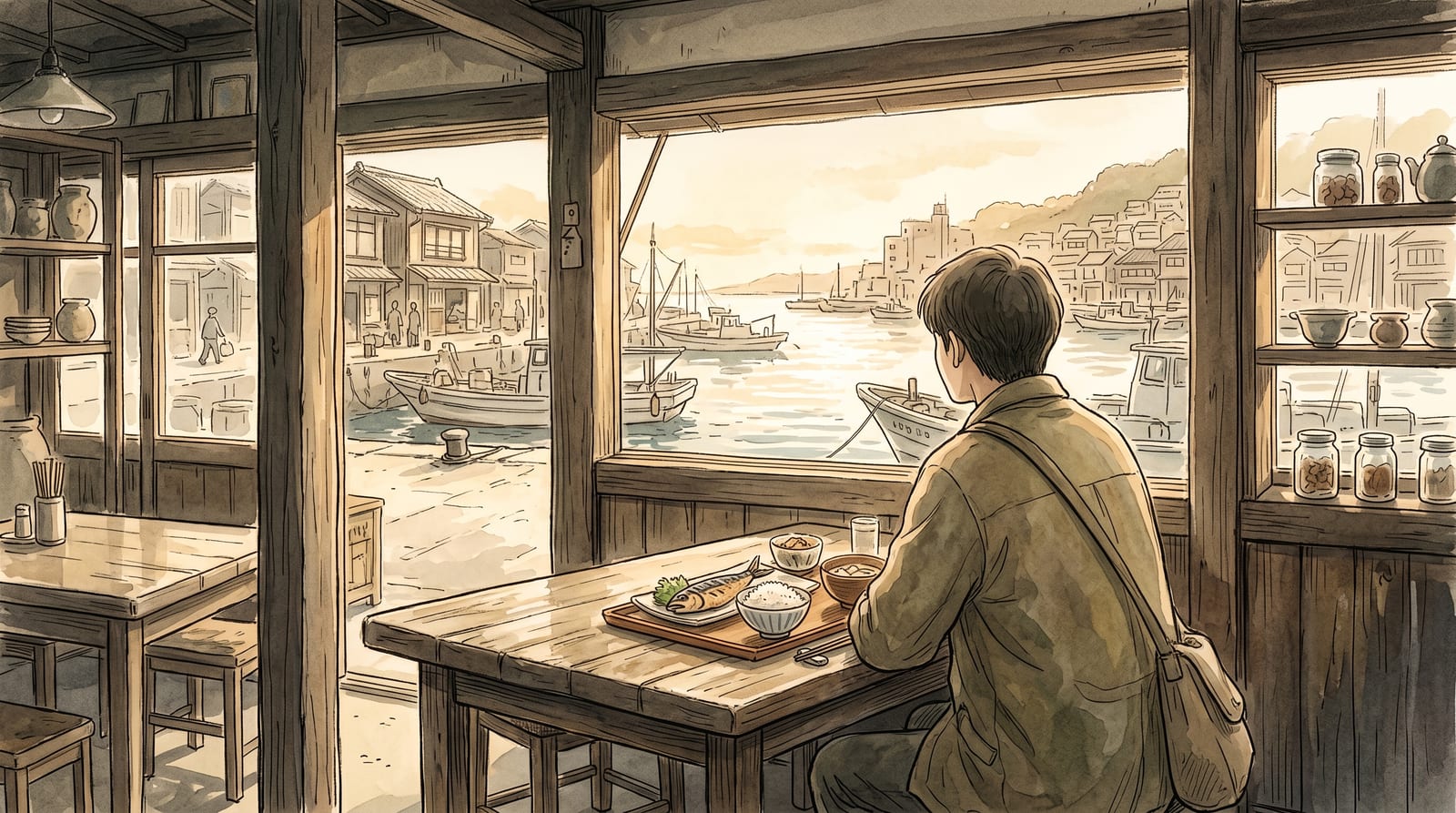
Food in Mitarai is limited. This is not a food destination. The town is small, and the number of operating restaurants and cafés fluctuates. Some close on weekdays; some close without notice.
A few places serve food near the preservation district: simple set meals, grilled fish, and local oysters in season. We do not name specific restaurants here because we cannot verify their current operation; the safest approach is to check at the Mitarai rest house on arrival and, if eating is a priority, to bring your own lunch from Hiro Station or Kure.
Oysters from the Kamikamagari and Osaki Shimojima area are a local product, and you may find them offered seasonally.
There are no certified Kure Kaiji Curry restaurants in Mitarai. For naval curry, the certified network is in central Kure. See our Hiroshima to Kure day trip guide for how to connect that into a wider itinerary, or our one-day Kure itinerary for the full central-Kure program that includes the Yamato Museum.
Bring cash. Card acceptance in a small island town should not be assumed.
Mitarai vs. the Tobishima Kaido: two ways to use the same island
Mitarai and the Tobishima Kaido are not competitors. They are the same geography approached from different angles.
| Mitarai destination guide | Tobishima Kaido cycling route | |
|---|---|---|
| Focus | Edo-period port town, preserved streetscape, cultural heritage | Seto Inland Sea cycling, island scenery, physical activity |
| Admission | Free (outdoor); ¥200 per paid site | Free (bridges are free for cyclists) |
| Time needed | 2–3 hours on the ground, full day with transit | Full day (30 km blue-line route from Kawajiri) |
| Highlight | Intact Edo commercial streetscape; Kaneko Residence Bakumatsu history | 7 bridges, almost no traffic, views across the inland sea |
| Atmosphere | Quiet, slow, slightly time-stopped | Physical, coastal, open |
| Best for | History readers, preservation-district collectors, architecture interest | Cyclists, nature travelers, those wanting to cover distance |
The best combination: cycle the Tobishima Kaido, stop in Mitarai for 1.5 to 2 hours in the middle, and continue. Mitarai is on the fourth island, roughly mid-route. A cyclist with an early start at Kawajiri can arrive at Mitarai around midday, walk the streetscape and visit one paid site over lunch, and still make it to the route's end at Okamura or back to Kawajiri by late afternoon. The Tobishima Kaido guide covers the full logistics.
If you are traveling by bus without a bike, you are committing to Mitarai as the destination itself. That is a legitimate trip. The bus from Hiro takes the same road the cyclists take and you see the same sea.
A note for readers who have researched the Tobishima island chain: the celebrated Korean envoy (朝鮮通信使) reception that the Hiroshima domain staged across multiple missions — known in Japanese as "安芸蒲刈御馳走一番" — took place at Shimokamagari (下蒲刈島, the first island on the chain), not at Mitarai. The Shōtōen reception hall and the 御馳走一番館 museum on Shimokamagari are the correct sites for that history. The two islands appear in the same context and are sometimes conflated in English sources; Mitarai was a merchant tide-waiting port, not the envoy reception headquarters.
Sample itineraries
Bus Day Trip
Mitarai only, from Hiroshima via Hiro
- Depart Hiroshima Station, JR Kure Line toward Kure/Aki-Kawajiri
- Arrive Hiro Station; board Setouchi Sanko Okitomo Line bus
- Arrive Mitarai-ko bus stop; pick up free map at rest house
- Walk the gangi, Ebisu Shrine, Tenmangu, Manjuji; visit one paid site
- Depart on return bus to Hiro Station (~84 min)
- Back at Hiro; connect to Kure or Hiroshima via JR
Best Balance
Mitarai + both paid sites + proper lunch
- Depart Hiroshima Station early; confirm the first bus from Hiro
- Arrive Hiro Station; board first available Okitomo bus
- Arrive Mitarai-ko; rest house opens; collect map
- Outdoor circuit: gangi, lighthouse, Ebisu Shrine, Tenmangu, Manjuji, clock shop
- Lunch (confirm options at rest house on arrival)
- Kaneko Residence and/or Otome-za (confirm open days)
- Return bus to Hiro; afternoon free in Kure or Hiroshima
Tobishima Kaido Loop
Cycle the route, stop in Mitarai, extend to the sea
- Day 1: Train to Aki-Kawajiri; rent bike at Cottage Kajigahama; cycle the Tobishima Kaido blue line; arrive at Mitarai by mid-afternoon; walk the preservation district at dusk; overnight on or near Osaki Shimojima (see the accommodation note below)
- Day 2: Morning in Mitarai (visit Kaneko Residence and Otome-za); cycle remaining route to Okamura Island; take the Sekizen ferry to Imabari for Shimanami Kaido connection, or return by bus to Hiro and onward to Hiroshima
- Stay: Accommodation on Osaki Shimojima is very limited. A few family-run minshuku are reported on the island, but capacity is small and booking is through Japanese-language channels; many visitors instead base in Kure or Hiroshima and treat Mitarai as a long day trip.
Practical notes for foreign visitors
English language support
Mitarai has no dedicated English-language audio guide for the preservation district as of 2026. The rest house distributes free maps that are primarily in Japanese. Signage inside the district is limited and mostly Japanese. The two paid sites (Otome-za, Kaneko Residence) have Kure City Cultural Properties staff who may have basic English pamphlets, but cannot be relied upon for detailed English guidance.
Traveling with a translation app (Google Translate's camera function works well for signage) is recommended. The structure of the town is legible without language (you can read the gangi and the lanes spatially), but the historical interpretation is richer with some preparation.
Tuesday closures
Both Otome-za and the former Kaneko Residence close on Tuesdays. If Tuesday is a public holiday, they close the following day instead. The outdoor preservation district has no closing day. Plan for a Wednesday-through-Monday visit.
Cash
Bring cash. Card acceptance in Mitarai should not be assumed for any venue. The bus from Hiro also likely requires exact change or IC card. Confirm with Setouchi Sanko (0823-70-7051).
Connectivity
If your phone plan does not include Japan data, pick up a Klook Japan eSIM eSIM before your trip. Navigation apps and translation tools are more useful here than at major urban attractions, and bus timetables are not on a reliable English-language app.
Physical accessibility
The preservation district involves uneven stone surfaces (the gangi, old paving, temple steps). Otome-za is a tatami seating environment: floor-level sitting. The Kaneko Residence involves a traditional garden layout. Wheelchair access should be confirmed locally before relying on it.
FAQ
How long does it take to visit Mitarai?
Walking the core outdoor preservation district takes about 1.5 to 2 hours at an unhurried pace. Adding both paid sites (Otome-za, ¥200 each way, about 30–40 minutes per site) extends the total to about 3 hours on the ground. Factor in the roughly 84-minute bus ride each way from Hiro Station: a day trip from Hiroshima to Mitarai is a genuine full-day commitment, not a half-day outing.
Is Mitarai suitable for children?
The outdoor streetscape works for children of most ages. The gangi and the small shrines are accessible and interesting. The paid sites are quieter and less structured. Otome-za is an old theater on tatami, and the Kaneko Residence is a traditional garden property. Neither is particularly child-oriented, though both are safe. The long bus ride is the limiting factor for young children. Minimum admission age for the paid sites is elementary school age.
Can I take photographs in Mitarai?
Outdoor photography of the streetscape, gangi, shrines, and public areas is generally unrestricted. Inside Otome-za and the Kaneko Residence, check with staff on arrival. Photography rules for cultural properties can vary and are not always posted in English, so ask before photographing interiors.
What is the admission for Otome-za and the Kaneko Residence?
Both sites charge ¥200 for adults. High school students pay ¥120; elementary and junior high school students pay ¥80. Kure City residents below high school age enter free. Both sites have a group rate for parties of 20 or more.
What does "Important Preservation District" actually mean?
Japan's national Important Preservation Districts for Groups of Traditional Buildings (重要伝統的建造物群保存地区, often abbreviated 重伝建) are designated under the Law for the Protection of Cultural Properties. They protect groups of buildings that together form a historically significant townscape, rather than just individual structures. The Agency for Cultural Affairs designates the districts; local governments manage them and cannot approve development that would damage the protected streetscape. Mitarai was designated on 4 July 1994 as a "port town" type. As of 2024, there are over 120 such districts across Japan; Mitarai is one of fewer than a dozen classified as port town type.
Is there an overnight option near Mitarai?
There are reportedly some minshuku (family-run guesthouses) on Osaki Shimojima, but capacity is small and advance booking through Japanese-language channels is likely required. An overnight stay turns the trip from a full-day endurance run into a genuinely relaxed visit. If the island's minshuku are full or the Japanese-only booking is a barrier, most visitors base in Hiroshima or Kure instead and run Mitarai as a long day trip; Rakuten Travel Hiroshima hotels covers the Hiroshima side, including the ryokan stock that suits an unhurried port-town day.
Is the Tobishima Kaido accessible for non-cyclists?
Yes. The road along the islands is a public road and can be traveled by car, bus, or on foot. Non-cyclists who want to see the Tobishima Kaido islands without cycling can ride the bus from Hiro Station and get off at Mitarai. The bus travels the island roads the cycling route uses. You will not cover the full 30 km route on foot, but you will experience the same coastal landscape and the same destination.
Twelve buses a day, no online fare listing, and a two-hour round trip — sort the connections before anything else.
The Setouchi Sanko bus has about a dozen departures a day and will not wait. These are the four bookings worth sorting before you leave Hiroshima: your rail leg, any guided day tour, Japan mobile data, and accommodation if you are extending the trip.
Related guides
- Best Day Trips from Hiroshima — the ranked overview of the region's options, with Mitarai as the slow-travel pick
- Tobishima Kaido Cycling Guide — the full Kawajiri-to-Okamura cycling route that passes through Mitarai on Osaki Shimojima; rental logistics, bridge details, and the Shimanami connection
- Hiroshima to Kure Day Trip — how to get from Hiroshima to Kure and what to do there; the JR Kure Line is the same line you use to reach Hiro for this trip
- One Day in Kure: Complete 2026 Itinerary — the central Kure program (Yamato Museum, Tetsu no Kujira, naval curry) that combines well with Mitarai if you have two days in the region
- Okunoshima (Rabbit Island) Guide. Another Seto Inland Sea day trip on the same JR Kure Line, with a different character. Useful if you want to compare Setouchi options.
- Etajima Naval Academy Guide. Free guided tour of Japan's former naval officer training school. A Seto Inland Sea island reached by ferry from the Kure area.
Last visited: 2026-06 | Author: Masayuki Ogasahara | Illustrations generated with AI (Gemini) using real reference photographs. Photographs are original or used with permission; some include light AI-assisted post-processing for cleanup or exposure, with the scene itself unchanged. This article contains affiliate links to GetYourGuide, JRPass.com, Klook, and Rakuten Travel. We may earn a small commission at no extra cost to you. All admission, pricing, and operational information was verified against official sources in June 2026; please confirm with the venue before your visit as details can change.