
This post contains affiliate links. We may earn a small commission at no extra cost to you.
Most two-day Hiroshima itineraries send you to Miyajima on the second morning, and the reasoning is sound: the floating torii is the postcard, and postcards exist for a reason. But there is a version of day two that almost no English guide mentions, and it is worth considering if your first day already went somewhere difficult.
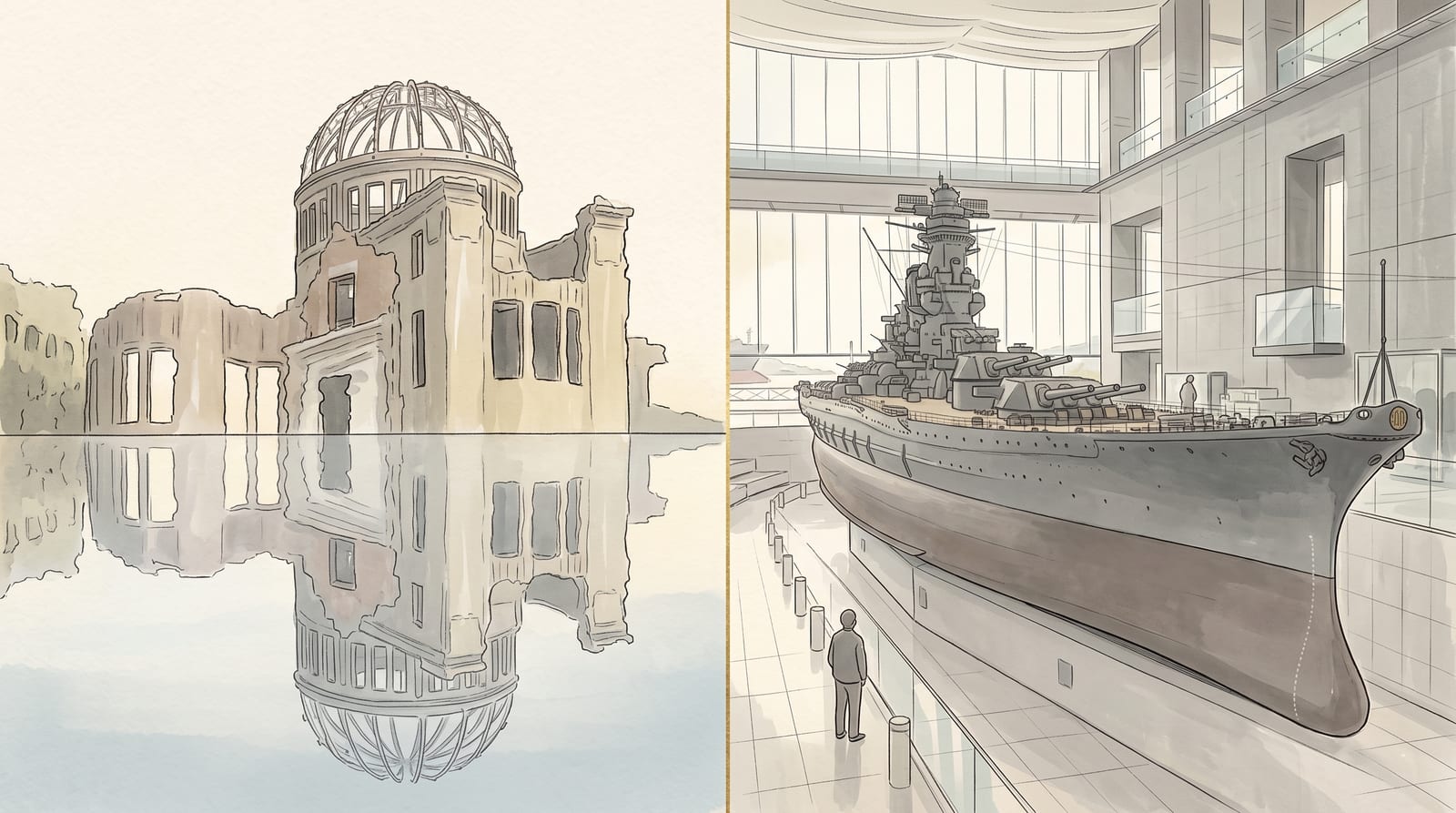
Hiroshima's Peace Memorial Museum is not a place you walk out of and immediately want a deer selfie. A soft second day after it makes sense, and Miyajima does that job well. This guide is for the other instinct: a second day that keeps pulling on the same thread, showing what the same country built, lost, rebuilt, and now maintains, forty minutes down the coast. That thread runs through Kure, the city where the Imperial Japanese Navy's largest arsenal once stood and where the battleship Yamato was laid down.
This guide sets out that specific two-day shape: Peace Park first, Kure second. Neither day should be rushed into the other, and we say so plainly below.
Day one: the Peace Memorial Park and Museum
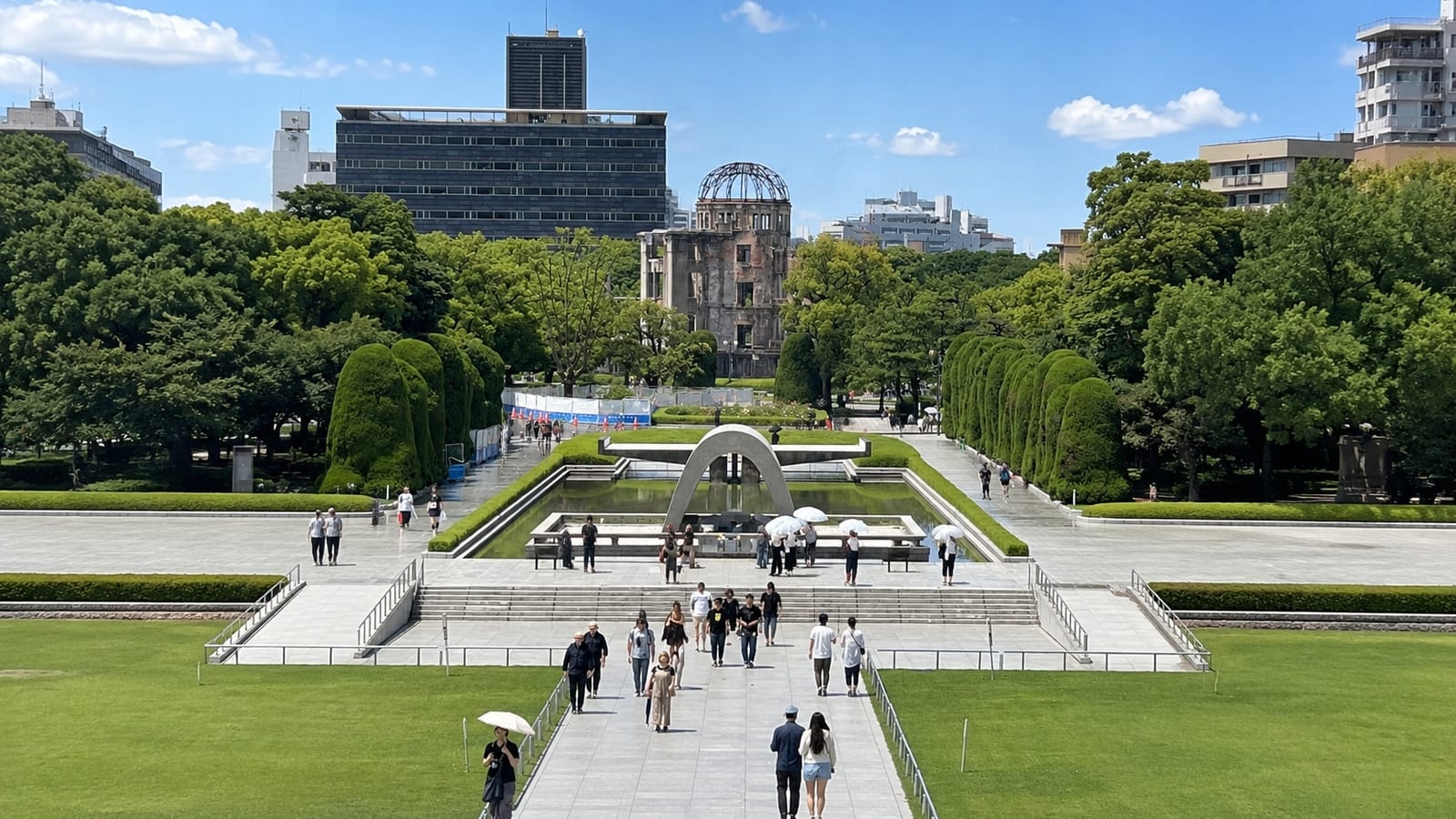
This is not our deep-dive territory: the Peace Memorial Park and Museum are extensively documented by the museum itself and by dedicated Hiroshima guides, and we would rather send you there than repeat it badly. What we can offer is pacing advice, because that is where first-timers most often go wrong.
Start early. The Peace Memorial Museum's adult admission is ¥200 (high school students ¥100, junior high and under free), and hours run seasonally: 7:30am to 7:00pm from March through July, extending to 8:00pm in August (9:00pm on August 5–6), 7:30am to 7:00pm September through November, and 7:30am to 6:00pm December through February. The museum is closed December 30–31 and for several days in mid-February. Advance online reservation is strongly recommended around the August 6 anniversary, when the city fills up.
Walk the park before or after: the Cenotaph, the Children's Peace Monument with its cranes, and the Atomic Bomb Dome (Genbaku Dome) across the Motoyasu River, a UNESCO World Heritage Site since 1996. Most visitors spend 60–90 minutes in the museum and another 30–45 minutes in the park outside it.
Here is the pacing note that matters: the museum is not a place to rush before lunch, and it is not a place to schedule right before a train. Give it the whole morning. If you try to fit the museum, the park, lunch, and a Kure day trip into one calendar day, something gets shortchanged, and it is usually the museum, since the train has a fixed departure and the museum does not. We recommend against combining the two.
If you want a lighter counterweight for the afternoon, two options sit a short tram ride from the park:
- Hiroshima Castle grounds — free to walk, but the keep itself has been closed to the public since March 22, 2026 over concerns that the 1958 reinforced-concrete reconstruction does not meet modern earthquake-safety standards; there is no confirmed reopening date. The moat and Ninomaru area remain open.
- Shukkeien Garden — a compact Edo-period landscape garden, adult admission ¥350, open 9:00am–6:00pm (last entry 5:30pm) from March 16 to September 15 and 9:00am–5:00pm (last entry 4:30pm) from September 16 to March 15, closed December 29–31.
Neither of these needs a deep guide from us; they are well covered elsewhere, and one afternoon is plenty for either.
If your trip includes August 6
August 6 is the anniversary of the 1945 atomic bombing, marked each year by the Peace Memorial Ceremony at the Cenotaph inside Peace Memorial Park. The official program runs from 8:00am to 8:50am, with a one-minute silence observed at 8:15am, the time the bomb was dropped. It is a public ceremony, open to anyone, with no ticket or registration required to attend.
In the evening, lanterns are floated on the Motoyasu River in front of the Atomic Bomb Dome, generally from around 6:00pm to 9:00pm. Watching is free; floating your own lantern costs ¥1,000, cash only.
None of this changes the museum's basic hours: it opens at its usual 7:30am and stays open later than usual, until 9:00pm, on both August 5 and 6, the same extended hours already mentioned above. What changes is everything around it. The city regulates traffic near the park that morning and there is no parking, so plan to arrive by streetcar or bus. Expect the park, and the streetcars feeding it, to be at their most crowded of the year, and expect Hiroshima hotel rooms to be scarce for several nights around the date, not only the night of August 6 itself.
If August 6 falls inside your trip, we would build day one around the ceremony rather than around this itinerary's usual pacing: attend the morning program, then spend the rest of the day at the park and museum as described above. Push the Kure day to August 7 or later. Adding a Kure day trip onto the same calendar day as the ceremony is not something we would recommend, for the same reason we already recommend against combining the museum and Kure on any other day: neither deserves to be rushed.
Where to stay for these two days
The simpler plan, and the one we recommend for most readers, is two nights in Hiroshima, treating Kure as a full day trip on day two. Hiroshima has far more hotel inventory near the station and the Peace Park, and you avoid packing and moving between two cities for a single overnight. Booking.com Hiroshima hotels and Rakuten Travel Hiroshima hotels both list rooms across that range, and worth checking early if your dates fall near August 6, when the anniversary fills the city.
There is a genuine alternative worth considering: one night in Kure instead of a second Hiroshima night. The upside is specific. Kure's evening belongs to Mt. Haigamine, one of the "Three Great Night Views of Chugoku and Shikoku" and a certified Japan Night View Heritage site, looking down over the naval waterfront and the Seto Inland Sea after dark. The summit is impractical by public transport: the nearest bus stop leaves a roughly 90-minute uphill walk, so most visitors book a chartered taxi. The city's official Tabi Taxi night-view course runs about 2 hours from the Kure Tourist Information Center for ¥12,700 (regular car) or ¥17,100 (large van), as of the March 2026 fare revision. A cheaper option exists for groups of four or more staying at a specific hotel; see our FAQ note below on Haigamine access.
There is a real cost, too: a Kure overnight means a hotel change for what is essentially one evening view. What makes it easier to justify in 2026 is that Kure finally has a major chain hotel by the station. The Toyoko Inn Kure Station opened on July 3, 2026, a 3-minute walk from the station's south exit, with 218 rooms and a free morning buffet, and the Yamato Museum is a short walk beyond it. It is the first big business-hotel chain to open in the city, and if you would rather stay somewhere established, Comfort Hotel Kure sits by the station as well. Book either through Booking.com Kure hotels or Rakuten Travel Kure hotels.
Getting from Hiroshima to Kure
By far the simplest option is the train. The JR Kure Line rapid service runs Hiroshima Station to Kure Station in about 35 minutes (local trains take about 50 minutes), for roughly ¥510 with an IC card, departing every 20–30 minutes through the day. A Japan Rail Pass covers the fare, but it is not worth buying for this single leg: the point-to-point fare is only about ¥510 each way. If Kure is part of a wider Japan trip that already includes Shinkansen travel, Japan Rail Pass can still make sense as part of that bigger itinerary; for a Hiroshima-and-Kure-only trip, buy the individual tickets.
Two alternatives exist if you want variety:
- Crea Line highway bus, from the Hiroshima Bus Center (city center, not Hiroshima Station) roughly every 15–20 minutes, taking about 45–50 minutes for around ¥860 one way to Kure Station front.
- Setonaikaikisen ferry, from Hiroshima Port (Ujina) to Kure, about 45 minutes for roughly ¥1,100 (a faster jet service runs about ¥2,800). Hiroshima Port sits south of the city center, reached by tram, so the ferry is rarely faster door-to-door than the train. It is a scenic choice, not an efficient one.
Our full transit breakdown, including sample departure times and a step-by-step from Hiroshima Station, lives in the Hiroshima to Kure day trip guide. If you would rather skip the logistics entirely, GetYourGuide Kure day tour runs a private day tour from Hiroshima that includes round-trip transport and an English-speaking guide.
Day two: a full day in Kure
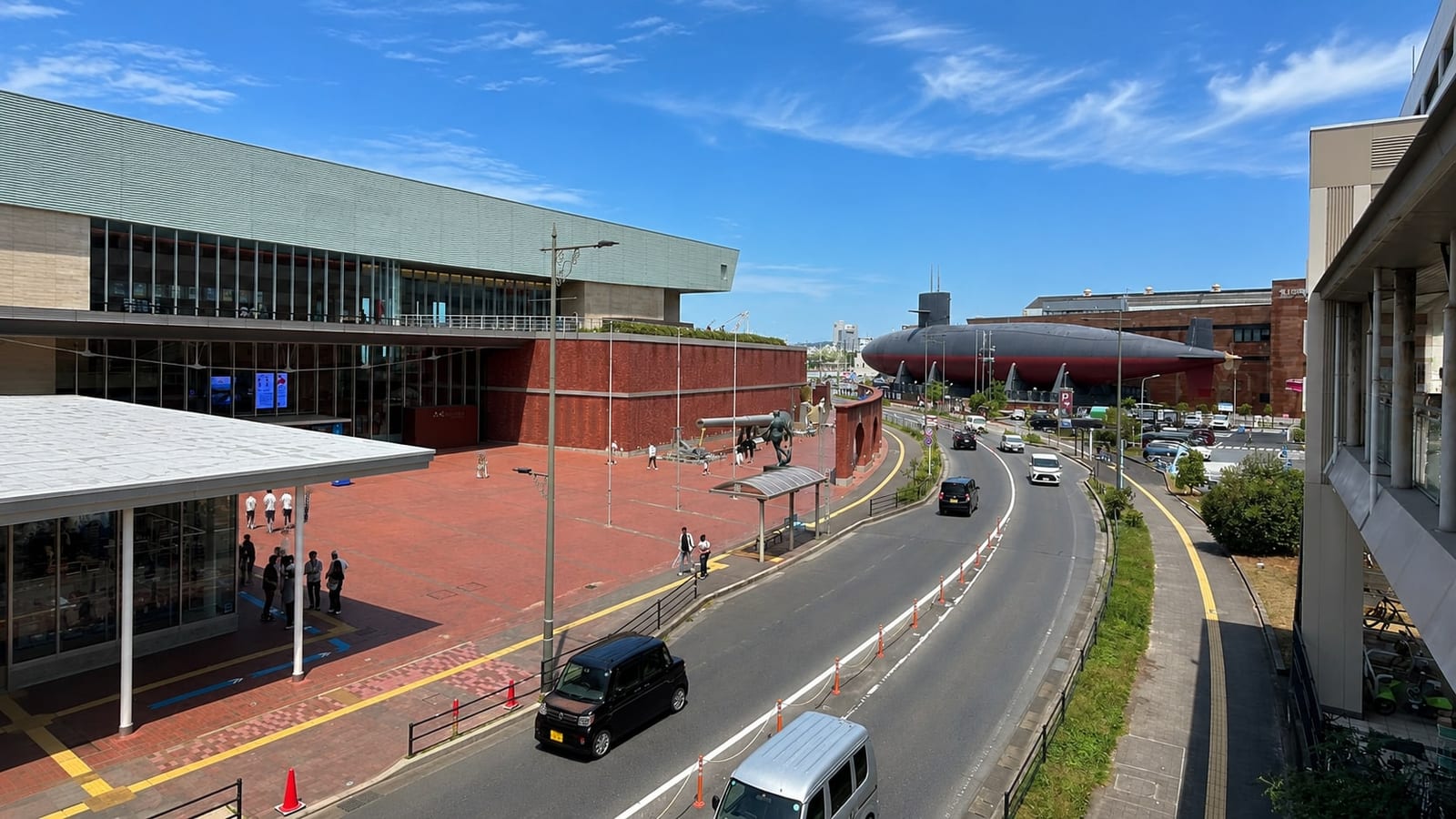
Kure built the battleship Yamato, and for the first half of the twentieth century housed the Imperial Japanese Navy's largest shipyard and arsenal. Today the Japan Maritime Self-Defense Force still bases its fleet there, and the two histories, one imperial and defeated, one modern and allied, sit within sight of each other on the same waterfront.
Step off at Kure Station and the Yamato Museum is a 5-minute walk. The 1:10 scale model of the battleship, 26.3 metres long and built from original construction plans, hangs in the atrium; adult admission is ¥1,000 (Kure residents ¥500, high school ¥300, elementary/junior high ¥200), open 9:00am–6:00pm, closed Tuesdays. Full details, including the 2026 reopening after renovation, are in our Yamato Museum guide.
Directly across the plaza, about 100 metres and a 1–2 minute walk away, is the free JMSDF Kure Museum, better known as Tetsu no Kujira, the Iron Whale. Its centerpiece is JS Akishio, a decommissioned diesel-electric submarine you walk through, hull and all. It is smaller inside than the exterior suggests, and the low ceilings and narrow passageways make the crew's working conditions concrete in a way no photo does. Open 10:00am–6:00pm, also closed Tuesdays, so do not plan a museum day for a Tuesday.
For lunch, Kure's certified naval curry restaurants sit a few minutes from the plaza. Kure Haikara Shokudou, a 1–2 minute walk from the Yamato Museum, serves the certified JS Sōryū recipe as Sōryū Teppan Curry (¥1,650) or an entry-level Submarine Curry (¥980), open 11:00am–3:30pm (last order 3:00pm), closed Tuesdays. Cash is the safe assumption. The naval curry guide covers the full certified network, which runs to 23 participating restaurants for the 2026–2027 season, each tied to a different JMSDF ship.
In the afternoon, choose one:
- The Kure Harbor Warship Cruise — no booking lottery, ¥2,200 per adult for about 40 minutes past the active JMSDF base, departing from the Chuo Sanbashi terminal one minute from the Yamato Museum. Book online at least two days ahead. Full details in the warship cruise guide. This is the reliable choice: it runs on a published schedule and needs no application.
- The JMSDF open-ship lottery — free, but requires applying in advance through a Japanese-language form and winning a draw; admission desk opens 1:00pm and closes at 1:20pm sharp. This is the deeper option if you planned ahead, covered fully in the open-ship days guide, but it is not something you can decide to do the morning of your visit.
If you have applied for neither and want a guaranteed slot, take the cruise; it stands on its own rather than serving as a consolation prize.
| Day 2: Kure | Day 2: Miyajima | |
|---|---|---|
| Focus | Naval history, ships, wartime and postwar Japan | Shrine architecture, sacred island, classic Japan image |
| Admission (core sights) | ¥1,000 (Yamato Museum) + free (submarine museum) | Free (shrine grounds), ¥300 for the inner shrine boardwalk area at high tide |
| Time needed | Full day | Half to full day |
| Highlight | Walking through a real submarine; the 1:10 Yamato model | The floating torii gate at high tide |
| Atmosphere | Quiet, industrial, waterfront | Crowded, scenic, touristic |
| Best for | History and military-history travelers, second-timers | First-timers, families, anyone who wants the postcard |
Being honest about the pacing
A few things are worth saying plainly rather than glossing over.
The two days do not carry the same emotional weight, and that is by design, not an accident of scheduling. Hiroshima's Peace Memorial Museum documents a civilian catastrophe; Kure's waterfront documents the military-industrial machine that, among other things, made such destruction possible in the first place, and the modern fleet that succeeded it. Putting them on consecutive days rather than the same day lets each register on its own terms instead of blurring into a single "war stuff" afternoon.
Kure's own attractions have real limits, and we would rather tell you now than have you discover them at the pier. The harbor cruise and the open-ship lottery can both be cancelled for weather, training schedules, or an absent vessel, with little notice. Both museums close on Tuesdays, so a Tuesday visit to Kure means skipping the Yamato Museum and Tetsu no Kujira entirely and building the day around the harbor cruise and curry instead. None of this is a reason to skip Kure. It is a reason to build one flexible afternoon into the plan rather than a rigid, back-to-back schedule.
Quick Version
Peace Park half-day + Kure half-day
- Peace Memorial Park and Museum
- Rest, or Shukkeien Garden
- JR Kure Line to Kure Station
- Yamato Museum + Tetsu no Kujira
- Curry lunch, then train back by mid-afternoon
Best Balance
The plan this guide describes
Recommended- Peace Memorial Park and Museum (full morning)
- Castle grounds or Shukkeien; early night
- JR Kure Line to Kure Station
- Yamato Museum, then Tetsu no Kujira
- Naval curry lunch near the plaza
- Harbor cruise or open-ship viewing, then evening train home
Deep Naval History
Adds Etajima and a Kure evening
- Day 1: Peace Memorial Park and Museum in Hiroshima
- Day 2: Kure waterfront as above, overnight in Kure
- Day 3: Ferry to [Etajima](/etajima-naval-academy) for the former Imperial Naval Academy's free guided tour, or the [Okunoshima rabbit island](/how-to-get-to-okunoshima-rabbit-island) day trip, before returning to Hiroshima
- Evening 2: Mt. Haigamine night view, by chartered taxi from central Kure
Practical logistics at a glance
- Peace Memorial Museum
- ¥200 adult; hours vary by season, closed Dec 30–31 and mid-Feb
- Hiroshima to Kure
- JR Kure Line, ~35 min, ~¥510 one way
- Yamato Museum
- ¥1,000 adult; 9:00am–6:00pm; closed Tuesdays
- JMSDF Kure Museum (Tetsu no Kujira)
- Free; 10:00am–6:00pm; closed Tuesdays
- Naval curry lunch
- ¥980–¥1,650 depending on restaurant; most cash-only
- Kure Harbor Warship Cruise
- ¥2,200 adult, ~40 min, no lottery, book 2+ days ahead
- JMSDF open-ship viewing
- Free, requires advance lottery, Japanese-language only
- Rough two-day total (museums + transit + lunch, before lodging)
- ~¥6,000–7,000 per adult
FAQ
Should day two of a Hiroshima trip be Miyajima or Kure?
Depends on why you came. Miyajima is the classic image of Japan and the safer first choice if you have never seen it. If your first day already went into the Peace Memorial Museum and you have any interest in ships, naval history, or how Japan rebuilt after 1945, Kure is the deeper second day: the Yamato Museum, a real submarine you walk through, and the naval curry culture, all within a five-minute walk of Kure Station.
Can I visit the Peace Memorial Museum and Kure on the same day?
You can move the logistics, but we do not recommend it. The museum is emotionally demanding and most visitors want time to sit with it afterward rather than rush for a train. Splitting the two across separate days, in either order, gives each one room to land.
How long should I spend at the Hiroshima Peace Memorial Museum?
Most visitors spend 60 to 90 minutes in the museum itself and another 30 to 45 minutes walking the park outside: the Cenotaph, the Children's Peace Monument, and the Atomic Bomb Dome across the river. Budget a full morning if you want to read the exhibits at a normal pace rather than skim them.
How do I get from Hiroshima to Kure?
The JR Kure Line rapid train takes about 35 minutes from Hiroshima Station for around ¥510 with an IC card, running every 20 to 30 minutes. A highway bus (Crea Line) and a ferry from Hiroshima Port also run the route, but the train is the fastest and cheapest option for most travelers.
Should I base myself in Hiroshima or Kure for this two-day plan?
For most travelers, Hiroshima as a base with Kure as a day trip is the simpler plan, with more hotel choice, and you keep your Peace Park hotel for both nights. Staying one night in Kure instead makes sense if you specifically want the Mt. Haigamine night view or a slower evening in a quieter port town, or if you want to try the Toyoko Inn Kure Station that opened by the station in July 2026.
Is Hiroshima Castle worth visiting on day one?
With a caveat: the castle keep closed to the public on March 22, 2026 over earthquake-safety concerns, and there is no confirmed reopening date as of this writing. The grounds, moat, and Ninomaru area remain open and free to walk, but you can no longer climb the tower or see the museum exhibits inside it.
What does this two-day plan cost, roughly?
Museum admissions and Hiroshima-Kure return transit alone run about ¥6,000 to ¥7,000 per adult (¥200 Peace Memorial Museum, about ¥1,020 round-trip train, ¥1,000 Yamato Museum, a certified curry lunch, and a harbor cruise), before lodging, other meals, or optional tours. The Tetsu no Kujira submarine museum is free, which helps.
What if I only have one day, not two?
Pick one. Both the Peace Memorial Park and a proper Kure visit deserve unhurried time, and doing both in a single day means shortchanging one of them. If forced to choose for a single day, most first-time visitors should take the Peace Park; the Kure day trip is easier to slot in later in a longer Japan itinerary. Our best day trips from Hiroshima guide compares Kure against the other options if Miyajima and Kure are not the only two on your list.
Can I do this itinerary around August 6?
Yes, but expect a different day one. August 6 is the anniversary of the atomic bombing, marked by a free Peace Memorial Ceremony at the Cenotaph from 8:00 to 8:50am and, in the evening, lantern floating on the Motoyasu River from roughly 6:00 to 9:00pm. The museum keeps its usual 7:30am opening and stays open later than usual, until 9:00pm, on August 5 and 6, but the park is at its most crowded of the year that day and hotels around Hiroshima book out well ahead of the date. If August 6 falls inside your trip, build day one around the ceremony and push the Kure day to August 7 or later rather than adding it onto an already full day.
Is the Peace Memorial Ceremony open to foreign visitors?
Yes. It is a public ceremony and anyone can attend the morning program at the Cenotaph without a ticket or advance registration. Arrive early if you want to stand close, since the area fills well before the 8:00am start, and note that the city regulates traffic and parking near the park that morning, so plan to arrive by streetcar or bus rather than car.
Related guides
- Best day trips from Hiroshima — how Kure compares against Miyajima, Okunoshima, Etajima, and four other options
- Hiroshima to Kure day trip — the full transit breakdown, train times, and sample schedules
- One day in Kure: the complete itinerary — a single-day version of the Kure half of this plan
- Yamato Museum complete guide — the 1:10 scale model and the 2026 reopening
- JMSDF Kure Museum (Tetsu no Kujira) — walk through a real submarine for free
- Kure harbor warship cruise — see the active fleet from the water, no lottery
- JMSDF Kure open-ship days — how to apply for the lottery to board an active warship
- Kure naval curry guide — the full certified-restaurant network
- Miyajima-Kure Blue Line ferry — a direct sea route if you want to link both destinations without returning to Hiroshima
- Etajima and the former naval academy — the natural extension for a three-day version of this plan
- In This Corner of the World film locations — for anime fans visiting wartime Kure's real streets
Last visited: 2026-07 | Author: Masayuki Ogasahara | Illustrations generated with AI (Gemini) using real reference photographs. Hero illustration's left half derived from Japan to home dec 2008 (367) by Stephen Krupnick, CC BY 3.0. Photographs are original or used with permission; some include light AI-assisted post-processing for cleanup or exposure, with the scene itself unchanged. This article contains affiliate links to Booking.com, Rakuten Travel, GetYourGuide, Klook, and JRPass.com. We may earn a small commission at no extra cost to you. All admission, pricing, and operational information was verified against official sources in July 2026; please confirm with each venue before your visit as details can change.
.jpg)